Page 26 of 37
This panel explores research and recommendations in community building and engagement at three organizations: the Finkelstein Memorial Library; Pax Gaming Community; and the United States Military, Academic Library, West Point. Special emphasis is placed on social media.
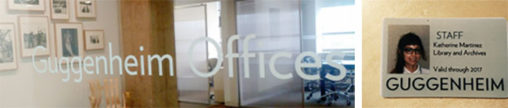
This project was completed during a year long fellowship at the Guggenheim Library & Archives, where I processed a backlog of born-digital, institutional records. My poster will review the workflow we tested and activated, as well as suggestions for the next steps in processing.
This paper will address the extremely influential role of archives in identity formation processes, and will explore how this asymmetry is magnified when considering marginalized, and specifically stateless, communities. This complex relationship will be further explored as it relates to depictions of Palestinians in two unique digital archives.
Libraries around the world have been concerned with the digitization of theirmaterials for the past two decades. A digitally available global library is growing, thanks to immense projects like Google Books, and large academic libraries that have been ceaselessly digitizing their materials as new scanning and data storage technologies continue to revolutionize the field. This presents a question of a huge amount of labor—who will do it?
First, I want this paper to shine a light on the actual labor performed by book
scanners for Google, and for other, smaller, library digitization projects. Manual labor continues to drive technological advancement, whether it’s in Apple’s Chinese factories where women construct iPhones for menial pay, or in Silicon Valley where Google’s scanning team works overnight to digitize the world’s libraries.
Second, I want to reveal the ways in which this labor goes undiscussed, both as
(likely) company policy at Google, and in smaller libraries, public and private, around world. Why does this labor remain hidden? The underground sensation that surrounds the Google’s scanning labor, and the way that the transformative labor of digitization goes unremarked, gets us close to the very old class conflict that is at the center of the new tech economy.
The first section of this paper will look at artist Andrew Norman Wilson’s
findings in his art pieces dealing with Google’s book scanning operations, and what we can know about labor conditions there. I then want to connect those findings to labor in smaller digitization undertakings at academic, public, and private libraries around the country. This leads to a discussion of automated robotic book scanners, and the future of library material digitization in the burgeoning convenience economy.
“‘Data-Drive Transparency’: Creation and Consequence of the Data-Public” analyzes the impact open government data programs have on society. The paper discusses how open government data, despite being marketed as democratic transparency initiative, results in the formation of a ‘data-public’ and the ascendance of neoliberal politics.
My paper deals with social justice, diversity, and demographics in the LIS profession and its practice.
Students from this semester’s “Usability Theory & Practice” course present highlights from three client-facing usability projects – for Columbia Libraries, Pratt SAVI, and the NYC Open Data Portal – and reflect on lessons learned from their experience, from communicating with the client about the project’s scope to presenting their final analysis and recommendations directly to the client via a face-to-face presentation.
Usability report detailing the overall usability of the Morgan Library and Museum website along with four concrete recommendations to improve the website for both new and returning visitors.
An overview of the various user-centered steps in the journey to redesign the website of the Huntington Historical Society. By combining design principles, many stages of user testing, and analysis of user data, Four Corners Design produced a new information architecture for the Huntington Historical Society website and a design prototype.
A story about re-designing UbuWeb, an independent resource dedicated to all strains of the avant-garde. The goals of the re-design were to (1) make the website accessible to non-specialists; (2) improve the organization of Ubu’s content; (3) improve the site’s visual design; (4) increase user engagement; and (5) maintain UbuWeb’s unique aesthetic and identity.
For Professor Cocciolo’s Fall 2015 course “Management of Archives and Special Collections” our class processed files relating to the founding of Pratt Institute Free Library School (now School of Information). These files were removed from the School decades ago by a professor who had hoped to write a book. The files had been returned years ago, but were brought to Professor Cocciolo’s attention this past year. Our task was to figure out the best possible way to process these “recovered files.” Since the official records of the School have a finding aid and are housed in the Pratt Institute Archives, we decided to figure out where the documents in the files might belong in the institutional archives. Using the series and subseries in the already established finding aid, we wrote a new finding aid in AtoM explaining the files’ history and our belief that these recovered files should be reintegrated into their rightful home in the institutional archives.
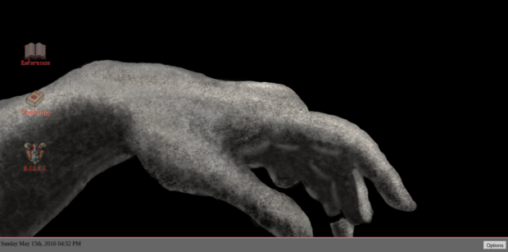
Alt_Text: A Bibliographic Nightmare – This game was created as part of the LIS-664 Web Development class at the Pratt School of Information

The People v. Edward Snowden
Edward Snowden announced he will return to the United States to stand trial if the US government guarantees him a fair trial that will allow him to make a public interest defense.
LIS 611 Information Policies and Politics, will give him one.
Please join us at the #infoshow as we let the jury decide:
Judge: Briana Moore
Edward Snowden: Kolbe Resnick
For the Prosecution: Elizabeth Frank ; William Hagenah ; Coral Salomon ; Michele Drohan
For the Defense: Maryanne Hall ; Laura Childs ; Carmen Irabien ; Allison Nellis
Expert witness for the defence representing NSWBC: Laurin Paradise
Expert witness for the prosecution representing NSA: Debbie Rabina
Court recorders and Jury: Nataya Culler ; Mia Bruner ; Samantha Levin ; Katherine Martinez
With votes for the audience
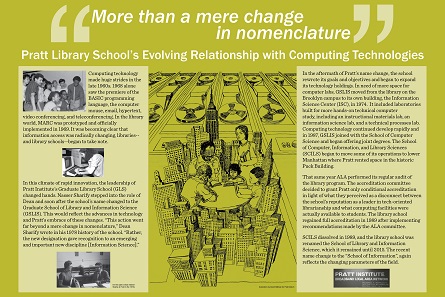
In this presentation, students from Management of Archives & Special Collections will discuss the exhibition and curation of records from Pratt School of Information, which is on-display now on the 6th floor. They will also discuss the conservation work of fragile late 19th century and early 20th century records.
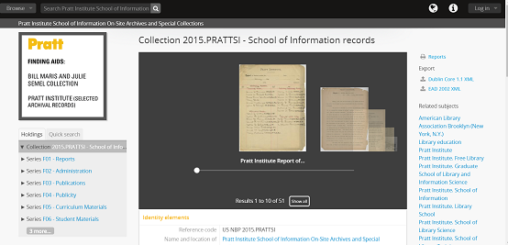
In this presentation, students from Management of Archives & Special Collections will present the work in processing the records of Pratt School of Information, including making appraisal decisions and creating an online DACS/EAD finding aid. Records cover the activity of the school from the 1960s through the 1980s.
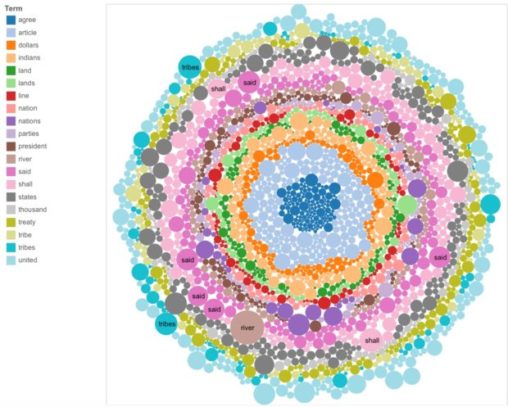
Treaties are living documents that link Native American Nations with the Federal Government of the United States, and their multifaceted conditions continue to raise numerous questions in our post colonial age. A combination of multiple word frequencies attempt to provide further insight in treaties with 142 Native American Nations.