Overview
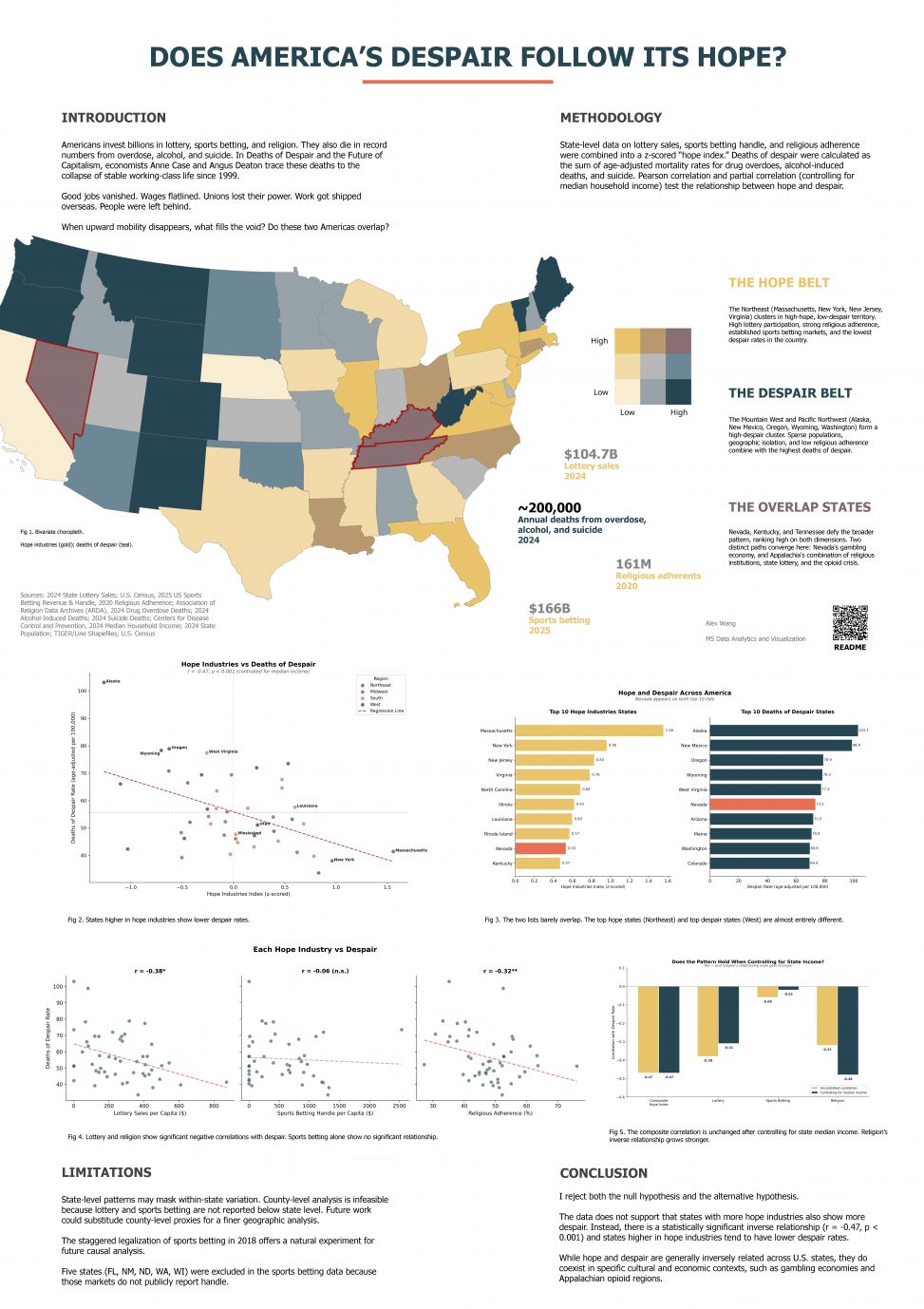
Using state-level data on lottery sales, sports betting handle, religious adherence, and deaths from overdose, alcohol, and suicide, this analysis tests whether “hope industries” cluster with deaths of despair. The findings show all three industries correlate negatively with despair rates, suggesting hope and suffering follow distinct American geographies.
Two Americas, Drifting Apart
In their book Deaths of Despair and the Future of Capitalism, economists Anne Case & Angus Deaton coined the term to describe the spike in deaths from suicide, drug overdoses (mostly opioids), and alcohol-related illness. The trend began climbing around 1999, and it’s hitting white Americans without college degrees the hardest.
Good jobs vanished. Wages flatlined. Union lost their power. Work got shipped overseas. People were left behind.
When upward mobility disappears, what fills the void?
For those with a college degree, the path is still navigable: better healthcare, more mobility, more options. For those without one, the opportunities keep shrinking and life keeps getting harder.
A Freakonomics Moment
Steven Levitt and Stephen Dubner built a career out of asking strange questions of ordinary data. Freakonomics showed that surprising answers often hide in datasets nobody thought to combine.
This analysis borrows that spirit.
Research Design
Research Question
Do states with more lottery sales, more sport betting, and more churches also have more “deaths of despair” (suicide, overdose, alcohol-related deaths)?
Null Hypothesis (H₀)
Lottery sales, sports betting activity, and church density have no relationship with deaths of despair across U.S. states.
Alternative Hypothesis (H₁)
States with higher lottery sales, more sport betting, and more churches also have higher rates of deaths of despair.
Data
2024 State Lottery Sales; U.S. Census, Annual Survey of State Government Finances
2025 US Sports Betting Revenue & Handle; Legal Sport Reports
2020 Religious Adherence; Association of Religion Data Archives (ARDA), U.S. Religion Census
2024 Drug Overdose Deaths; Centers for Disease Control and Prevention
2024 Alcohol-Induced Deaths; Center for Disease Control and Prevention
2024 Suicide Deaths; Center for Disease Control and Prevention
2024 Median Household Income; U.S. Census, American Community Survey
2024 State Population; U.S. Census, American Community Survey
Limitations
State-level aggregation may obscure within-state variation (ecological fallacy). County-level analysis was infeasible because lottery and sports betting data are not reported below the state level. Future work could substitute county-level proxies for a finer geographic analysis.
The staggered legalization of sports betting in 2018 offers a natural experiment for future causal analysis.
Five states (Florida, New Mexico, North Dakota, Washington, and Wisconsin) were excluded in the sport-betting dataset because the markets do not not publicly report handle.
Conclusion
I reject both the null hypothesis and the alternative hypothesis.
The data does not support that states with more hope industries also show more despair. Instead, there is a statistically significant inverse relationship (r = -0.47, p < 0.001) and states higher in hope industries tend to have lower despair rates.
However, three states (Nevada, Kentucky, and Tennessee) deviate from this pattern, occupying the high-hope, high despair quadrant.
While hope and despair are generally inversely related across U.S. states, they do coexist in specific cultutal and economic contexts, such as gambling economies and Appalachian opioid regions.

Alex Wang
Latest posts by Alex Wang (see all)
- Does America’s Despair Follow Its Hope? - May 12, 2026