Presenting Suno at Stanford Longevity Challenge – Apr ’26
Abstract
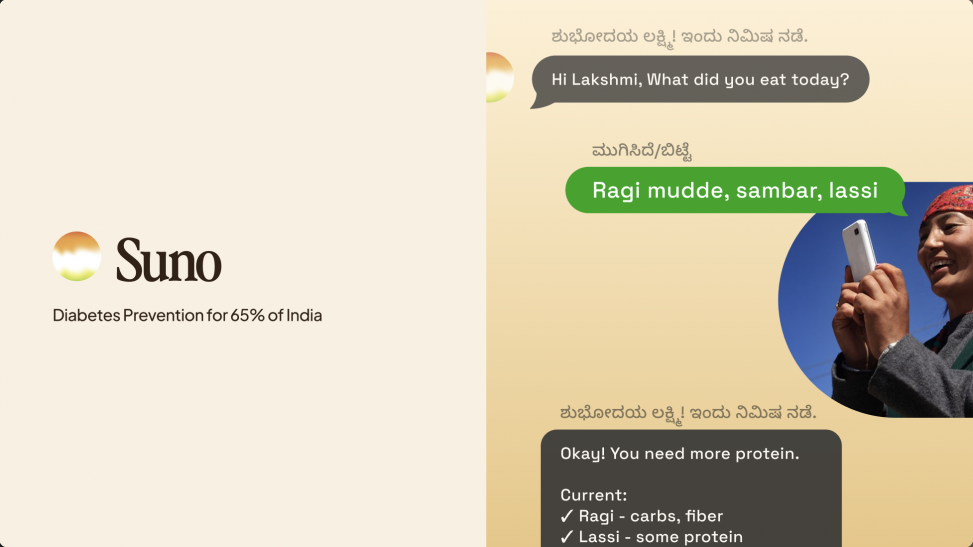
India is home to over 100 million people living with diabetes, with the largest growth happening in tier 2 and tier 3 cities where specialist care is scarce and continuous monitoring is rare. Most patients see an endocrinologist once a quarter at best, and the daily work of managing the condition (eating, walking, sleeping, taking medication on time) falls entirely on the patient and their family. Suno is a voice-first AI health service designed to live inside this gap,offering daily, conversational support in the patient’s own language without requiring literacy, app fluency, or a stable data connection.
Field Conditions and Design Constraints
Suno was shaped by three constraints surfaced during patient interviews. First, text-based health apps systematically exclude older adults and lower-literacy users, who make up a significant share of the diabetic population in India. Second, behavior change in diabetes is driven less by information and more by daily accountability, which existing apps fail to provide beyond push notifications. Third, the language of care matters: a coach that speaks in Hindi or a regional dialect, with the warmth of a family member rather than the tone of a clinician, is more likely to be heard.
System Overview
Suno is a bilingual (Hindi and English) voice agent that patients call from any phone, including feature phones. A typical session lasts two to four minutes and covers three things: a check-in on glucose readings and meals, a small actionable nudge for the day, and an open conversational space where the patient can share what is on their mind. The system is built around three flows. The daily check-in is initiated by the patient or scheduled at a fixed time. The Village Circle is a group call format where three to five patients in the same locality join a shared session, modeled on existing women’s self-help groups. The escalation path routes concerning readings or symptoms to a human ASHA worker for follow-up.
The system was intentionally narrowed from a general wellness coach to diabetes self-management, because the daily rhythms of the disease (meals, medication, movement) gave the voice agent a clear, repeatable structure to anchor each conversation.
Evaluation and Outcomes
Suno was selected as a top 8 finalist out of more than 300 submissions across 40 countries at the Stanford Longevity Design Challenge. Prototyping focused on conversational naturalness, the calibration of nudges (specific enough to act on, gentle enough to return to), and the handoff to ASHA workers when escalation was needed. Early user sessions suggested that the group call format generated stronger adherence signals than one-on-one calls, likely because of peer accountability.
Deployment Pathway
The intended deployment is through partnerships with primary health centers and ASHA programs, with Suno acting as a continuous layer between quarterly clinic visits. Cost per call, voice model latency over 2G networks, and clinical safety review remain open questions.
Contribution
Suno contributes a voice-first, group-aware model for chronic disease support in low-resource settings. It suggests that the next layer of diabetes care may not be a smarter app, but a patient conversation that happens every day.

Latest posts by Krathish Prakash (see all)
- Suno – Voice first AI health service for rural india - May 12, 2026
- Soma: Bio-Signal Ritual System for Embodied Well-Being - May 11, 2026