“Advancing Racial Equity in Your Library” Event Response

For the Event attendance, I am reviewing the webinar entitled, “Advancing Racial Equity in Your Library: Case Studies from the Field,” presented by the Race Forward Government Alliance on Race and Equity (GARE) on October 10, 2018.

The two speakers were Gordon Goodwin from the Government Alliance on Race and Equity, and Andrew Harbison from the Seattle Public Library. To help capture the intention of this talk, the goal of GARE was provided as, “to develop the capacity of libraries to make racial equity a priority within our libraries, cities, communities, and national associations.”

The topic of racial equity is a hot one being discussed in the information world, yet it is also a problem that has not been properly addressed still. With libraries being the sole free and accessible information and cultural center for most communities, racial equity needs to be made a priority. Children from poor and under-privileged areas are relying on technology and aid from public libraries more than ever to receive the same quality of education and opportunities as the more privileged communities.

If racial equity does not exist in libraries, it just adds to the problems the socially excluded face in society. Public libraries need to understand the magnitude of what social exclusion can do to a community. John Gehner points out that there are severe consequences to the, “negative perceptions affecting the way that professional librarians approach those who face social exclusion for many different reasons,” explaining what happens when libraries and their staff do not support equality.[1]

Realizing the importance of racial equity, specifically in public libraries, Goodwin and Harbison get right into it. Goodwin begins by laying out the goals they wanted this webinar to help achieve, which was first and foremost: to inform and to motivate the audience into action. I believe this is the purpose behind most, if not all, seminars and webinars dealing with social issues, specifically those about the information world. They are tools to educate and spread awareness for certain topics that are typically ignored, and motivation is the key to enacting change. Goodwin states right away that he wanted to, “Motivate listeners to take action, and how exactly to do that.”

The rest of the objectives for the talk were to understand the critical need for libraries to focus on race and improving equality for all communities, to learn about the ideas and tools that support racial equity, and how libraries are applying all of this to increase access and improve life for the patrons and staff of color.

Next the definition of racial equity is given as, “Closing the gaps so that race does not predict one’s success, while improving outcomes for all.” It is pointed out that race plays an important factor in determining how well someone does in life. Race helps to determine the barriers or blocks that people of color face in their life. Goodwin states that with improved racial equity, libraries can become places that help eliminate those barriers, and help to reduce race as decider for the success of an individual.

Putting race in front of equity targets the strategies for improving the quality of life and reduction of barriers that people of color face. Goodwin wants people to have an understanding that race does not separate humans beyond the superficial level of appearance, and that the practices and enforcement of laws within American society are still discriminatory, despite having removed the legality of segregation and racist discrimination. The cultural institutions we have still contribute to outcomes that disadvantage people of color, and that an awareness of this is an important first step in the right direction.

Briefly, Goodwin acknowledges the equal importance addressing the inequities faced based on gender, class, and disabilities. The intersectionality of these issues is key, as race plays a role even within the context of gender, class, and disabilities. He then continues onto the topic of how to begin achieving racial equity.

Thinking about issues of race and racism, Goodwin states a common tendency to focus on individuals, to immediately think about who is racist and how. It is better to focus on the institutional basis of racism, that changes within the structures of society are more important than individual cases or people. We need to be asking what roots of racism and prejudice exist within the foundations of our government and institutions, our groups of systems that determine how society functions. This will provide more equitable outcomes. Goodwin claims that, “achieving racial equity requires us to target strategies to focus improvements for those worse off,” and that there’s a need to, “Move beyond service provision to focus on changing policies, institutions and structures.”

Going into the history of libraries, and how during the creation of these institutions, people of color were not allowed any access. The roots of many laws and policies made at this time are still prevalent. Thinking about what laws and policies may still be negatively affecting certain communities inadvertently today can begin to address what changes need to be made. This means that there are rules that can unintentionally hurt certain people, such as the targeting of low-income groups that prevents people from participating fully.

Along this vein of thinking, there are also invisible or unknown prejudices ingrained into people by the institutionalized racism of our society that can be very harmful, as this prejudice leads to racist actions that can negatively impact people of color and the opportunities they receive. The example provided for this was a white librarian being more helpful to white patrons, waving their fees more often, and providing them with more renewals or leeway then they do for patrons of color. Collecting the data on the impact of practices and procedures on people of color is important in finding out what changes need to be made the most.

Implementing a racial equity initiative is the proposed solution for effectively changing things at the root of the problem, not just address individual blame or racism. Harbison begins polling the online audience on how many of them represent libraries that already have such an initiative. Case studies are gone through, providing evidence on what these initiatives have been able to successfully achieve and what impact on racial equity they have had. This wrapped up the webinar in an ideal way, as the first objective was to motivate action. Examples of how institutions executed that call for action and created a better society with better opportunities and a more equal treatment of people of color in places so relevant to the social exclusion and information access gap provide the best motivation for the audience, as they are able to see that this action works.

[1] John Gehner. Libraries, Low-Income People, and Social Exclusion, p. 39.


-Brianna Martin, Sula Info 601

Webinar can be accessed here: http://www.ala.org/pla/education/onlinelearning/webinars/ondemand/racialequity

Slides provided to accompany presentation found here:http://www.ala.org/pla/sites/ala.org.pla/files/content/onlinelearning/webinars/archive/Advancing-Racial-Equity-in-Public-Libraries_final.pdf

References:

John Gehner (2010): Libraries, Low-Income People, and Social Exclusion, Public Library Quarterly, 29:1, 39-47.
 

Observation: Boo-Hooray Archive Space

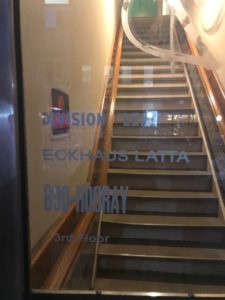
Boo-Horay is an organization dedicated to the archiving of ephemera, photography, and book arts from 20th and 21st century counter-culture movements. They operate mainly from their small space on the third floor of 277 Grand Street in Lower Manhattan. On December 12th, I decided to pay the space a visit via a completely unannounced walk-in.

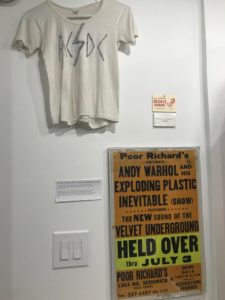
Despite the unexpectedness of my presence, the staff at the space were very easy-going, friendly, and accommodating. The space is divided into two areas: one more public-oriented where they host events and exhibitions in addition to (at least for the time being, due to lack of workspace) process archival materials, and an office where most of the staff can be found at their desks working on various projects. In tandem with the staff’s artistic backgrounds and interest in counter-culture, the space is organized in a very informal way. Nevertheless, their resume is very impressive. The organization has handled archives from the likes of Larry Clark, Ira Cohen, William S. Burroughs, and Ian Dury, as well as putting together the Paris-May 1968 collection at Yale University’s Beinecke Rare Book and Manuscript Library, and the Hip-Hop History Archive at Cornell University.

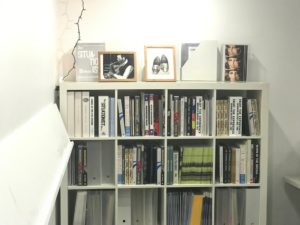
Shelf inviting casual browsing from public
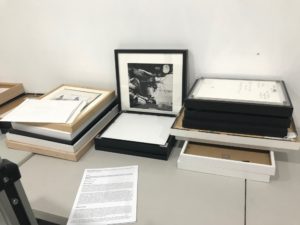
Materials being processed

Upon entering, I was greeted enthusiastically by Johan Kugelberg, the organization’s founder and head curator. Johan is a colorful person with a fascinating background, of which I am unable to go into detail about here. He was going to speak at 8-Ball Community, a zine archive and library, later that evening. After I spoke to him about being an archiving student and needing something to write about for my assignment, he introduced me to Beth Rudig, the Director of Archives at Boo-Hooray. Beth studied film at SUNY Purchase and has been with Boo-Hooray since 2015. She tells me that while she does not currently have a library science degree, she plans on acquiring one in the near future. She is currently working on a project pertaining to the costumes of renowned performance artists Joey Arias and Klaus Nomi.

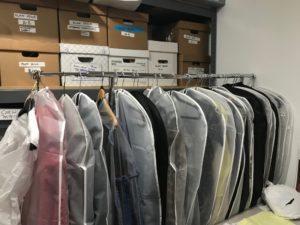
Klaus Nomi and Joey Arias’ costumes. Above them is Alan Vega’s archive, belonging to the former lead singer of legendary punk band Suicide and who passed away in 2016.

When I brought up digitization, Beth told me that most of the work is outsourced and that very little digitization happens in the space itself due to lack of resources. Staff makeup is very small, and they only have a few interns and volunteers. Aside from Beth and Johan, the remaining key curator is Daylon Orr, Director of Rare Books and Manuscripts, whom I unfortunately did not get a chance to speak to. Recently, he prepared Boo-Hooray’s first rare books catalogue. The organization’s next big project is the acquisition of an archive from a renowned filmmaker. When I asked who it was, they told me they would tell me, but then they would have to kill me.

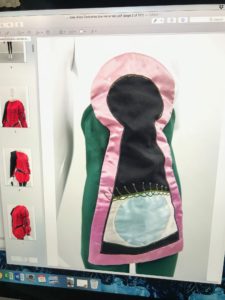
Beth’s desktop, featuring photographs of Joey Arias’ costumes. She jokes that this is the closest thing they do to digitization in-house.

Reflection
In his interview with Saturdays Magazine, Johan brings up a much-discussed aporia within the world of archives in the 21st century, and one in which we have spoke about in length in class. That is, the tension between the rise of digital technology, and the archive’s purpose of preserving past artifacts and narratives. Archives are pushed to embrace digital technology as a means of preservation, and advocates for change usually point to the inherent impermanence of material objects. As Michele Valerie Coonan writes in his paper W(h)ither Preservation?,

“The paradox of preservation is that it is impossible to keep things the same forever. To conserve, preserve, or restore is to alter. Even if an object survives untouched, it will have changed just by virtue of aging or by a change in its surroundings.”

But many feel that the increasing digitization of everything un-anchors us from the material world, as well as other people. As Johan articulates,

“A lot of people talk about content and archives that are born-digital and, I mean, look at all of our smart phones lined up right now and look at how you have thousands of text messages and photographs. You know your personal narrative of the last four or five years is contained in this machine. Our relationship to our memories has changed because we feel everything that’s born-digital is so super ephemeral that it actually has less meaning. On one level that can obviously liberate people from feeling too anchored in their past, but the flip side is that it really boosts this sort of hyper-individual sense of the perpetual now.”

This tension is a microcosm of a larger epochal problem in our culture brought about by the advent of digital technology, which we can broadly understand as the tension between modernity and postmodernity. While modernity seeks to retain a universal order that allows for rational communication, postmodernity argues for the embracing of the inherent irrationality, ephemerality, and atomized individualism of the digital era. While I would not dare to propose any sort of solution to such a monumental problem, I would simply conclude but pointing out that this tension is not necessarily one that needs to be resolved and that, as Jean-Francois Lyotard (the French philosopher who wrote perhaps the most influential text on postmodernism) once argued, modernity and postmodernity actually always co-exist. With this in mind, perhaps we can imagine the possibility of archives both embracing digital technology while retaining its traditional mode of preserving artifacts.

Observation: Ridgewood Community Library

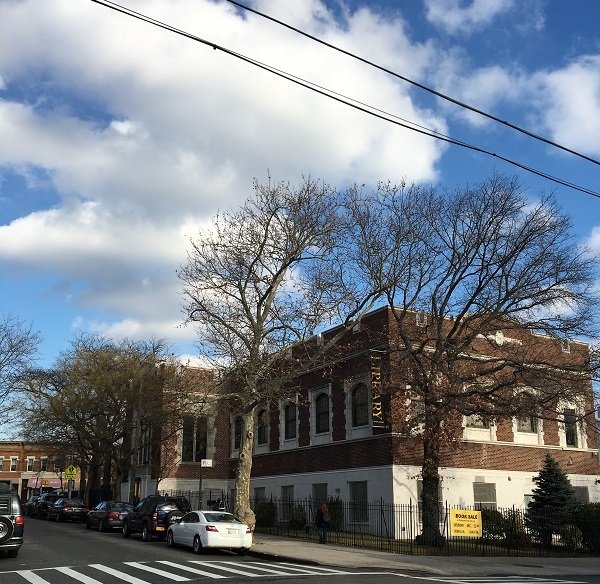
Ridgewood Library buildingThis week, I visited the Ridgewood Community Library, a branch of the Queens Library. Even though this is my neighborhood library, I had never spent time there except to pick up books I’d had transferred. The library is a fairly small branch housed in a beautiful brick building built in 1929. It was the first branch of the Queens Library to be constructed with funds from the city rather than from Andrew Carnegie. Renovated most recently in 2011, the library is fully accessible, with elevator access to every level. It is clean and well lit, with lots of natural light on the main level.
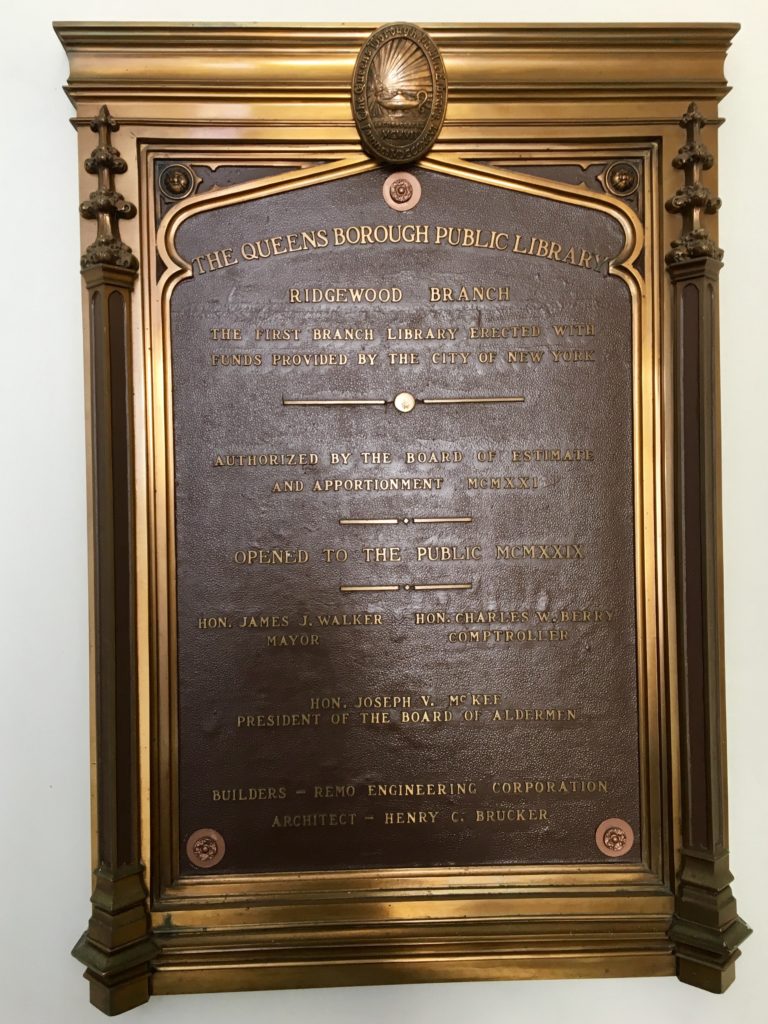
Ridgewood Library plaque


After entering the building at street level, I went downstairs to see the large meeting room for events, as well as a dedicated children’s room, which houses all of the children’s material. This room has its own circulation and reference desks, computers, and bathrooms.

The indoor book drop is located on this level just outside of the children’s room. The outdoor book drop is located down a ramp next to the main entrance, which allows for 24-hour book return. Both book drops use a computerized system with a retractable metal flap that opens when materials are placed on a conveyor belt. This system usually works smoothly, but I have had issues such as the machine being out of order or not sensing books that I placed on the belt.

I next went up one level from the entrance to the large main floor of the library, which houses the teen and adult sections. At the circulation desk at the center of this room, as well as the one in the children’s room, checking out books is fully automated, with a touchscreen monitor and a pad that senses library cards and books. This system is fairly straightforward to use, although in my experience, it’s not always clear how to complete the checkout process, and I’ve seen other people having difficulties as well. I think that instructions for checking out could be relayed more clearly on-screen.

The reference desk on this floor is positioned by the back wall toward the middle of the room. At the reference desk, patrons can sign up for the 20 teen and adult computers located in a balcony area, which offer free internet access, Microsoft Word, and limited free printing. A desk near these computers provides technical support. There is only one single-occupant bathroom for the entire floor, although I do appreciate its being labeled with the inclusive term “all-gender.”

This branch has different hours every day of the week, and is closed on Sundays. Ideally, it would have more consistent and longer hours to better serve patrons. I visited on a Tuesday, when it’s only open from 1 p.m. to 6 p.m. I asked the librarian at the reference desk if this issue was budget-related, but he explained that Tuesday has always been a short day due to staff training in the morning. The reference librarian did mention austerity measures currently in place that affect how many new materials the branch can acquire. The library’s programming, fortunately, is robust and seems to reflect the diverse population it serves. On its website, I saw a wide array of free programming, including kids’ Jeopardy, English as a Second Language (ESOL) lessons, a class on dealing with stray and feral cats in the neighborhood, a Financing Your Education session, and Flamenco dancing.

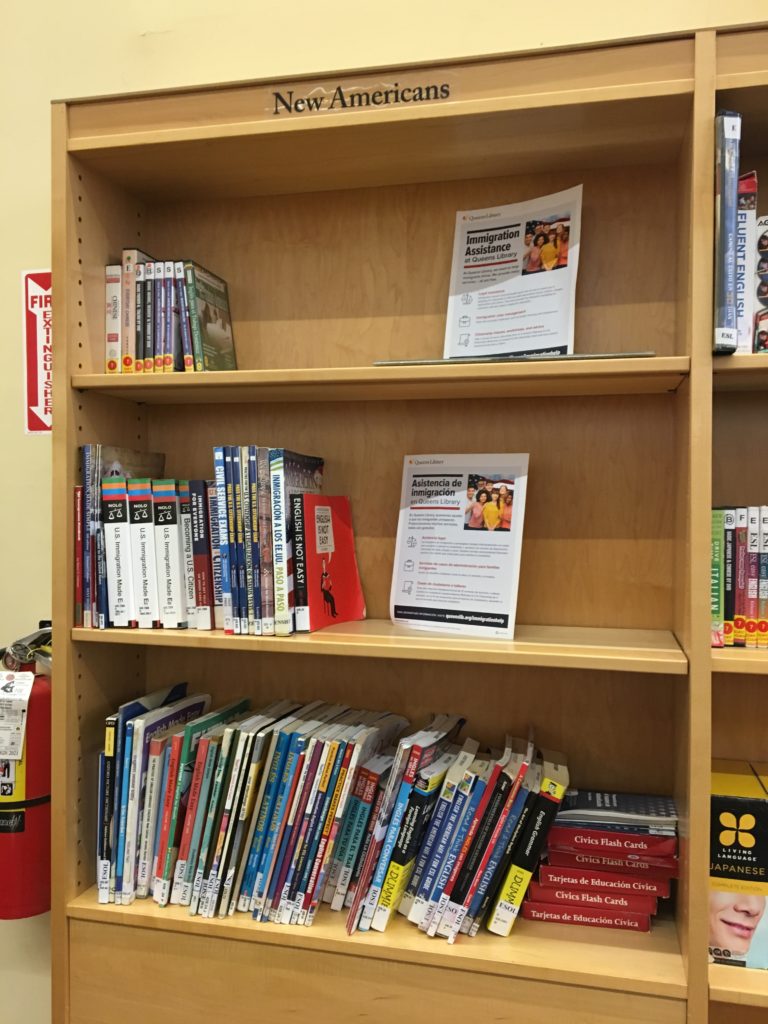
This branch is also impressive for its collections in languages that reflect Ridgewood’s immigrant population. In the adult section, there are designated shelves for languages including Albanian, Polish, Serbian, and Spanish. There is also a “New Americans” section geared toward immigrants, with videos, books, information pamphlets, and ESL materials. The literature near the circulation desk advertising library and community resources is printed in many languages. Having lived in Ridgewood for more than five years, I can attest to the large Eastern European and Spanish-speaking populations.

Ridgewood Library New Americans area


When I arrived at 1:30 p.m., the library was very quiet. Once school let out though, the teen section filled up and became loud and boisterous. Conversations reached the point of yelling, and because there weren’t enough tables or chairs, some students sprawled out on the floor. Since the teen and adult sections share the main floor, this noise filled the entire area and made it difficult to focus or hear the reference librarian as he answered a question.

While I think it’s great that teens are using the library, a more separate teen area like the younger children have would be ideal, as it would allow the rest of the library to remain a (reasonably) quiet environment. The reference librarian on the main level said that it can be a challenging place to work just because it does get so busy and loud. To me, these issues speak to the ever-present tension between providing access to everyone and ensuring that all groups of patrons have a good experience at the public library, all while dealing with space and budget constraints.

It seems like the best option for addressing the high volume of patrons at the Ridgewood branch would be to expand the building or move to a new location. Alternately, perhaps an additional neighborhood branch would help to address some of these issues. Of course, this is dependent on funding from the state and city governments as well as private sources. This blog post from YALSA (Young Adult Library Services Association) gives recommendations for dealing with noise and disruptions from teens after school when expanding isn’t an option. Suggestions include rearranging shelving and furniture to create noise barriers, opening up meeting rooms for teen use after school, and scheduling programming and activities for teens during this time.

Overall, while the Ridgewood branch faces challenges, I do think it’s doing a great job of targeting materials, programming, and resources to the needs and interests of the community it serves.


Observation of the Cooper-Hewitt Smithsonian Design Museum

When considering the kind of information environment I wanted to observe, I wanted to observe an institution whose mission centered around engagement with and education about art objects. I chose to observe the Cooper-Hewitt Smithsonian Design Museum as it is known  as a trailblazer in the field of interactive museum experiences.  I believed I would have the opportunity to observe the intersection of people, technology, and art collections in one space.

I visited the Cooper-Hewitt during a weekday morning shortly after it opened for the day. The Cooper-Hewitt is a converted mansion on the Upper East Side, situated in the middle of Manhattan’s “Museum Mile.” It is known as the Mecca of museum interactives, with touch screen and immersive digital tools featured prominently in almost every gallery space.

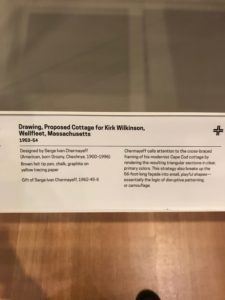
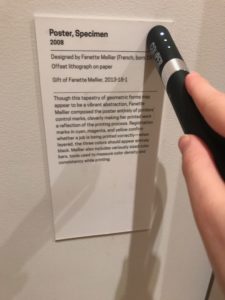
After I entered the museum, myself and a few other visitors made our way to the ticketing counter. There, we were given a demonstration of the museum’s most notable digital tool, the digital “pen.” The visitor services associate held up a sample wall label explaining if we pressed the end of the pen to a cross symbol on the label, we could save artworks we enjoyed. The works saved by the pen became a part of our own curated collection which we could access via an online code after our visit. I think this is an interesting way for the Cooper Hewitt to encourage their visitors to engage with works in the collection and continue their exploration outside of the museum.  As I stepped away from the counter, I observed another visitor approach the counter to ask an associate a question. The visitor pointed to his digital pen and asked “do you give out these out so I won’t take pictures in the gallery?” The associate assured the visitor that they could still take photographs with their cellphone, but encouraged them to try the pen. They explained the pen  provides clear images without the glare of the display cases, which the visitor can access at any time. The visitor did not seem entirely convinced, but made their way up to the main exhibition.

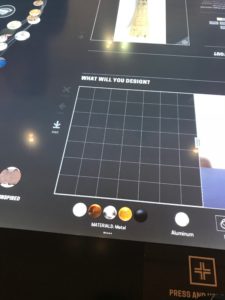
Interactive Tables: Interacting with the Web of Objects (Left) and Design Studio (Right)

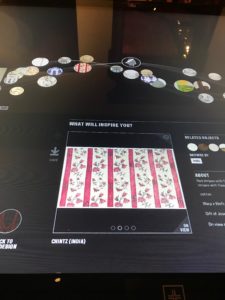
As I made my way to the  second floor and into the main exhibition, Saturated: the Allure and Science of Color, I noticed display cases all around the room with multiple objects inside. Near the displays and scattered around the room were table-sized touchscreen tablets. When I arrived, many visitors were hunched  over the touchscreens with their pens in motion. Upon approaching the first table, I began reading the introductory text while other visitors continued to move their pens around the screen. The prompts on the table asked visitors “what will inspire you”, “what will you design,” and “be inspired.” Each screen table allowed four visitors at a time to design their own object and learn from a moving web of circles. Each orb in the web contained an object from the Cooper-Hewitt’s extensive permanent collection. From observing visitors at these tables, older patrons seemed to be apprehensive of the display oftentimes, avoiding or not approaching the screens. Younger visitors appeared very comfortable with interacting with this kind of technology  and spent a majority of their visit designing their own virtual objects. Most visitors I observed did not interact with the moving web of images, instead opting for the more interactive features of the display. The touchscreen tables allowed visitors to engage with ideas from the galleries and actively design, but it seemed not many visitors were engaging with the wider collection in the way the museum was anticipating.

The Wall Label (Left) and the Pen (Right)

Observing visitors with the pen was more interesting. With the large tables, it appeared that many visitors approached the screens, because they were unfamiliar with its presence in a traditional museum gallery. Their curiosity with the technology seemed to be its main draw. Despite unfamiliarity, they had some inherent ease using the touchscreen technology, as I assume most visitors are already familiar with using a smartphone or iPad outside the museum. The digital pen was a little different as it is a piece of technology foreign to most people. and takes some effort to become comfortable with it. I observed many visitors struggling to save objects with their pens. A few visitors, frustrated with this process, let the pen dangle from the wrist-strap while they proceeded to take photos with their smartphones. It appeared patrons were either very engaged with the digital pen technology or ignored it all together. From my perspective, if a visitor was feeling apprehensive in this technologically dense environment, their interaction with the pen was the first thing to go.

In many ways, the Cooper-Hewitt functions as an information dense environment. The museum allows their patrons to engage with works on view, but also tap into their larger collection through the use of interactive technology. Given its density and foreign technologies, I found that many visitors’ “information seeking behaviors” were affected by what Elfreda Chatham defines as a sense of risk-taking. Visitors to the museum, in order to trust the information from the  Cooper-Hewitt’s exhibitions, needed to trust the new technology as their connection to the information. I think the risk of not understanding how to use the pen or the touchscreen tables, made some visitors avoid the information all together.


Sources

Chatman, E. A. (1996), The impoverished life‐world of outsiders. J. Am. Soc. Inf. Sci., 47: 193-206. doi:10.1002/(SICI)1097-4571(199603)47:3<193::AID-ASI3>3.0.CO;2-T

Newman Library Observation


The Baruch College Newman Library is a prestigious building located off of third avenue and 25th street, near the Flatiron and Gramercy Park district of Manhattan. Their website advertises the school as being, “in the heart of one of the world’s most dynamic financial and cultural centers.” The variety of patrons that come in to the library represent that extremely well.

The largest portion of students that attend the school are business and finance majors, so most of the books are textbooks cater towards this, though there are other types of books available as well. The Newman library is one of the busier CUNY school libraries, as not just the Baruch students- but alumni, staff, and other CUNY students utilize it as well. Its location is also very conveniently near where most of Baruch classes are held.

Working there for over a month now, I have been exposed to the majority of what the library and staff deal with on a daily basis. I’ve met the regulars, given the fines, mastered the Library of Congress Classification system, and worked both the rushes and slow periods.

Layout

Entering and navigating the Newman library can be a challenge in the beginning, though most students are very familiar with the floor plan after their first year. Walking into the building, you can either enter through card-access only turnstiles on the first floor or upstairs on the second and main floor. Here you have the circulation desk, reference department, reading room, laptop loan kiosk, computers, scanners, printers, periodicals, and reserve sections of the library. You can then use the elevator or stairs to access the third, fourth, and fifth floors. These are where the general stacks books are located. Call numbers are broken up by A-E on third, F-N on fourth, and P-Z on the fifth floor.

The laptop desk is located on the third floor, and this is where laptops and chargers are rented out to Baruch students. The sixth floor is the technology department and computer lab that is open to Baruch students only. This is also where the Bursar and financial aid offices are located. The only way to access the sixth floor is through the elevators located on the first floor. The first floor has the security office, student eating area with vending machines, and lockers. This makes giving directions a bit more difficult for staff, especially to newer patrons.

http://cdn.redalertpolitics.com/files/2015/09/6550614889_aa55971a7a_o.jpg

Technology Rentals

The Newman library circulation desk is the center for the majority of the rentals available for students. Here Baruch students may check out cameras, tripods, recorders, microphones, three types of headphones, five types of calculators, DVDs and players, hdmi cables, and presentation remotes. Each type of equipment has its own rules and check out procedures.

The calculator options are graphing, financial standard or professional, basic, and scientific. There are semester long, two week, three day, and daily loans offered. Students check these out on a first come, first serve basis, which is why priority is given to current Baruch students, though the library has quite an impressive stock. Students may also rent Mac and PC laptops, though this is not done at the circulation desk. The majority of interactions with patrons at the circulation desk are for technology loans.

Rentals and Reserves

Reserve textbooks and DVDs are found on the shelves behind the circulation desk and must be requested by the patron to check out. They are organized by the course code that placed the material on reserve and alphabetically by the professor’s name within the course section. Patrons must know at least the title of the reserve book they want, and ideally the course number as well. If no course code is found, staff must search the Baruch catalogue.

Most materials are given for either multiple weeks, daily, and three hour periods. Reserve materials are only loaned for three-hours at a time, and most students keep them inside the library because of this. Other books are given to students for four weeks and are allowed to be renewed a maximum of three times- unless requested by another student. Faculty and staff may reserve for more extended time periods and are not as strictly held to renewal limits. Professors may rent books and DVDs but not technology or room keys. All returns, excluding tech rentals, may be given to staff at the circulation desk or dropped in the book drop. The patron must physically hand in technology rentals to a staff member.

Interlibrary loans (ILL) and the CUNY Book Delivery service (CLICS) are available here as well. ILL books are sent from any local library and delivered and processed separately from all other books. They have their own check out/in program, separate from Aleph. Students may also request books from any CUNY library and have them sent here, as well as return the books at any CUNY library. This is the CLICS service. These books are treated the same as the Baruch stacks books, except placed in a different location when returned or requested daily. All CLICS and ILL books are located behind the circulation desk on the shelves beside the reserve materials.

Late Fees

There are strict late fees that automatically occur when patrons return items late, and the size of the fee depends of the item in question. Calculators are the lowest charge, being $5 a day. This is done to ensure that the library stock does not run out, students are much more likely to return items on time when the fines are so high. The library does have a cap on student fines, so that the bills are not posted to the bursar office until they reach $25 or over. This helps make sure the bursar office does not get bogged down with paperwork and that students are not forced to pay for lower fines or being late for the first few times. The more in demand items have larger fees, so laptops and cameras are much higher. The items that are shorter rental periods like reserve textbooks and room keys have hefty fines as well, these are more frequently check out and needed by most students.

Study, Presentation, Interview, and Carrel Rooms

There are a variety of rooms that students have access to. There is an online reservation system on the Newman library website where students sign up for time slots in advance. There are small group study rooms and large group study rooms as well as graduate only rooms available for reservation on the site. The sixth floor also has a section for room reservations, though these are not locked and students may use them as they please. These time slots fill up fast, though staff is allowed to book rooms for patrons if there is open availability, a rare commodity. Students who book rooms must come to the circulation desk to check in and rent the keys. The study rooms can be booked for a maximum of two hours or a minimum of thirty minutes.

Presentation rooms are for small groups of people who need a projector and these rooms are not reservable, but loaned out first come first serve. This is the same for interview rooms, but these are small one-person rooms where students can practice for interviews as well as use for remote/Skype interviews. These two rooms can only be used and loaned out for one hour, with one renewal if no one is put on a waiting list. The carrel rooms are larger rooms with cubby sections for quiet study. There are separate graduate and undergraduate carrel rooms, and each room has multiple keys for each cubby section. These keys are daily loans and students may have them until the circulation desk closes.

Patron Catering

As stated earlier, the Newman library is primarily a space for the students, an incredibly wide array of amenities are offered to the Baruch undergraduate and graduate students, as well as certain loans reserved for Alumni and other CUNY students. All the technology, book, and room reservation rental services are available to Baruch students, as they are the first priority patrons. The goal is to make sure that the students are given access to everything they need to succeed in class. Students can use the space for studying, practicing presentations, homework, student group meetings, and even preparing for job applications and interviews.

The library circulation desk is open from 9am until 10 on Monday through Friday, as well as 10am to 8pm on weekends, while the main library is open from 7am-midnight everyday. During finals season the library is open continuously from 7 am on December 10 through 11:59 pm on December 21. This 24-hour policy only applies to Baruch students between midnight and 7 am, other patrons must wait until 7am to enter. This is done to ensure that Baruch students have priority to all books and study rooms, as well as to more easily allow patrons to enter using their Baruch id cards to gain access to the building after normal hours are over.

Conclusion

Overall the Newman library has a plethora of resources available to students and is a great space for students and faculty to work. The library has become much more than a place to rent books, and the way they have integrated technology, spaces to work, and book renting together is both successful and innovative. The resources offered here are very generous and surprisingly well stocked. This library has become an integral place for most Baruch students, providing them with more than enough to get through graduation and even after, as the alumni continue to utilize the services here.


By: Brianna Martin

On-Site Observation — Pratt Library Manhattan Campus.

Pratt Library has two branches, one in Brooklyn and one in Manhattan. Pratt Library in Manhattan is a much smaller branch compare to the Brooklyn branch. With Wilson’s information behavior in mind, for this observation, I was interested to see how a small school library operates and if they were able to make full use of its limited space to serve its patrons and embrace the community.
Physical Space Setup 
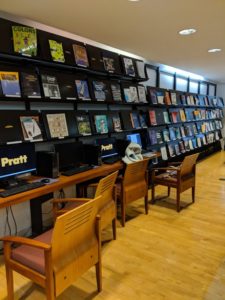
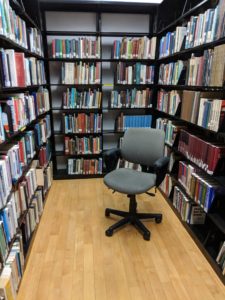
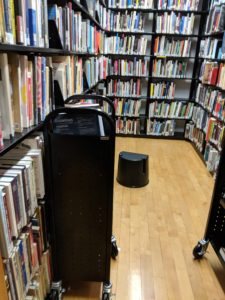
Even though the physical space is relatively small, the setup of the library makes it seem very spacious. There are nine book shelves in total, however, there are plenty of room between each shelf. In one of the blocks, a short stand is also provided for patrons to reach books on a higher shelf. Such design reflects the accessibility principle and provides convenience for patrons who are in search of information.


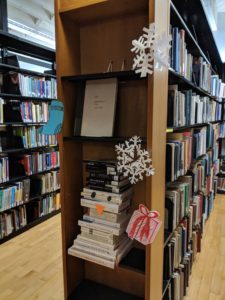
It also came to my notice that the librarians made a lot of display space for the books. For instance, an entire wall is designed  for journal/magazine display. A great majority of the journals are information library related, and less than five journals of the entire display is non-information related, such as Harvard Business Review, Rolling Stone and New Yorker. It is interesting to see that they also display quit a few children related librarianship magazines, such as the Horn Book and Children&Libraries. On the other hand, I only see two or three museum or archival related journals. I think the library did a great job in representing a variety of topics that could relate to the students, but the proportion of each topic needs to be adjusted. For information behavior, this large amount of display provides more opportunities for patrons who are not actively searching to receive new helpful information.
Welcoming Environments 
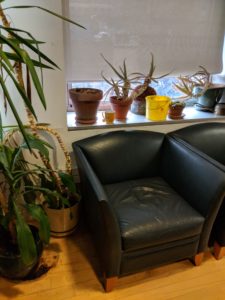
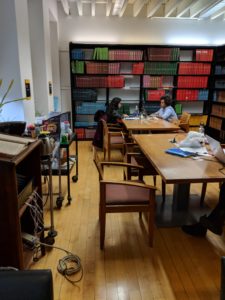
I also noticed that about half of the library space is designed for patrons to relax or work and study. By the windows, there are two big tables which allows group study. A coffee/tea cart is placed next to the two big tables. On the side, there are four small sofa where students can study on their own comfortably. There are also green plants on the windows. During my stay of three hours, more than half students used and stayed in the relaxing area to work on their own laptops. However, the seats were never full. There were always seats available. It shows that the relaxation space design meets the needs and expectation of Pratt students. Students use it as a learning space to acquire new information, regardless of whether the information is coming from the physical library. There are aspiring quotes about library and books. It led me to think of how libraries is integrated as an important part of the community. It is the environments that the libraries provide to its patrons to become more information open and available.
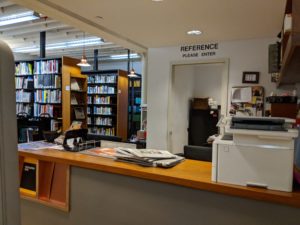
The Reference Room is at first sight when people come into this library. The words below the “REFERENCE” says “Please Enter”. It is inviting and decreases the worries and shyness of entering a room (a closed space) for help. When I talked to the front desk about looking for a book that I was interested in, she was very friendly and helpful. She told me that even if they didn’t have the book, they could request it for me from the Brooklyn branch. I appreciated that a lot, because it is indeed an disadvantage of fewer resources when coming to smaller library. The fact that the two branches can share resource and make them as available and as convenient as possible to their patrons definitely helps a lot.
Overall, it is interesting to see how a school library operates within its community and use its space and service design to help and accommodate its patrons. Despite that the Manhattan branch is already doing a great job in serving its students, I do hope it will be more active and involving in the community by holding some small events, such as themed book week or small talks on popular information topics.
Theory used: Wilson, T.D. (2010). Fifty years of information behavior research. Bulletin of the American Society for Information Science & Technology, 36(3), p.p. 27-34.

Observation of the 58th Street Public Library

The 58th Street branch of the NYPL is one of their smaller locations. My observation took place midday on a weekday. Some patrons did appear to be stopping by during a lunch break, quickly picking up hold materials before leaving. However most patrons did linger in the library, many for the entirety of my observation.

Physical Library Space

When you walk into the library it is all one room. To your immediate left are a handful comfy chairs and behind that a small children’s area. This has two small tables with three or four chairs around them, and a very small open area. Then on the left are the stacks. To your immediate right is the reference desk. This library does not have self-checkout, so it is the only location to check out materials. (There is a book drop in the vestibule of the library so you can return books without entering the main space.) Beyond that, on your right are a dozen or so computers, which can be checked out for 45 minute intervals, and the DVD collection. Straight ahead of you there are some more comfy chairs, two long communal tables to work at with outlets built in and hold/reserve shelves which line the back wall.

One of the first things you notice about the space is that it is designed primarily for adult patrons. There are mostly places to sit and read/work individually. Some parents/caregivers have modified the space to suit their needs. An empty space in front of the reference desk, where the line forms when the demand is higher, is taken over by unofficial stroller parking. There isn’t enough space in the children’s section to store any belongings and have space to move around.

Use of the Space

Patrons at the time of the observation seem to be coming to the space to either work independently or pick up holds from the hold shelves. Only a handful of patrons even visited the stacks during their time in the library. Those working either at the computers or communal tables didn’t visibly have physical library materials with them. Over the course of the observation there were two older patrons who read periodicals that the library had on display. But only two patrons visibly had library books at their spaces. And only one of them spent time reading their book. Patrons primarily took advantage of the computer/Wi-Fi/digital resources that the library offers, as opposed to books or periodicals.

This library fulfills a very important role as a ‘third space,’ somewhere that is not home or work/school where people can congregate and just be. For example, there were many retirees, who came here to spend time outside of their homes. While not apparent from the layout, according to their website there is also a second floor, which houses a space that can be reserved for community events/needs as well as their tech classes.

Library Staff

During my observation I saw four different members of staff working the reference desk. Only one of them was a women. Considering the stereotype of the middle age white female librarian this felt noteworthy. Additionally two of the men were people of color. This felt important because as you look around the library, they have a diverse range of patrons. Having a body of staff that reflects your patron-base allows them to best serve their patrons, and be aware of any special needs or considerations their patrons might have.

Recommendations

This is not a high-tech library that is going to have a maker space or a lot of automated systems. However there are small areas where they could probably integrate more digital services. The addition of a self-checkout station would allow patrons who are just picking up materials, and not asking questions, to quickly get their business done.

There also felt like a need for a more designated child friendly space. Some patrons verbally complained about the strollers left in front of the reference desks. Many also made faces when navigating around them. While space is at a premium in a library of this size, the reading area next to the children’s area could probably be rearranged to have space for the strollers. Then those seats could be moved to another area of the library.

Another option would be to take advantage of the second floor space. Maybe when there aren’t events up there have the space open for children to use. That way there would be space for them to run around or read aloud without disturbing the people working downstairs. However I have not seen that space so I don’t know how difficult that would be or if there is a computer set up that would make that difficult.

Digital Archives and Preservation at the Mark Morris Dance Center

I visited with Stephanie Neel at the Mark Morris Dance Center on Friday November 9th. Neel is overseeing a group of archivists working on a large-scale project at the Center in Fort Greene, Brooklyn. Her team has been making diligent progress towards digitizing the Center’s library of VHS and pneumatic tapes. 

History of the Mark Morris Dance Center

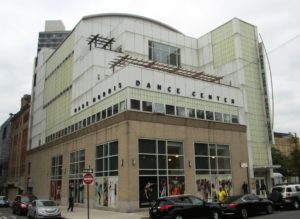
The Mark Morris Dance Center, located one block west of the Brooklyn Academy of Music at the intersection of Lafayette and Flatbush in Fort Greene, Brooklyn, has been the home base of the Mark Morris Dance Group since 2001.  The Center was the first building to be dedicated solely to a dance group, and serves an additional function as an education space and outreach facility for the community.  The Mark Morris Dance Center offers many affordable and inclusive classes to the community and are not prejudicial with regard to experience or ability.

The Team

Neel is conducting this project in consultation with Greg Lisi and Savannah Campbell. Lisi and Campbell are video digitization specialists employed by the Dance Heritage Coalition. Lisi is also the moving image preservation specialist for the NYPL and has overseen all of their AV digitization efforts for the past ten years. Campbell is a graduate of the NYU Tisch School’s Moving Image Archiving and Preservation program. This team is rounded out be Regina Carra, Archive Project Metadata and Cataloging Coordinator, and Sarah Nguyen, a University of Washington MLIS student.

Funding

Neel and her team have been producing their work in accordance with a three-year Mellon grant, which is specificly tailored to the Mark Morris Dance Center. The grant is compliant with current digitization standards, and is aligned with OMEKA, a performing arts database standard. The main objective of this work is to organize and digitize their large holding of pneumatic tape, beta, VHS and high eight.

Archival Process

Neel and her team begin by cross-referencing the individual records with open source software. This method is similar to that which is employed by the NYPL and the Tate in London. 

The primary challenge of this work is in coordinating between Mark Morris and the various institutions throughout the world that commission dance pieces from the institute. Each of these institutions employ their own videographer, and therefore maintain proprietary usage rights of their footage. This footage then resides in a cold storage facility.  Mark Morris must then request an extraction of the digital files from cold storage.  The files are then checked for compliance with the Collective Access.  Collective Access is database software technology for use in cataloging.  

Further Challenges

The archival process at the Mark Morris Dance Center poses exciting challenges. These challenges are best illustrated by Michelle Caswell’s article “The Archive” is Not An Archives: Acknowledging the Intellectual Contributions of Archival Studies. In this article, Caswell identifies the importance of the record in archival practice. She writes: “The ‘record’ is the foundational concept in archival studies. Records, according to the prevailing definition in archival studies, are ‘persistent representations of activities, created by participants or observers of those activities or by their authorized proxies.'”1 Neel and her team of archivists and preservation specialists are sifting through a various forms of records in their process and must create separate hierarchies. 

Neel and her team are grappling with the archiving and cataloging of the so-called “uncatalogable.” They approach this problem by dividing the work into two aspects. One aspect is the choreography, which is authored soley by Mark Morris. The choreography is its own text. This text is then translated to other institutions that choose to perform the work with their own companies. The performances are a separate aspect of the process. They are made physical in the form of the recordings captured by each company’s individual videography department.

This process of sorting relates to Caswell’s definition of provenance. She writes: “Through provenance, archival studies insists on the importance of the context of the record, even over and above its content.”2 While content is important for Neel, the contextualization of the performance (when, where, which company) is the primary method of placing the records within the archive.

Outside Assistance

Neel has contracted with The MediaPreserve in Pittsburgh to complement the work being done in Brooklyn.  Shipping crates come and go from the Center’s archival office. The crates are filled with analog reels and cassettes, a couple of which I helped carry up to the lobby. According to the website of The MediaPreserve: “We have digitized for hundreds of institutions, universities, and museums transferring an array of formats including 1” Type C, 2” Quad, video cassettes, digital videos, film, and many more. Our work has covered numerous genres, including home movies, propaganda, documentaries, and works of art, as well as news, scientific, musical and educational programs.”

Practical Use of the Archive

The digital resources, once archived, are not simply kept in a closet. The tapes are a vital aspect to the company’s process, and are heavily referenced by new dancers and other global dance companies in order to recreate the specifics of Morris’s choreography. A database exists for the dancers where they are able to access time-stamped footage of past performances and other forms of raw choreography that serve as the building blocks for new performances.

Secondary Goals

Neel’s team is also responsible for the large collection of costumes and ephemera belonging to the Mark Morris Dance Group. These costumes  span the forty-year history of the Group. Additional items in need or archiving include historical prints, photographs, and programs. Most of these items are securely stored are of a less urgent manner for the team.  The analog technology of the video tapes is more fragile and requires urgent attention. Neel has decided to tend to the costumes toward the back end of the grant. 

Conclusion

Stephanie Neel and her team are dealing with an interesting challenge in archiving the digital materials at the Mark Morris Dance Center. They must parse through the records and create hierarchies of place and performance in order to assign order to their holdings. Their digitization and preservation methods are sophisticated and the team is composed of accomplished specialists in the field. The archive is unique in that these records will then become widely used as practical tools for instruction.

Sources:

  1. Michelle Caswell, “The Archive” is Not An Archives: Acknowledging the Intellectual Contributions of Archival Studies.
  2. Caswell, “The Archive.”