Symposium Review: “The Uncomfortable Archive”


I attended a New York Archives Week Symposium at the Center for Jewish History on West 16th Street on Friday October 16th entitled “The Uncomfortable Archive.” The symposium, co-sponsored by the CJH and the MetLife Foundation, was open to the general public and aimed at bringing together archivists, librarians, museum professionals, scholars, and researchers around the subject of difficult and “dangerous” information in the digital age. Of particular interest to me was the early afternoon program entitled “Uncomfortable Powers: Archiving Dangerous Knowledge,” which promised talks ranging from cloistered Soviet-era archives, presidential records, and Wikileaks.  

Omission and Obfuscation in the Private Soviet Archive

Katherine Tsan presented the first talk, “Omission and Obfuscation in the Private Soviet Archive.”  It was structured around her research into the coded messaging that survived this highly-censored historical epoch.  Tsan outlined the difficulty facing the contemporary archivists responsible for interpreting these incomplete records, which were obfuscated in order to circumvent the draconian provisions of Soviet-era oversight. Archives were state-controlled this way until 1991, meaning abbreviations, incomplete names, and code words were the norm in information files.

Tsan discussed the dual concerns when focusing on Soviet-era projects.  She highlighted the ethical conundrum involved in archiving writings and information that were purposefully celf-sensored. Tsan also discussed the dilemma posed by Putin’s current-day deep-freeze of national archives, which show strong evidence of private citizens blotting out images and cultural memory. Tsan questioned if historical preservation should probe beyond these intentions or approach them from an ostensibly globalist, progressivist slant? Putin’s unwillingness to fund archival activities is in line with Soviet effacement, indicated by the complete lack of KGB archives and the concealment of Russian presidential archives.

Tsan’s talk echoed concepts of power and the archive that we read in Schwartz and Cook’s article Archives, Records, and Power: The Making of Modern Memory. They write: “The point is for archivists to (re)search thoroughly for the missing voices, for the complexity of the human or organizational functional activities under study during appraisal, description, or outreach activities, so that archives can acquire and reflect multiple voices, and not, by default, only the voices of the powerful.”1 The near-totalitarian aspects of Soviet rule should be examined in the archival renegotiation of history. However, the key challenge here is how archivists can locate missing voices in a historical period in which they were silenced and redacted? 

Tsan’s talk also recalled Drabinski’s article Queering the Catalog: Queer Theory and the Politics of Correction. Drabinski notes that Queer theory also found roots in a postmodernism that challenged the idea that truth could be final.”2 Is there a possibility for a more thoroughly accurate and truthful picture of Soviet Russia given the degree of suppression and censorship prevalent in that era? Or is the fact that so much of Soviet history was censored the truest depiction of its archival history? Would further excavation create a muddled history? These are intriguing questions posed by Tsan’s presentation. 

Watergate, Covfefe, and presidential records

Katherine M. Wisser followed with her presentation, “Watergate, Covfefe, and presidential records.”  Wisser, an Associate Professor and Co-Director of the Archives/History Dual Degree Program at Simmons College in Boston, conducted an entertaining talk which contemplated the implications of presidential records. Presidents Nixon and Trump were Wisser’s primary examples as she grappled with the debate over whether or not presidential records constitute the private personal property of those individuals in office.

The Presidential Records Act of 1978 served as Wisser’s primary  point of orientation. She chronicled the various ways in which the executive branch has handled this Congressional decision, which mandates the preservation of Presidential and Vice Presidential records and states public ownership of said records. Various Executive Orders have been issued since the Act’s inception that have variously limited and broadened the scope of the PRA.

Wisser was quick to point out the Trump administration’s valuing of  secrecy over transparency. She highlighted this by discussing Trump’s proclivity for tearing papers to shreds, which has resulted in government officials taping said documents together to avoid egregious violations of the PRA.

SID Today and SID Tomorrow: Releasing an Archive of Leaked Government Documents

The final talk was given by Tayla Cooper, Digital Archivist at The Intercept.  The Intercept is home to the Snowden Archive, which archives the internal newsletter of the NSA’s Signal Intelligence Directive (SID).

According to The Intercept’s website: “SIDtoday is the internal newsletter for the NSA’s most important division, the Signals Intelligence Directorate. After editorial review, The Intercept is releasing nine years’ worth of newsletters in batches, starting with 2003. The agency’s spies explain a surprising amount about what they were doing, how they were doing it, and why.”3 In August 2018 alone, The Intercept published 328 separate documents from a source inside the NSA . These documents covered a range of topics, and summarized “how corporate the agency had become and rallied other frustrated spies to his cause; about the NSA’s environmentally-driven spying; and about some of the virtual private networks the agency cracked into, and why. Other highlights from this release, which covers the first half of 2006, touch on Iranian influence in Iraq, the attitudes of NSA staff toward the countries where they are stationed, and much more.”4

Cooper discussed the labor involved in redacting elements from these documents when sent to the NSA for review. Cooper also talked about  how organizations like The Intercept work to counteract what she described as “surveillant anxiety,” in which no amount of data is ever seen as offering a complete picture of governmental activity. She concluded by stating that this anxiety is something that can not be quelled, a dispiriting endnote that also served as a rallying cry.


Sources:

  1. Joan M. Schwartz and Terry Cook, “Archives, Records, and Power: The Making of Modern Memory,” 4.
  2. Emily Drabinski, “Queering the Catalog: Queer Theory and the Politics of Correction,” The Library Quarterly: Information, Community, Policy 83, no. 2 (2013): 94-111. doi:10.1086/669547.
  3. https://theintercept.com/staff/talyacooper/
  4. https://theintercept.com/snowden-sidtoday/
A visit to Capital One’s Design Team


Entrance (Capital One)

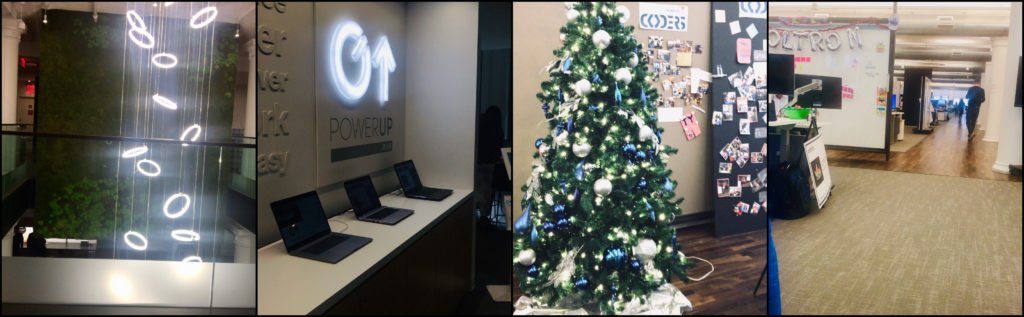
My teacher, Sandra Davilla, connected me to Chris Castaneda who is the Principal UX Product Designer at Capital One. Capital One Financial Corporation is an American bank holding company which specializes in credit cards, auto loans, banking and saving products. It is headquartered at McLean, Virginia. Chris invited me to spend a few hours at their New York office on 19th street. I spent around five hours there on the 28th of November. The New York office space is dedicated to business, design and technical teams in commercial banking.

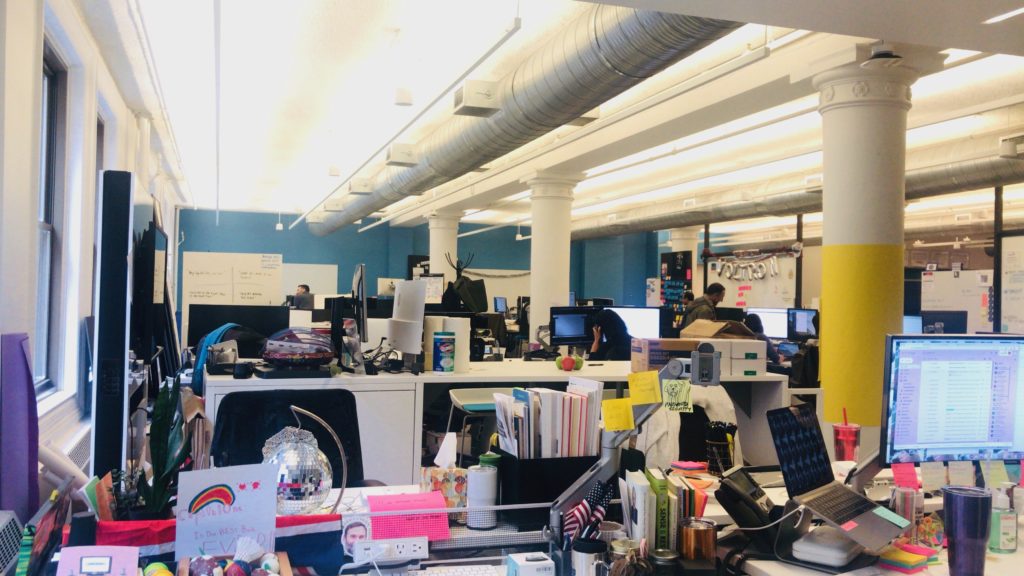
Design Team Workspace (Capital One)

I met Chris in the lobby and he offered me to join an ongoing design meeting. This meeting was about the upcoming sprint for Capital One’s mobile application. It was conducted by the design lead, Laura. The objective was to discuss completed user stories and to analyse new authentication, logging, and user onboarding features. There were eight team members in total from design, and mobile development teams. All the designs for the sprint were displayed on a screen in the meeting room. They thoroughly discussed a feature about authenticating a transaction on the mobile. Eventually, they decided to move the feature to the upcoming sprints. New stories were created for payment challenges and API issues. It was good to see people from diverse backgrounds, reaching a consensus after an intense discussion. The meeting room was arranged nicely. One wall of the room was dedicated to six goals of the current sprint and how the team was achieving those goals. I found it intriguing that there was a health indicator for the team, code, design and the user. I was glad to see the team’s health ‘good’ at that time. There was a calendar that had sticky notes for all upcoming meetings and, more importantly, there were donuts and candies to lift up everyone’s spirit. I was especially inspired by the productive discussion the whole team had and the way they were working together to improve the user experience. The meeting lasted for an hour.

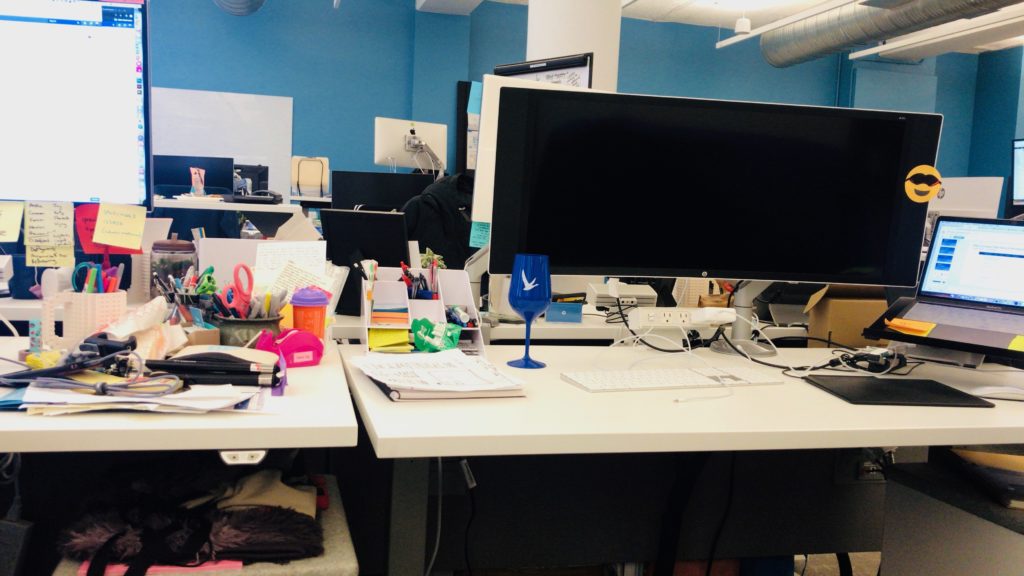
Chris’s Work Station (Capital One)

After that, I followed Chris to his workstation. We had a fun discussion about research methodologies and the design process Capital One is following to improve their products. Chris is on the design team that works for commercial banking. He explained that in commercial banking, clients are large company owners and the design team does not have direct access to them. To overcome this issue, Capital One has internal research partners. They help the company in recruiting proxy clients. Proxy clients are people who have a similar profile to the actual clients of Capital One. The similarity can be based on the kind of business the proxy client owns. Once a proxy client is recruited, the design team can invite them for an interview. On the choice between quantitative and qualitative research, Chris replied that the company prefers to use qualitative research methods due to the nature of their clients. He explained that in commercial banking, the client base is narrow. Recruiting ten proxy clients or inviting important clients to the office can be more effective than quantitative research methods like a survey. According to Chris, the most significant challenge as a designer in commercial banking is to understand the intricacies of financial complications. I brought up the theoretical approaches mentioned in Yvonne Rogers’s paper “New Theoretical Approaches to Human-Computer Interactions.” I asked Chris if he knew any of these approaches and what his opinion was regarding the approaches designers and researchers are following these days. Chris replied that he understands these theories but he thinks the world of user experience and human-computer interaction is advancing rapidly. He further added that businesses are realising the importance of user satisfaction and are ready to invest in it, which gives designers a great opportunity to research and expand their horizons. While we were having this conversation, he got a reminder of a meeting. Before heading towards the meeting, he introduced me to Samantha Li, Design Manager at Capital One.

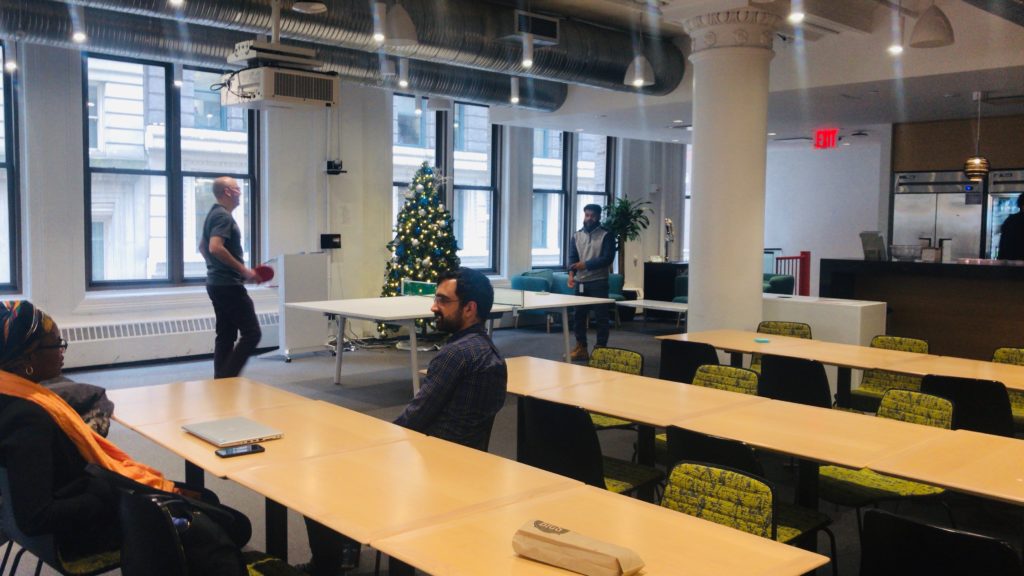
Cafe (Capital One)

Samantha offered me a tour of the office space. We started with the design team’s space. She showed me the office of John, head of the design department. She told me that he is hard to find in his office because he prefers sitting among the designers so that everyone has direct access to him.  The best thing about his office was a board where the goals for the design team were posted. During this tour, I got the chance to meet a lot of people but one notable conversation I had was with Alisha. She is a lead designer at the incubator, Captial One Labs. She is part of a team of six including four developers and one researcher. The team focuses on innovative ideas which are not a part of their products. She did not describe the type of experiments they do but she was very excited about her work. She said that she likes her job because it lets her go beyond limits. In my opinion, the incubator was a great idea. I think companies can have such incubators to help employees explore and work on their innovative ideas. Another notable thing was Coders Program. It was a summer program where kids from different areas in NYC come to Capital One and learn to code from their tech team.

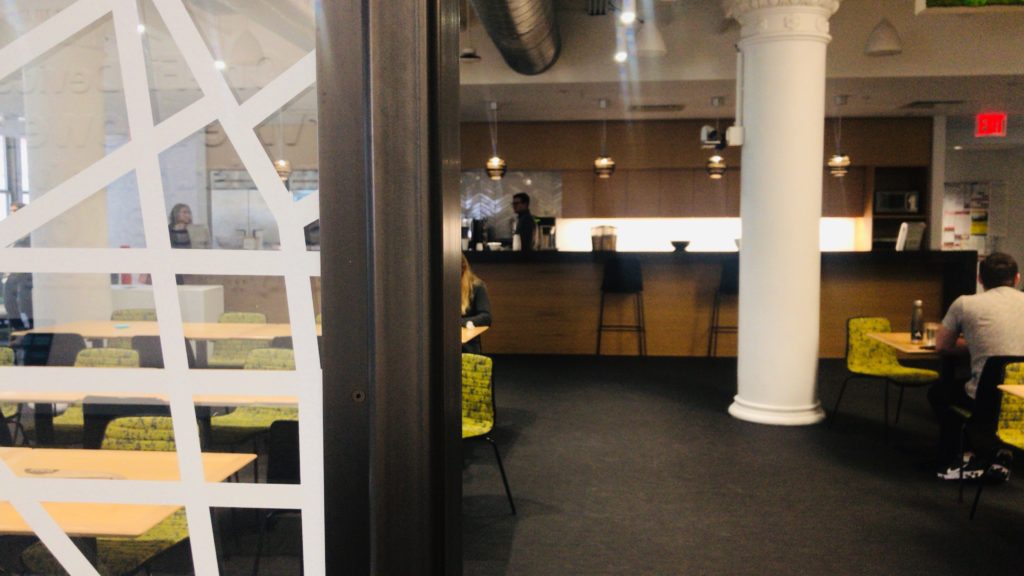
Kitchen Area (Capital One)

After the tour, we chatted in the lounge area. Samantha has been working in the industry as a designer for ten years now. I told her about the discussion we had in the class about inclusive designs and gave her an overview of the paper “Design Justice: towards an
intersectional feminist framework for design theory and practice” by Costanza-chock Sashaa. She said that she understands the concept of design justice and has been an advocate for it. She said she deeply cares about inclusive design and that she was very proud of herself because, during a design release, she made sure that mockups and images for the products were inclusive. She explained that some of the mockups had hands, she transformed those male Caucasian hands into brown hands with nail polish. She acknowledges the fact that mockups or design sprints will only be shared among the team but she believes that by adding these tiny details we can at least try to include everyone in the process. In her opinion, there is still a long way to go in terms of dealing with biases in design.

Judy Wajcman said in her paper, “Feminist theories of technology,” that drawing women into [technology] is crucial about how the world we live in is shaped and for whom. According to her, we live in a technological culture, a society that is constituted by science and technology, and so, the politics of technology is integral to the renegotiation of gender power relations.

Samantha has been working in the tech industry for ten years now and I got interested in her experience as a woman in the male-dominated industry. I asked her about how we can draw more women into tech, and what her experience has been. She was excited about the topic, and gave me an elaborate answer. Seeing women at higher executive levels in Capital One makes her very happy and she is enjoying working as a design manager. She told me that Capital One has a good male to female ratio but it is still not where it should be. According to her, initiatives like introducing high school girls to coding can bring a positive change. She further appreciated the collaboration at the company, where different teams meet once a month to share their problems. She invited me to design meetups that she arranges every other month for designers.

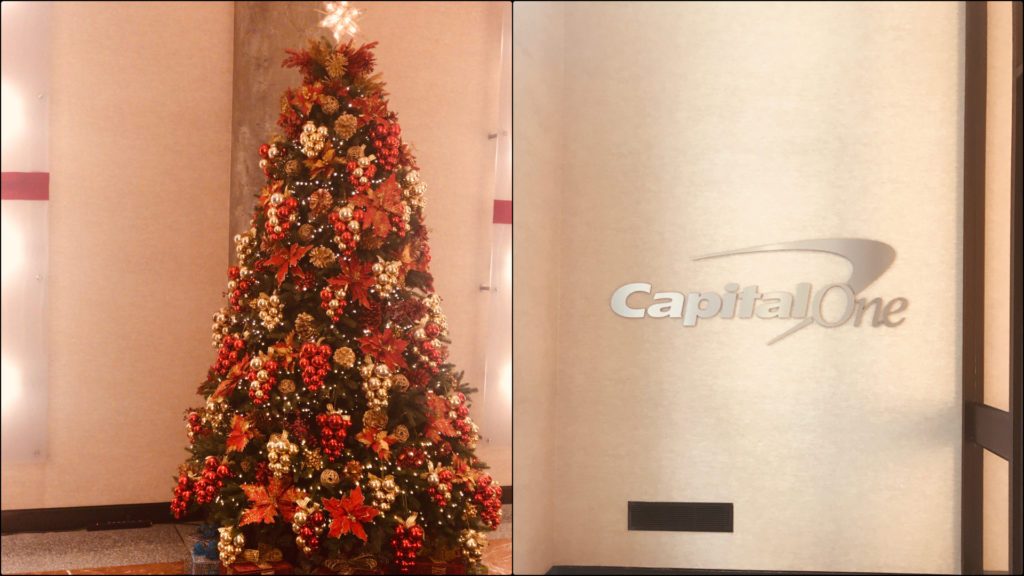
The office was amazing and the tour was a great learning experience for me. It was decorated for Christmas and was looking really beautiful. There was a positive vibe in the entire office. Everyone I met, seemed very happy with their job. 


Useful Links:

Capital One Labs -> https://www.capitalonelabs.com/
User stories ->https://searchsoftwarequality.techtarget.com/definition/user-story
Agile sotware development process ->https://agilemanifesto.org/
Sprints -> https://searchsoftwarequality.techtarget.com/definition/Scrum-sprint


Cited Work

“Feminist theories of technology”, Judy Wajcman
“Design Justice: towards an intersectional feminist framework for design theory and practice” by Costanza-chock Sashaa.
“New Theoretical Approaches to Human-Computer Interactions.” Yvonne Rogers


Digital life: New Museum archive system ARIES

Private Tour to Frick Art Reference Collection.

In their roles of preserving tangible and intangible heritage, museums have documented a corpus of knowledge that is fundamental for societies. However, this orientation, which has paid more attention to artifacts, is one of the reasons why museums are perceived as distant institutions that are more concerned with the past, and that are more at the service of the intellectual elite of the museums (MacDonald and Alsford, 2010). Consequently, museums, beyond being places to collect, preserve, study, and exhibit, are redefining themselves and making efforts to respond to a fast paced information society by incorporating more interactive museum management information technologies.

Frick Art Reference collection is a leading organization for digitizing their collection it is dedicated their resources to collect, preserve, study, exhibit, and shared through online. Frick Art Reference Library’s mission is to provide public access to materials and programs related to the study of fine and decorative arts created in the Western tradition from the fourth to the twentieth century.

Entering Frick Art Reference Library(FARL)

In order to visit the Frick Art Reference Library, you need to be 18 and older and you need to be registered or pre-registered through online. for security issue Coats, umbrellas, camera, and laptop cases, and bags larger than 9″ x 12″ x 3″ must be checked.

Stephen J. Bury

Stephen J. Bury is a scholar, art historian and the Andrew W. Mellon Chief Librarian of the Frick Art Reference Library in New York City. Meeting Stephen J. Bury was a strange experience to me, especially right after I read his essay about his plans about digitalizing Frick Collection: Embedding a culture of innovation at the Frick art reference library in Technology and digital initiatives: innovative approaches for museums / edited by Juilee Decker.  He introduced ARIES and equipment they use for documenting works.

ARIES: ARt Image Exploration Space

Louisa Wood Ruby, the Head of Research at The Frick Art Reference Library gave us to talk about the open source program they developed. As an emerging museum and digital culture professionals, I hope to create a culture of openness and accessibility in museums, so that visitors can reduce their fear of institutions and have a better understanding of the contents of collections and exhibitions. ARIES is the perfect example for  Libraries in incorporating technologies.

ARIES is an open source developed by members of the Digital Art History Lab (DAHL) collaborated with New York University’s Tandon School of Engineering and the Universidade Federal Fluminense, Brazill. This program is originally created to help to visually compare the artwork it saves tremendous time for art historian and curator.

ARIES follows Sir Tim Berners-Lee’s theory of “information management” system and it became the conceptual and architectural structure for the Web. Berners-Lee eventually released the code for his system — for free — It became a milestone in easing the way for ordinary people to access documents and interact over the Internet. (Digital life in 2025: Experts predict the internet will become ‘like electricity’-less visible, yet more deeply embedded in people’s lives for good and ill by Prof. Janna Anderson, Lee Rainie)https://lms.pratt.edu/pluginfile.php/831785/mod_resource/content/0/PIP_Report_Future_of_the_Internet_Predictions_031114.pdf

ARIES is free program for all and it is designed not just for the art historian and researcher, it is designed for everyone who is interest in the collection in Frick Art Reference Library(FARL)

Art historians have traditionally used physical light boxes to prepare exhibits or curate collections. which is exhausting and time-consuming ARIES is created to address problems. It is an image Exploration Space, an interactive image manipulation system that enables the exploration and organization of fine digital art. The system allows images to be compared in multiple ways, offering dynamic overlays analogous to a physical light box, and supporting advanced image comparisons and feature-matching functions, available through computational image processing.


ARIES is still under the development and they recently added tracking program for dispersal of an artist’s work. Tacking work would be really useful for curating exhibitions.


The Art Gallery of Ontario: Visitor engagement in the museum with the application.(HCI)

INFO-601 Foundations of Information Dr.Sula
Juri Rhyu
Observation

Observation—Complete an approximately three-hour observation of an information environment, chosen in consultation with the professor. Your article should describe what happened during your observation and should connect those details to larger issues in the field, citing/using readings where they are relevant.

Observation: The Art Gallery of Ontario: Visitor engagement in the museum with the application.

The About the Art Gallery of Ontario (AGO)

Visiting The Art Gallery of Ontario (AGO) was one of my travel list in Canada.
The Art Gallery of Ontario (AGO) is an art museum located at 317 Dundas Street, West Toronto, Ontario. Toronto is the largest city in Canada, and the AGO is one of the largest art museums in North America. The museum has nearly 95,000 of various artworks from contemporary art to European masterpiece. They support emerging indigenous Canadian artists and collaborative exhibitions with other museums and galleries around the world. The AGO is also known for their architecture. It was designed by famous Canadian architect Frank Gehry. The AGO is the first place where he experienced art in his childhood. I always admire Frank Gehry’s works because of his design philosophy. He wanted to build a museum that connects a city and its people to great art and art experience. His design intention is exactly appropriate for AGO’s mission: “We bring people together with art to see, experience and understand the world in new ways”1.

Before visiting the AGO, I checked their website to get information about the museum. The website is well designed; the first page has all the necessary information including gallery hours, current events, how to get to the museum, getting admission tickets, education events or classes and museum news which are all I wanted to know. The AGO presents wide-ranging exhibitions and educational programs. The museum is funded by the Ontario Ministry of Tourism, Culture, and Sports and additionally supported by the City of Toronto. The AGO always invites interesting and worldwide known exhibitions as well as developing own educational programs for visitors and publications. Recently, the museum has been crowdfunding to purchase “Infinity Mirrored Room” by artist Yayoi Kusama.2 They encourage visitors to donate for the artworks. More than 3,000 people have chipped in a contribution to permanently acquire Kusama’s brand new installation, even though they haven’t seen it until now. The artwork itself costs $2 million, with $1 million of the price tag paid for by the Art Gallery of Ontario Foundation. With one more week to go, the month-long crowdfunding campaign to raise the remainder sits at nearly $413,000, as of midday Friday. The AGO says it’s hoping more people donate on next week’s “Giving

1 About the AGO. (n.d.). Retrieved from https://ago.ca/about/about-the-ago
2 Here’s a sneak peek at the new Yayoi Kusama infinity room the AGO wants your help to buy | CBC News. (2018, November 23). Retrieved from https://www.cbc.ca/news/canada/toronto/kusama-infinity-room-first-look-1.4917109

Tuesday,” a day devoted to donations following “Black Friday” shopping. Funding is not enough to buy Kusama’s work yet, but it shows how much people care about the museum and participating in the development of the museum.

Special Exhibition

Anthropocene: The Human Epoch
Anthropocene: dramatically illustrates how we, individually and collectively, are leaving a human signature on our world.3 This show is organized by the Art Gallery of Ontario (AGO) and the Canadian Photography Institute(CPI) of the National Gallery of Canada(NGC), in partnership with Fondazione MAST.

Anthropocene is the culmination of an ambitious, four-year-long collaboration by the artist and filmmakers Edward Burtynsky, Jennifer Baichwal, and Nicholas de Penciaer. Their goal is capturing the massive scope of human effects on land, sky, and water.

Technology and Art(HCI)

The field of human-Computer interaction(HCI) is expanded alongside the extensive technological developments such as the internet wireless technologies, smartphones. These had created many opportunities for augmenting extending and supporting user experience, interactions, and communication.(New Theoretical approaches for Human-Computer Interaction by Yvonne Roger University of Sussex)

AGO developed an application with the artist to provide a unique experience to the visitor.

The artists created Augmented Reality (AR) Installations which can be activated by simply downloading application AVARA. The museum places the symbol on the floor and wall labels to help visitor identify each AR activation. There are six activations in total, four-videos, and two 3D AR installations which present experiences of confiscated ivory tusks, a northern white rhinoceros and a Douglas fir tree at or near the actual scale.

Conclusion

This museum visit did remind me of the several articles about digitalizing the institution, collecting data and museum heritage. The Art Gallery of Ontario (AGO) is seeking ways to directly interact with the visitors and to create an impressive museum experience rather than delivering pieces of information. This show is well curated with care and utilized the gallery space as much as possible. I visited this museum during the weekday, and the museum had a number of people and school groups, but it was not too crowded. Since this show encourages you to be on the phone, the show prepared the charging station right below the infographic about pollution and what is co. A museum educator was at the station to explain the works and environment and to answer questions from museum visitors.

As a museum educator, getting feedback is as important as curating shows. They set up a pathway at the end of the exhibition to make people experience interactive activities with touch screens which helps museums collect data. They invite people to upload photos of the show with hashtag#. Once you upload a photo with hashtag#, it is also automatically uploaded on the museum website (https://ago.ca/exhibitions/anthropocene). In my opinion, they should not post personal pictures until they get permission. Even though people tag the museum and the show, they would not expect that their pictures could be uploaded on the museum website.

In addition, I hardly believe that digital museums can replace traditional ones because a museum is where not only provides information and archives historical heritage but also where allows people to have a physical experience with art. The Museum building itself is

3 Anthropocene. (n.d.). Retrieved from https://ago.ca/exhibitions/anthropocene

also an art piece, and viewing digital contents does not give people the same experience as physically being in the space.

Observation- Larchmont Public Library: The Provisions of a Small Local Library

Despite having consistently been a resident of New Rochelle, I have had a long-lasting connection with the nearby Larchmont Public Library. As a senior in high school I volunteered there, but quite a bit has changed both physically and technologically since I was last there on a regular basis. Extensive renovations were made in 2016.

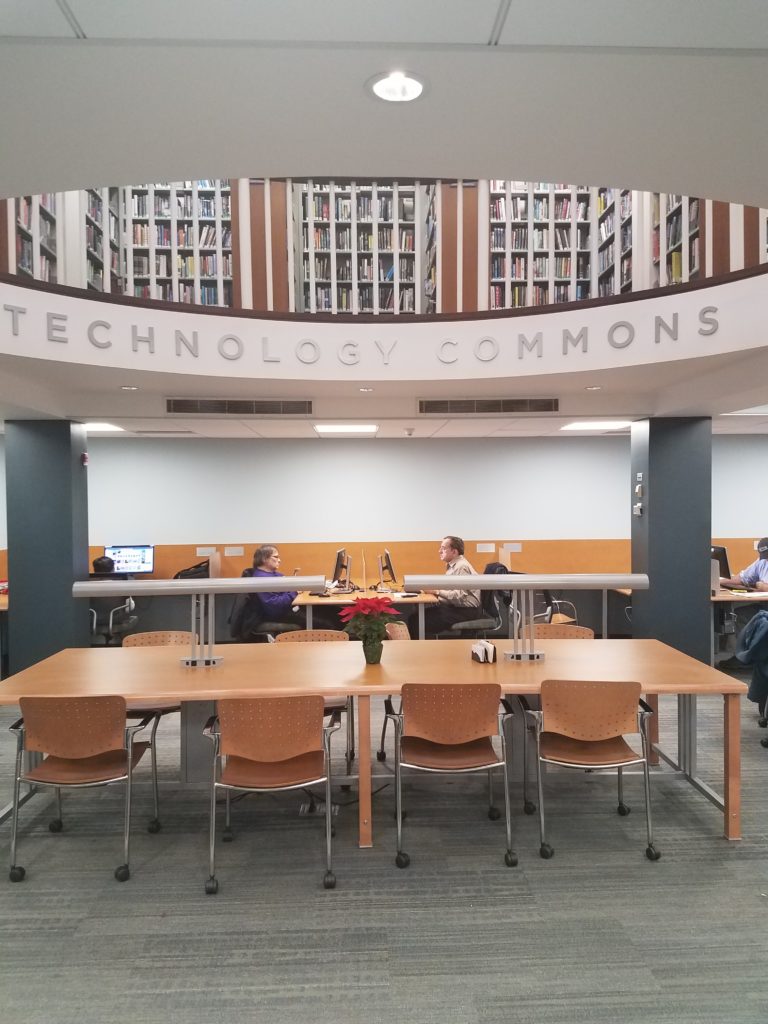
The circulation desk is straight ahead as you walk in. Beyond that is the newly added and beautifully constructed Technology Commons, an open space with computers and tables. This serves as an excellent location for such a center. It is in close proximity to the circulation desk which always has at least one person there to assist patrons. I went on a Sunday, which usually is a relatively quiet day and most of the librarians are not there. Nonetheless, there was one man there who had quite a few patrons approach him for technological assistance. He maintained his affable demeanor throughout his exchanges with the patrons despite having quite a few people approach him. One patron’s issue seemed to be persistent and he returned repeatedly to the librarian for help. I did not detect any sense of frustration from the librarian despite the patron getting rather flustered. The librarian simply set him up at a different computer and the issue seemed to have been resolved.

Surrounding the Technology Center are enclosed areas designed for private tutoring sessions. Overlooking the Technology Center is a balcony area which hosts the adult fiction books. On the floor below is the adult non-fiction section. There is a diminutive art gallery (the Oresman Gallery) on the way to the Burchell Children’s Room which was completed in 2010. For a small public library which only has 100,00 items, there are many services which are offered.

Slightly unusual for a public library of its size, there is quite a lot of French items. The Children’s Library  has an entire section of French books and there are an abundance of French options in the adult sections as well. There is a regular French/English story time offered on Sundays. Larchmont has historically had a large number of French speaking residents. The Lycee Franco-Americain de New York is right next door to the library. It is clear that the library has this community in mind when developing the collection and organizing the programming.

The library has been wheelchair accessible since 1995, although this is possibly an area where there can be room for improvement. On the bottom floor, there is a wheelchair lift next to the staircase so as to accommodate the physically handicapped. However, it can be a bit of a pain to use. In order to operate the lift, one needs to have a key which must be obtained from the circulation desk. It would probably be simpler to have a ramp instead.

Another issue I overheard someone complain about was that the book drop was underneath the computer kiosk for searching the catalog. It is possibly a slight inconvenience and perhaps not an intuitive place for it to be, but to be honest, I found the complaint to be rather petty. Still, I suppose it is something worth considering when creating an information space.

I was also surprised by the number of research resources that are provided at the Larchmont Public Library. There are four full-time reference librarians and one part-time reference librarian (she actually used to be the assistant director of the library and my supervisor). The reference librarians are not there on Sundays, but there is permanent use of the online resources, which include materials on Arts and Literature, Biographies, Genealogy, Health and Science, History, Business and Law, Social Science, Newspapers, Serials etc. I was astounded by how much this small public library has to offer.