We Are Brooklyn Event Blog

As fall comes, two things turn my mind towards the idea of immigration. One is a Thanksgiving tradition of my aunt having a few too many glasses of wine and tearfully recounting the story of how my great grandparents ended up in New York from Ireland (if it is as she tells it, it is a good story, with my great grandfather running from the British because he drunkenly signed up for the IRA and being told by my great grandmother that men were after him and he had to flee the country, and then rescuing her when her fiance refused to sponsor her through Ellis Island a year later because he had fallen in love with another woman) while we all nod along. The second is a much less charming reason- fall means elections, and elections mean debates about immigration, especially immigration from countries in South America and the strife our current administration seems to be intent on putting them through, as well as the scare mongering about these same people some political entities drums up for their own gain in election and legislative or monetary support.

With these two things in mind, I spent an afternoon in the New York City Hall of Records, checking out the “We Are Brooklyn: Immigrant Voices” exhibit that they originally premiered at Guttman Community College, put together by the Brooklyn College Listening Project. It was smaller than I had expected, but the information was denser than I had expected as well. The posters generally told either pieces of legislative history of immigration reform or the stories of individual immigrants, and there were QR codes that people could use to listen to full interviews online. There was also a board where you could put pins in a map to show where your family had emigrated from, and what year range they came to America, which was a fun bit of interaction with the visitors. I would love to visit the display closer to the end of it’s run and see what some of the demographics that were visiting the exhibit were, and try and see what information can be found from that. This brought to mind our discussions our class had at the very beginning of the school year, about how people interacting with a text or with a set of information changes the set of information itself. 

Because I went on a weekend and spent a while there listening to the multimedia presentations, I ran into a few more people who were also attending the exhibit. On the whole, most of the people there were not first generation immigrants themselves, which I found interesting. I was not extremely talkative with them (this was not a space conducive to lengthy conversation), but it seemed was primarily a group of people who were curious about hearing others speak (or reading summaries of the stories that other people gave, more on that in a minute) on things they had never experienced. It seems to be reaching a small group of people who are interested in local history and immigrant stories, which is not particularly unsurprising. 

       This exhibit really made me think of both the idea of archiving immigrant experiences and how that is best done, as well as the idea that there is no true neutrality that we have been discussing in class. I thought it was interesting that the main exhibition pieces were 6 foot tall boards with stories printed on them that were not the story of each person’s immigration as they said it. They were instead written in a third person narrative form, each following a fairly clear line and ending with the person living happily in Brooklyn to this day. These posters had some quotes from the interviewees sprinkled in, and they were a purely text based experience unless you went through the extra step of scanning the QR code and listening or visiting the website after the exhibit. This was obviously not done with malice, but I wonder how much that changed the story being told. It is rare that someone’s story is that open and shut or that narratively satisfying, and I wonder how much was left out in order to make the story fit both the narrative and the posterboard. The interviews are short but go into more depth, they feel a little less like a story and a little more real, but again, fewer people are going to go through the extra steps to listen to them. I wonder how much conscious choice went into that, the making of these experiences into neat little written stories. Is it in order to package them for people who are not direct immigrants and who grew up on stories of family histories of moving to America like my family (and many families like us) did? Is there a desire from the people being interviewed themselves to make their own narrative fit into the molds of the accepted immigration stories that are passed down in a lot of european households? Was the purpose of this exhibit simply to document stories, to act as a snapshot of an archive of more recent immigrant experiences? Or was there a political agenda as well. 

There has been much discussion in our class through almost the whole semester about the fact that there is no real neutrality. In archiving, in organizing, in the management of information, there are always biases and there are almost certainly individual or group motivations that are not always stated. The last few posters in this exhibit talked directly about this presidential administrations’ acts against immigrants from South American countries, specifically. In that space, there was no attempt to be neutral or to try and defend the heinous actions of the administration, just a statement of what had been done as facts and what the consequences of those legislative moves have been for immigrants and migrants (and some US citizens who have been detained or threatened). The lack of an attempt at neutrality here, I think, is both the greatest strength of the exhibit while also being what will keep many people away. Stating the facts here is not neutral, putting a face to and humanizing what some are calling the “migrant threat” in order to justify what is happening to them is not neutral, but it is something that needs to be done. Not many people know about this project, it is not particularly well advertised. Those who may need to see it are in some ways the least likely to go to see it, precisely because it is not interested in playing both sides and maintaining an idea of neutrality by masking facts. 
User Studies, Harm Reduction, and Queer Resilience

By Lillian Gooden
Looking at the Margins: Incorporating Harm Reduction Into Tech
Presented by Norman Shamas and Afsaneh Rigot of Article 19
Radical Networks Conference, October 2019
Hosted at Prime Produce, NYC

I attended the Radical Networks 2019 conference on a rainy October afternoon. This conference, which centers marginalized and oppressed groups, gathers artists, experimenters, and researchers, and invites them to exchange radical ideas on technology and telecommunications. Conference participants are radical thinkers who want to use technology to help their communities while resisting systems of control and surveillance. 

The sessions that initially drew me to this conference were titled “Media Infrastructures and Racialized Territorial Formations: Perspectives from the South” and “Everything Has A Resonant Frequency: On Crystals, Networks, and Crystal Networks.”

These bore a relation to my term paper, which (as of now) seeks to explore the physical aspects and environmental tolls of the Web’s infrastructure. I came to hear the work of a researcher looking into issues of access for the largely indigenous populations in the warmer, tropical, most remote regions of Colombia in “Media Infrastructures.” I came to hear the insights of another researcher and journalist interested in the supply chain of the minerals that power our communications, from World War II-era radios to smartphones in “Resonant Frequency.” 

Harm Reduction is Radical

But my attention was captivated by Shamas and Rigot’s presentation on harm reduction, entitled “Looking at the Margins.” To set the context, Norman Shamas began with a definition of harm reduction. Harm reduction consists of practices that ensure one’s survival and aim to minimize harm from certain activities, typically those that are illegal. With the aid of a tweet by @ReyBee10 (2018), they frame it as a term that was “was started by sex workers, queer & trans PoC, people who use drugs, people in the streets saving their own lives and all the intersections thereof—not by public health folks.” 

They presented a few examples of community harm reduction practives such as needle exchanges and safer sex education. Central to the idea of harm reduction is the acceptance of pleasure being a normal part of human life. Taking an abstinence-only approach harms by withholding potentially life-saving information. Shamas and Rigot might argue that harm reduction is design justice in motion, as it involves those most affected by structures of domination design their own solutions (Costanza-Chock, 2015).

In addition, Shamas highlighted humanitarian assistance for migrants crossing the desert in the form of providing food and water. Those providing assistance, they said, act in awareness and opposition to structural oppression in that they believe that migrants crossing the border deserve to live. If we are invested in reducing harm, we must shun stigmatization and judgement and work to mitigate risks instead. Harm reduction is inherently radical. 

Harm reduction in tech matters because we currently lack a way to bring in systemic support for people that are being harmed while engaging in certain activities—without stigmatizing them. The presenters brought up two case studies to demonstrate methods of designing harm reduction measures and show their effectiveness. My focus is on the first of the two.

Case Study: Queer Dating Apps in Hostile Societies

Afsaneh Rigot, the second presenter, introduced a case study involving queer dating apps in Egypt, Lebanon, and Iran. In all of these countries, queer people are targets of persecution by government officials and fellow citizens alike. Of course, criminalizing sexuality has never prevented queer people from seeking and enjoying love. They have endured despite the risk of arrest and abuse. 

The team at Article 19 sought to learn about queer dating app users, their needs, and design harm reduction solutions around these needs. Taking a design justice approach, they worked with local groups in Egypt, Lebanon, and Iran to get a sense of the environment on the ground. As they embarked on their research, the team understood that “the full inclusion of people with direct lived experience of the conditions [they were] trying to change” was crucial, to use Costanza-Chock’s words from “Design Justice.”

User Interviews Yield Revelatory Findings

It was established early on that participants in these countries had no interest in quitting their dating apps despite the risks, so proposed solutions had to support continued app use. Rigot pointed out that elsewhere, trainings around risky issues tend to be prescriptive, talk down to users, and fail to meet them where they are. Proposed solutions produced by these sessions fail their users by misunderstanding them and their needs.

For example, the discussion around safety on queer dating apps typically centers on privacy and geolocation. It is often recommended that users disable this feature in order to protect themselves. This advice seems reasonable enough, doesn’t it? 

However, in talking to queer communities in this study, Rigot and Shamas found that surprisingly, geolocation was one of the features that made users feel most secure when chatting with other GPS-located users on dating apps. Many respondents brought up that knowing that the person they were engaging with was someone who lived in their town made them feel safer!

This revelation underscores the importance of learning locally desired applications or service—one of the ethical guidelines for fieldwork laid out by PERCS at Elon University. It is crucial to tailor any solution that you are designing to the specific needs of your user, and to uncover those needs through dialogue and direct engagement. 

The Article 19 team found that devoting energy to developing geolocation solutions would not have been the best use of their time and resources, especially as many users already employed tactics such as GPS spoofing to preserve their anonymity on queer dating apps. Instead, users expressed that they would find it beneficial to have legal resources embedded in the apps they use in the event that they found themselves a target of government surveillance or other abuse. 

In their findings, the Article 19 team also identified a desire for app icon cloaking. Suspected “deviants” in the countries surveyed sometimes found their property, including the information on their phones, subject to search. A queer dating app discovered by a government official could be grounds for penal action. By cloaking their app icons, users might be able to keep themselves safe(r) by disguising, say, Grindr, as something so innocuous as a calendar or calculator app.

Perhaps this reality seems distant from a US perspective, as we live in a country where a queer person can legally adopt children, marry their beloved, and even run for president. However, the reality is that despite our tenuous legal protections, many queer Americans live in daily fear of persecution, discrimination, and violence. Solutions like the above can still be of use even to those who do not live in such overtly hostile environments. Designing solutions for the most  marginalized in society will yield applications that can protect all users. 

Works Referenced:

Costanza-Chock, Sasha. (2018). “Design Justice: Towards an Intersectional Feminist Framework for Design Theory and Practice.” Proceedings of the Design Research Society 2018. https://ssrn.com/abstract=3189696.

PERCS: The Program for Ethnographic Research & Community Studies. “The ethics of fieldwork.” Elon University. http://www.elon.edu/docs/e-web/org/percs/EthicsModuleforWeb.pdf.

ReyBee10. (2018, Oct 10). “#HarmReduction was started by sex workers, queer & trans PoC, people who use drugs, people in the streets saving their own lives and all the intersections thereof— not by public health folks….respect the origins and beware co-optation..to paraphrase @HarmReduction #HarmRed18” [Twitter post]. Retrieved from https://twitter.com/ReyBee10/status/1052975455748452352.

Observation at The Met Fifth Avenue: How is the museum tour guide in including different kinds of visitors.

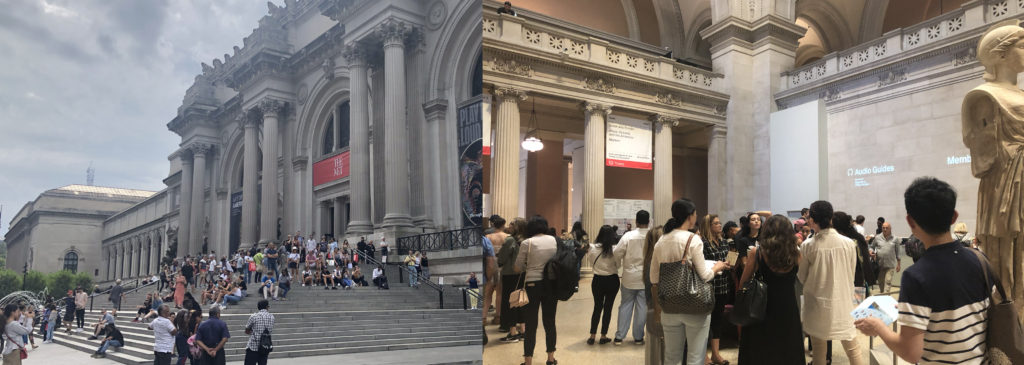
The Metropolitan Museum of Art is the largest art museum in US and the third most visited art museum in the world. The main building in Manhattan’s Upper East Side in one of the world’s largest art galleries. As was posted on January 4, 2019 that 1,659,647 visitors were attracted to The Met Fifth Avenue and The Met Cloisters from May 10, 2018 to October 8, 2018. Based on the data from Wikipedia and MET official website, with such large number of visitors from all over the world, I began to curious how the visit guide provided by the museum service did well in considering different kinds of visitors.

According to what I learnt from Design Justice, the tour guide designed by MET should aim to ensure a more equitable distribution of the benefits and in this case, the museum tour guide should also consider non-English speakers, people with disabled, etc.

I went to The Met Fifth Avenue on 27th, Sep. to directly observe as a visitor and my goal was to see whether different kinds of visitors were guided friendly and effectively in visiting the museum. It was a cloudy afternoon with crowded visitors, and I waited for 10 minutes in line to get my ticket.

1 Manual Guide

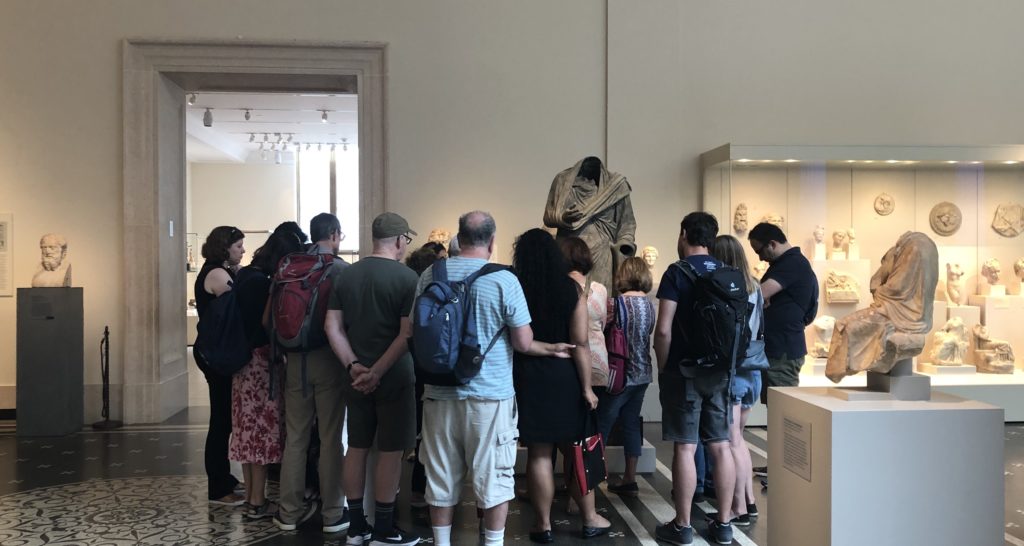
I saw several cicerones surrounded by a small number of visitors. I joined them for free. Some visitors followed by cicerones carried backpacks and not seemed like locals. The good thing for getting a manual guide is that you could directly ask questions and get answers, especially for history or art fanatics who are always filled with questions.

But this method is not that feasible for visitors who prefer to get through the museum quickly and are not fluently English speakers. Since you are guided by a certain route and listening to deep explanations of the exhibits really takes time. In this period, I found some of visitors would only follow a few minutes then left the group to visit by themselves.

2 Audio Guide Rent Onsite

These days the most commonly used tour guide in museum is audio guide. At the museum lobby visitors could easily find the words “Audio Guide”, and the return place was also obvious to find. During my observation period, I found no more than 50% visitors were using audio guide and I guess it was because the audio guide in MET was not free, or some were not first-time visitors or some just preferred to quickly visit the whole museum without deep explanations.

2.1 Whether considering non-English speakers.

Yes. The audio guide provided by MET contains 10 different languages, which is especially considerable for foreign visitors. When I visited the museum, I found a lot of Asian visitors renting audio guide and listening to the guide frequently. It’s much effective for them to get the explanations in their mother language.

2.2 Whether considering visitors with disabilities.

During my observation period, I did not find disabled visitors. But I found some information on the MET website that the museum offered assistive listening devices and real-time captioning for visitors with hearing loss.

2.3 Whether considering aged visitors.

I found an old woman who seemed uneasy to input numbers into the audio guide to get the explanations. And some visitors seemed tired to hold the guide near their ears to listen all the time and they needed to find a place to sit or change to another hand to hold the guide. I think the interaction method between visitors and audio guides is not that friendly especially for aged visitors. Manually inputting numbers could waste time. Besides, the guide is not that easy and convenient while the MET is large, and most visitors would stay more than 2 hours.

I guess it’s better to add automatic induction function to the audio guide and visitors don’t need to input numbers themselves but only to answer yes or no to listen the guide. In addition, always holding the guide near ear to listen is not convenient. Why not provide earphones to aged visitors together with audio guide? Or support the visitors using their own earphones.

2.4 Whether considering visitors who prefer quickly visiting the whole museum.

I did find a visitor hanging the audio guide around her neck, but she didn’t use it during the whole process. And some only listened a few seconds then gave it up. I guess the contents provided in audio guide were too long and they only wanted to get a concise version. They came to the museum to get something new but not preferred to get that deep understanding towards a single exhibit. In that case, perhaps better to provide different versions for visitors to choose from. For instance, a quick 1-minute explanation together with a detailed 5-minute version.

3 The MET App

There is an App called The MET which also provides travel guides and even augmented reality function. The good thing is you could use it offline, while the bad thing is that you have to download it beforehand. How many visitors would take trouble to download an App to help them visit the museum? I guess better to develop a Web App for visitors who just want to visit temporarily.

During my observation period, I only saw a young woman using her iPhone to get the audio guide. Generally speaking, not a large number of visitors choose to get a guide on App. I believed one of the problems was not enough contents on App, compared to the audio guide you rent onsite.

Conclusion

In 2015, the MET did a thorough research on how to improve the audio guide and during the research they did find 40% visitors were foreigners and the importance of reducing the complexity of using audio guide. However, just like what Norman said, “The world is not neat and tidy and things not always work as planned.” All the tour guides provided by MET are roughly satisfied but still have space to improve. Perhaps reconsidering different visitors’ needs could help better the overall experience.

Reference

1 Wikipedia: Metropolitan Museum of Art: https://en.wikipedia.org/wiki/Metropolitan_Museum_of_Art

2 Met Welcomes Nearly 7.4 Million Visitors in 2018:

https://www.metmuseum.org/press/news/2019/2018-calendar-year-attendance

3 Improving the Audio Guide: A Look at Our Visitors:

https://www.metmuseum.org/blogs/digital-underground/2015/improving-the-audio-guide-a-look-at-our-visitors

4 Norman, D. A. (1998). The Invisible Computer: Why Good Products Can Fail, the Personal Computer is So Complex, and Information Appliances are the Solution. MIT Press. Chapter 7: Being Analog http://www.jnd.org/dn.mss/being_analog.html.

5 Costanza-Chock, “Design Justice: Towards an Intersectional Feminist Framework for Design Theory and Practice”

Event Review: REcon 2019 UI/UX Conference in Bloomberg. LP

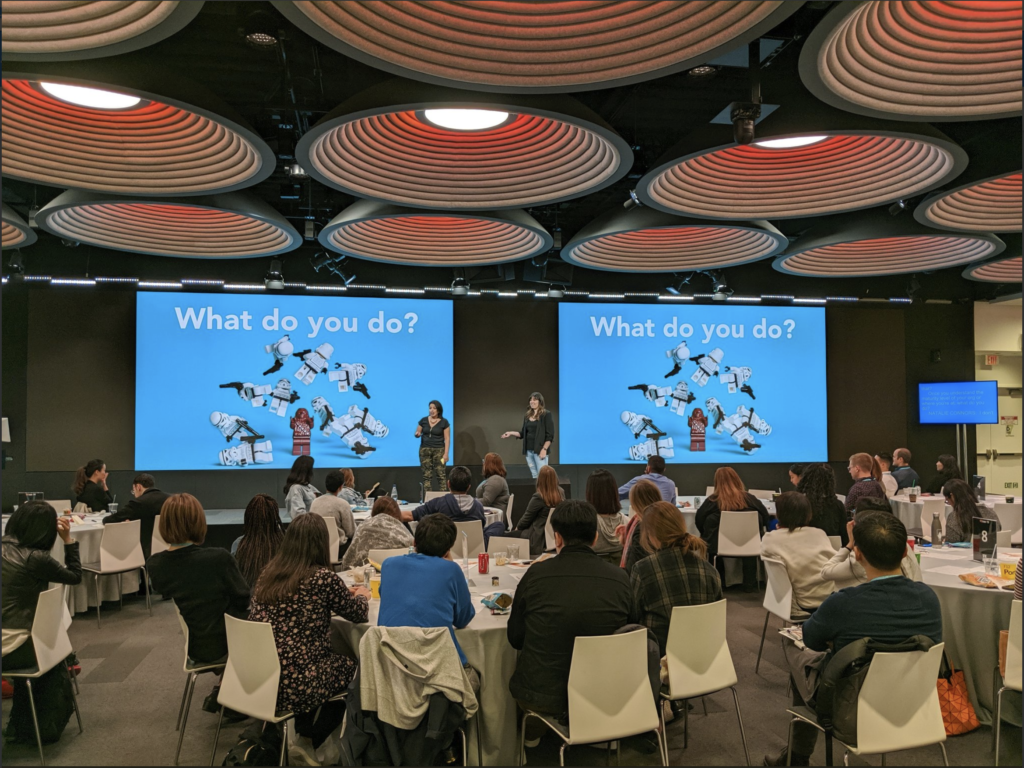
“REcon” is a yearly free conference for user researchers, and this event is an excellent opportunity to learn from industry leaders, share ideas, expand the connection, and discuss all things user research. The event was hosted on Oct. 5th and located at Bloomberg LLP. I was so excited to have this opportunity to join ‘REcon’ event. The event has all senior and above UX designers on-site to give speeches of sharing their experiences. 

Audiences checked in around 8 am and had a short social time in the breakfast session. Most of the people I chatted with are from UI/UX design industry or have the intention to transfer into this industry. We exchanged our ideas about how we started to think about working as UI/UX designer. I met a guy who currently works as a UX researcher in Instagram with a very different background. He majored in gender studies when he was in college. He began to think of pursuing his career as a UX researcher when he worked on his graduate project. His topic was about porn culture and focused on human needs. He told me that when he worked on his project, he has done tons of interviews about why people watch porn. The result made him realize that the success of a product is all about meeting customers’ needs, and he found he would like to dig deeper into UX research field and design a product that matches customers’ needs. After having a small conversation with this interesting guy. The event was about to start. 

The first guest speaker is Rachel Carpenter, the head of Design Strategy in Citi. She talked about why sometimes clients don’t care about the research and the result, but they still want researchers to do about it. She elaborated on what a researcher or designer should do when faces this situation. The first thing to do is to pitch the result and design ideas to the clients. During the process, give the clients multiple options to choose from, and interact with clients so that clients will have the sense of participant during the whole process. Thus, clients will have more interest in learning more about your research because they feel they are part of it. She also gave some suggestions and ideas about how to present your talent among your colleagues. 

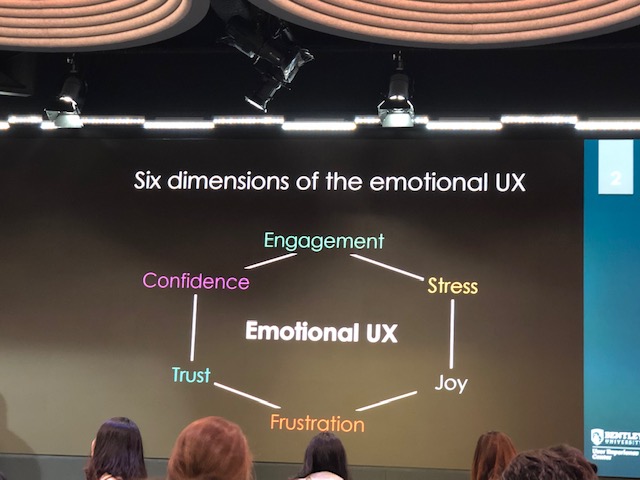
After Rachel, two more guest speakers who are from Bentley University, gave a speech about ‘A case study in measuring emotional engagement of customers using a virtual dressing room on an e-commerce website.’ They presented the research about users are most likely having the suspicious, ‘Is that really me?’ The key challenges they had were to accurately measure a potentially wide range of customer emotions, including engagement, joy, frustration, trust, surprise, and disgust. Their presentation shares the results from a case study that focused on measuring customer emotions while using different virtual dressing rooms using e-commerce websites. Biometric data from users, such as eye-tracking, facial expressions, and galvanic skin response (GSR), show a complete picture of the emotional customer experience which would otherwise be difficult to detect using analytics, market research, or traditional user research methods. This was a really interesting case study, which made me realize how widely the usability knowledge can practice in our world. 

The dimensions of the emotional UX

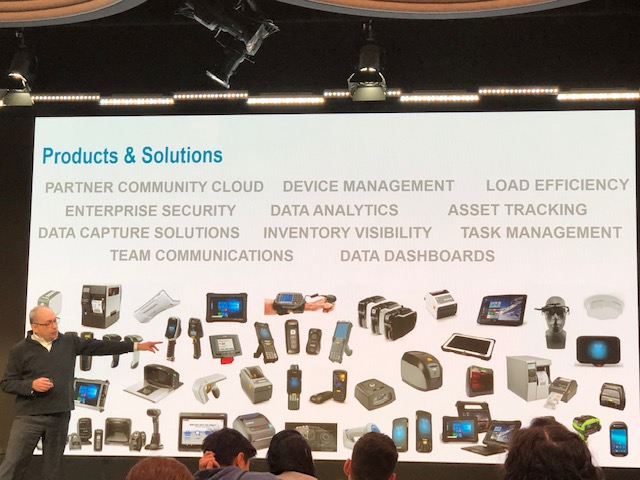
Next, we had Graham Marshall who from Zebra Technologies presents his talk about ‘Service design methodology for enterprise operations.’ He said that this methodology is often used to track the journey of a consumer through a thoughtfully designed retail environment or a citizen participating in a community service. This methodology is mainly used to analyze the dynamics of enterprise operations. At last, he stated that the practice of this methodology help to be able to communicate the interconnected complexities of the challenge and demonstrate where we might take it had been the most significant benefit of service design methodology. 

Graham was talking about the how to practice his methodology in the real world

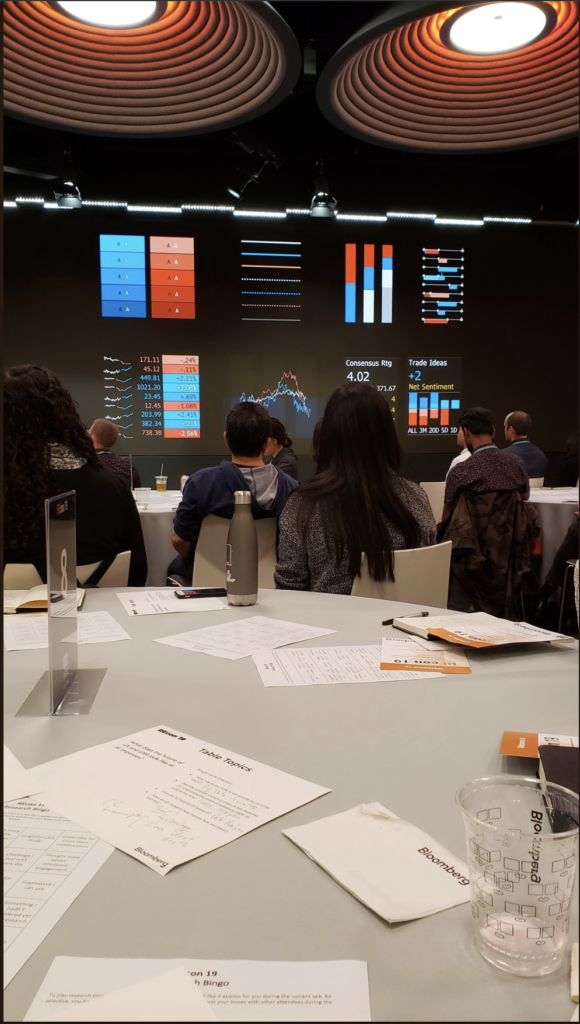
After Graham’s great speech, we had a lunch session in Bloomberg building. Staff from Bloomberg showed us around the building and the design department. Though Bloomberg is known as a finance company, the design department is more like an art corner which is full of creative decorates and structure. Bloomberg held a great lunch session, and they gave each table a topic to discuss during lunchtime to help people better interact and connect with each other. They even hand out some small games like ‘usability term bingo’ to make lunch more interesting. 

In the afternoon, the first speech was presented by two Bloomberg user experience designer, Jaris Oshiro, and Hala Shih. The topic they talked about is color accessibility. They elaborated on what they would design for color vision deficiencies in the financial industry with their Bloomberg Terminal as an example. The presentation enlightens me that UI design should consider people from different groups, such as people with color vision deficiencies. Also, it reminded me of Norman’s design thinking regarding the culture constraints that ‘ Each culture has a set of allowable actions for social situation’ (Norman, 2015). If the culture is not able to be changed, then the change should be made on design. Every industry should not discriminate against those people having an abnormal part. 

Hala Shih showed the color vision deficiencies design on Bloomberg terminal

The last speech was presented by Natalie Connors and Tiffany walker, who is a director of design and strategy department and senior UX researcher JP Morgan Chase. Their speech was the one that I can relate most since they gave the idea about how to do the essential work in UX research. They shared some case they have done with Cognitive Walkthrough, Heuristic Evaluation and Usability Testing, which are the three topics that I am learning in this semester. Moreover, they also shared the tricks when they are doing the research, they will research about clients’ behavior at first. For better future service, it’s essential to know more about their clients’ preference. From Natalie’s talking, I was thinking of Wilson says ‘ the origins of human information study is seeking behavior research’ (Wilson, 2000).

Natalie and Tiffany present what we should do in daily UX research work

In general, I had a great experience in this ‘REcon’ event. I met and talked to lots of interesting people. From the conversation with them, I realized I have a long way to go and feel like I have hidden passion in this industry. I believe what I have learned in this event would help me with my career in the future.

References:

Norman, Donald A. The Design of Everyday Things. MIT Press, 2013
Wilson, T. D. (2000). “Human Information behavior.” Informing science 3(2): 49-56

Person, Place, Thing- Dr. Rabina

Person: Iddris Sandu

Iddris Sandu is a 22-year-old architectural technologist entrepreneur paving his own way in the field of technology. Raised in South Central Los Angeles, technology always sparked his interest as a child. At the age of 8 years old, while visiting his home country of Accra, Ghana with his family, his father abandoned him in the village and returned to the States with his passport. Abandoned for almost 9 months, he was finally able to get in contact with a non-governmental organization that was able to assist him in returning back home. 

Upon his arrival back to the States the first iPhone had just been released. So inspired by the iPhone and the possibilities of what it could do, he began teaching himself every program language. For the next 2 years he spent most of his time at the Torrance Public Library, teaching himself how to code in C#, JavaScript, and Python. While checking out books in 2011, a Google designer noticed him and offered him an internship with the company. At 13 years old he was contributing to the development of Google’s social network. 

Sandu created an app for his high school that provided students with navigation directions to their classrooms at only 15 years old. The application received a great amount of notice, including President Barack Obama. Sandu was invited to the White House to meet Obama and was presented with a commendation certificate. He then wrote an algorithm that he would eventually sell to Instagram and began consulting for Snapchat by the time he was 18. At 19, he worked for his last major company, Uber, where he developed a collision detection interface for the autonomous vehicle program. After his work for Uber, he stopped working for major companies to focus on work that would impact kids that looked like him and create accessibility that would increase diversity in the field of technology. His mission since then has been to bridge the gap between the informed and uninformed. 

Sandu has also been focusing on merging hip hop culture and technology. His most notable work has been in the collaboration of the Marathon Clothing store with late rapper, Nispsey Hussle, which is also the world’s first smart store. He created the iOS app that enables visitors to unreleased music and video content by scanning the pictures on items of clothing, unlocking augmented reality experiences. The store received much acclaim from other big names in hip hop such as Kanye West, Jay-Z, and Jaden Smith and is currently collaborating on projects with them.

Place: Museum of the Moving Image

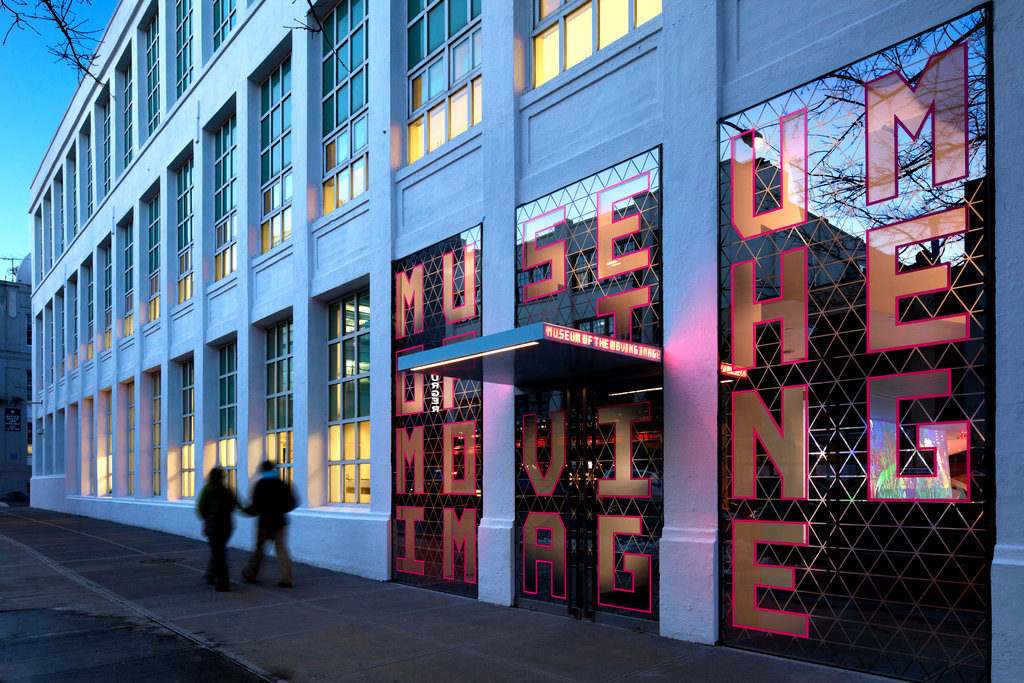
The Museum of the Moving Image is an institution which expands the appreciation and understanding of art, history, technique, and technology of film, television, and digital media. The museum collects and preserves moving-image relation artifacts while presenting exhibitions along with education and interpretive programs. The exhibits encompass notable audio and visual elements that are designed to assist the public in grasping the history of the industry and comprehension on its evolvement. 

Located in the Astoria neighborhood of Queens, New York, the institution was originally opened in 1988 as the American Museum of the Moving Image. It underwent an expansion in March of 2008 and reopened in January 2011. The museum is so remarkable due it being the country’s only museum that is devoted in the preservation and exhibition of the “moving image” in all its forms. The Museum screens more than 400 films each year, ranging from a diverse mix of classic and contemporary films. Many public panel discussions also take place at the museum such as the Pinewood Dialogues, which is a continuous series of conversations with the creative professionals in film, television, and digital media. Also maintaining the nation’s largest and extremely comprehensive collection of artifacts in relation to the moving image, the museum holds a great amount of pivotal history amounting to over 130,000 artifacts from every stage of producing, promoting and exhibiting motion pictures, television, and digital media.

The institution holds many noteworthy exhibitions each year that receive great acclaim. The Breaking Bad exhibit creates access to the props, costumes, schemes, more behind-the-scenes material that contribute to the transformation of Walter White. The Magnificent Obsessions exhibition showcases the little pieces that contribute to the bigger picture, such as set design and actor’s research. For example, the exhibit displays the notes of the production designer from Catch Me If You Can. The museum also has a theater which is one of its main attraction. Seating 267 people, it features classic films, filmmaker interviews, and live events.

Thing: Levi’s Smart Jacket

A collaboration between Google and Levi is resulting in a line of tech-infused denim jackets. The Levi’s Trucker Jacket was originally released in 2017 but now features Google’s Jacquard technology, making some notable upgrades. The tech features are installed on a now smaller Bluetooth-enabled tag that acts as a touchpad. Clipped into the jacket’s let cuff, one can control their applications by swiping on it. One is capable of setting which apps you want to function with different gestures: a swipe up, swipe down, double tap, and cover. Jacquard has also been upgraded to be compatible with more apps. Utilizing the gestures, one is able to take a selfie from their cellular device, overlook their calendar and traffic conditions, and activate Google Assistant. There is also an “Always Together” feature which alerts you if become separated from your phone while wearing the jacket. The jacket has all these tech features while being fully washable.

Unlike the original jacket, cost is significantly lower due to the Jacquard Bluetooth. The original jackets had touch-sensitive Jacquard threads weaved into the sleeve itself which made them costlier. The new and improved jackets are created normally and are then inserted with a small Jacquard fabric weave inside the cuff of the sleeve.  Initially costing $350, the cost dropped to $198 for the standard jacket, and $248 for the Sherpa Jacket, which included insulation for weather. The only difference physically between the originals and the new jackets are the left cuff being a tad stiffer due to there still being some electronics in there despite Jacquard being able to work with touch sensitive threads. 

Sources:

About. (n.d.). Retrieved from http://movingimage.us/about/.

Bell, K. (2019, September 30). Google and Levi’s introduce a new smart jacket that can answer calls and snap selfies. Retrieved from https://mashable.com/article/google-levis-jacquard-trucker-jacket/.

Bohn, D. (2019, September 30). Google’s Project Jacquard is available on new Levi’s jackets. Retrieved from https://www.theverge.com/2019/9/30/20888909/google-levi-project-jacquard-available-trucker-sherpa-jackets-price-design.

Iddris Sandu is Going to Change the World. (2019, September 24). Retrieved from https://www.surfacemag.com/articles/iddris-sandu-is-going-to-change-the-world/.

LaScala, M. (2014, August 11). Why the Museum of the Moving Image is the Coolest Museum Ever. Retrieved from https://www.cntraveler.com/galleries/2013-09-12/photos-museum-of-the-moving-image-exhibits-queens-new-york.

Museum of the Moving Image. (2019, October 15). Retrieved from https://en.wikipedia.org/wiki/Museum_of_the_Moving_Image.

Oteng, S., Oteng, S., & Oteng, S. (2018, December 23). Meet Iddris Sandu, who was once abandoned by parents’ in Ghana but now the brain behind Uber. Retrieved from https://ghnkomo.com/meet-iddris-sandu-who-was-once-abandoned-by-parents-in-ghana-but-now-the-brain-behind-uber/.

Ramalho, C. (2019, October 21). Iddris Sandu worked for Uber, Google and Kanye. Now he wants to fix tech’s diversity problem. Retrieved from https://www.wired.co.uk/article/iddris-sandu-tech-diversity.

Exploring The Explorers Club

On October 4th, the Pratt Chapter of The American Library Association organized a tour of The Explorers Club, as well as a discussion with their Archivist and Curator of Research Collections, Lacey Flint. Headquartered at 46 East 70th Street since 1964, the Club occupies the former residence of Stephen C. Clark, an interesting figure among New York museums and history in his own right, and founder of the Baseball Hall of Fame in Cooperstown. While Clark did not have a direct affiliation with The Explorers Club, his tastes in architecture and interior design have certainly shaped its surroundings.

Welcome to the Club

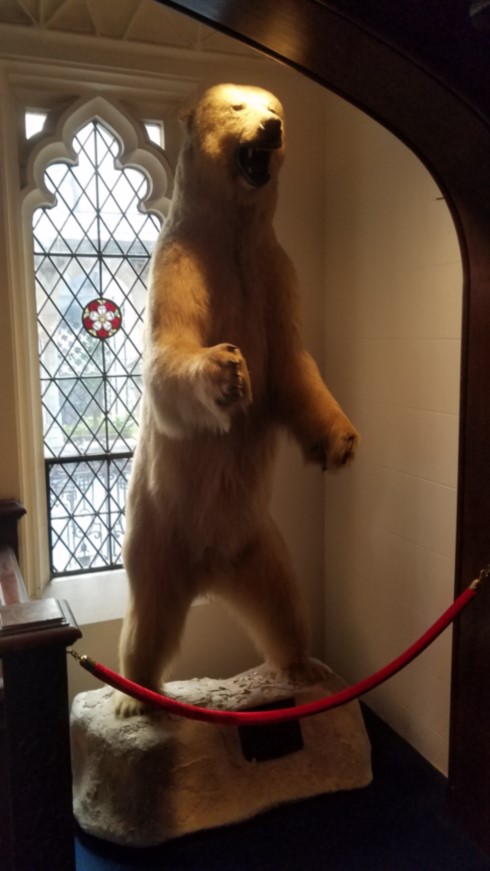
As we ascended a hundred year old staircase and made our way past the mounted Polar Bear, it was clear we had entered a very unique kind of club. Seated before Ms. Flint, in a room lined by various framed expedition flags, our group was treated to a substantial information session about the history of the organization, and her professional responsibilities. Joined at times by other staff members who offered additional insights as they were going about their duties, we also had an opportunity for some Q&A with Ms. Flint following her presentation and throughout the tour.

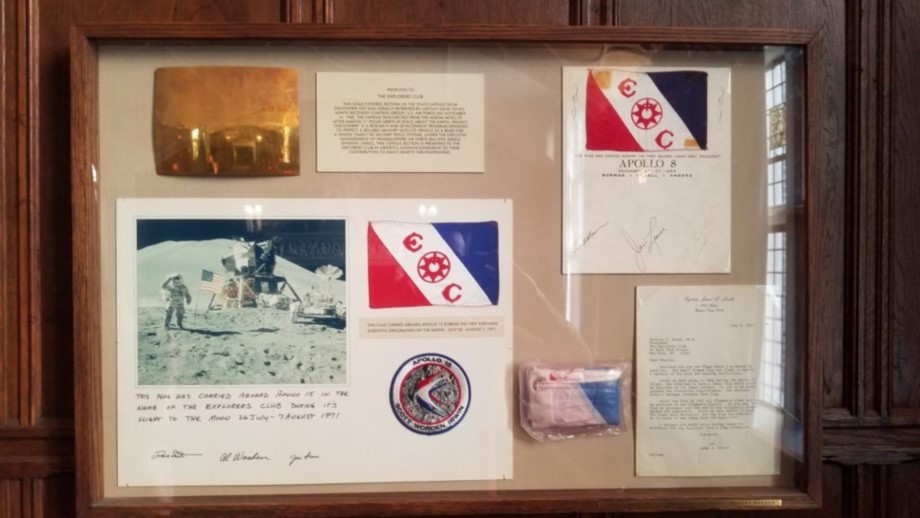
We learned that Explorers Club flags have been carried to the top of Mt. Everest, and the depths of the Marianas Trench, both the North & South Poles, as well as the surface of the Moon. Since 1918, over 200 flags have accompanied Club members on excursions all over the globe (occasionally beyond) and as I foresee myself eventually working within a museum or similar institution, one of my first questions for Ms. Flint was about the preservation of the flags and other items in her care. Despite being ensconced in the opulent trappings of Madison Avenue, the Club’s collection is curated under relatively austere means, and many of the retired and framed flags surrounding us were in need of conservation care and remounting under appropriate archival glass.

The largest lunar flag was never flown, it remains in a sealed bag from the Apollo 13 mission

Progressing into what was previously the Clark family library, we were again reminded of the Club’s constant need for generating revenue, as they were in the midst of preparing the space for a ticketed event titled Tales from Dark Places. Though the bookshelves were partially obscured by large paintings of cave scenes (and rather ominous ones at that), it was easy enough to imagine a quiet read in the shadow of the fireplace’s massive mantel. What was less easy to imagine was how the family was able to navigate the assembled volumes, as Ms. Flint revealed to us a quirk of their personal cataloging. As opposed to author, title or even year of publication, we were told the books were sorted under broad generalities such as ‘things that fly’, a description that can encompass animals, aircraft and even celestial bodies.

This intriguing classification system brought to mind Finding Augusta, particularly the idea of “similarity” and the TSP. (Cooley, 2014) Viewing the library through the lens of the traveling salesman problem, I could imagine the parallels of trying to most efficiently find your way through the seemingly haphazard collection, while trying to gauge the similarity of subject matter as understood by someone else. Just as ‘Augusta’ could simultaneously describe many disparate things to different people, so did this Clark library lend itself to unique interpretations by those using it.

Just Lion around

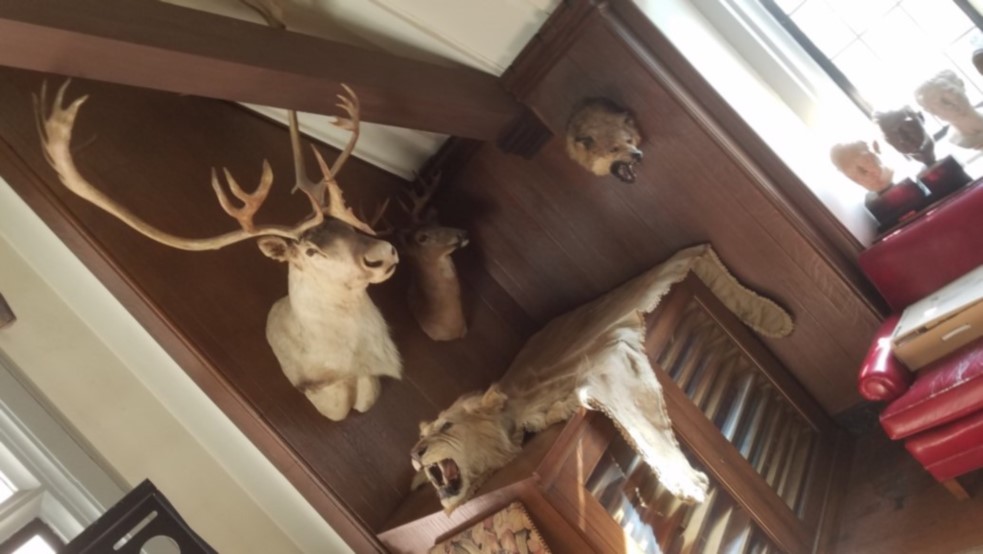
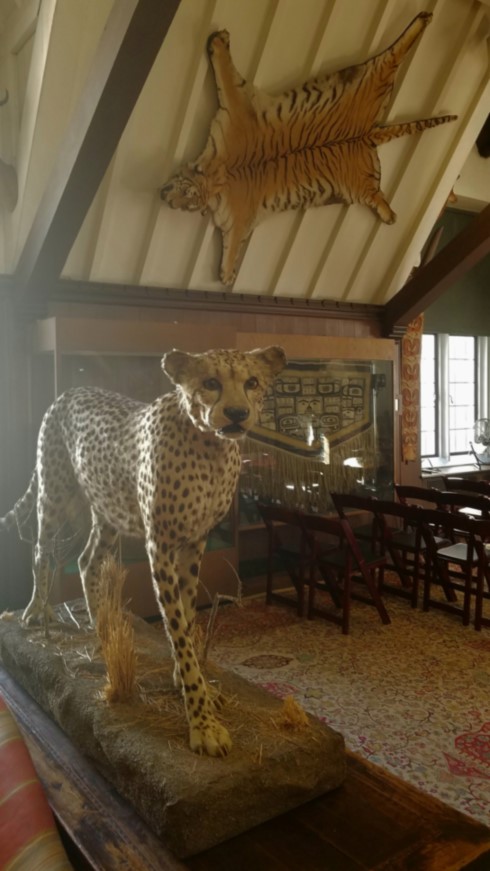
Reaching the highest level of The Explorers Club, our group became acquainted with the main showroom, and its large taxidermy collection. Despite the delicate nature of the artifacts, the room housing them is not climate controlled, nor have any countermeasures been implemented as of yet to address ultraviolet degradation from sunlight through the windows. (Though we were told the curtains are kept drawn most of the time) I had recently read “Fundamental Forms of Information” before the tour, and as we learned more about the mounted specimens, a passage immediately came to mind:

. . . structures previously associated with life recede back into their natural, inert forms. Trace information is that information that is degrading from being represented information (encoded or embodied) into being natural information only (neither encoded or embodied). Trace information includes the no-longer-used wasps’ nest, waste heaps, carrion, disintegrating ancient scrolls, and so on.

Bates (2006)
Trace Information?

Even under the best of conditions, (and sadly the Club is far from being able to provide that) these artifacts and the information they contain, can not survive forever. As Bates explains, all organized elements eventually break down into basic patterns of matter and energy, and while organic decay is unfortunate, the loss of life of these animals in the first place is no small tragedy in itself. Though Ms. Flint assured the group that the particular examples on display were the result of scientific research, and not sport hunting, it is never easy to clearly discern the motivation of previous generations, and even a commemorative plaque within the room described the assorted animals as “trophies”.

Thinking back on this risk of complacency with questionable past cultural norms brought to mind a recent reading selection from Robert Jensen. His examination of “neutrality” in GLAM fields points out the potential dangers in accepting the status quo of an institution’s practices. (Jensen, 2006) Looking back on the tour with this additional perspective, I find myself conflicted over The Explorers Club’s taxidermy collection. While the specimens may still possess historic significance and cultural relevance, is their continued display a tacit approval of all the killing necessary for them to exist in the first place?

These shadows of the past can loom large in the ornate corners of the old Clark home, but moral ambiguity was not the exclusive takeaway of the day. Despite some questionable collection priorities, the Club does maintain its dedication to exploring the natural world, and one item in particular struck me as an eloquent overlap of information and exploration.

Cheese

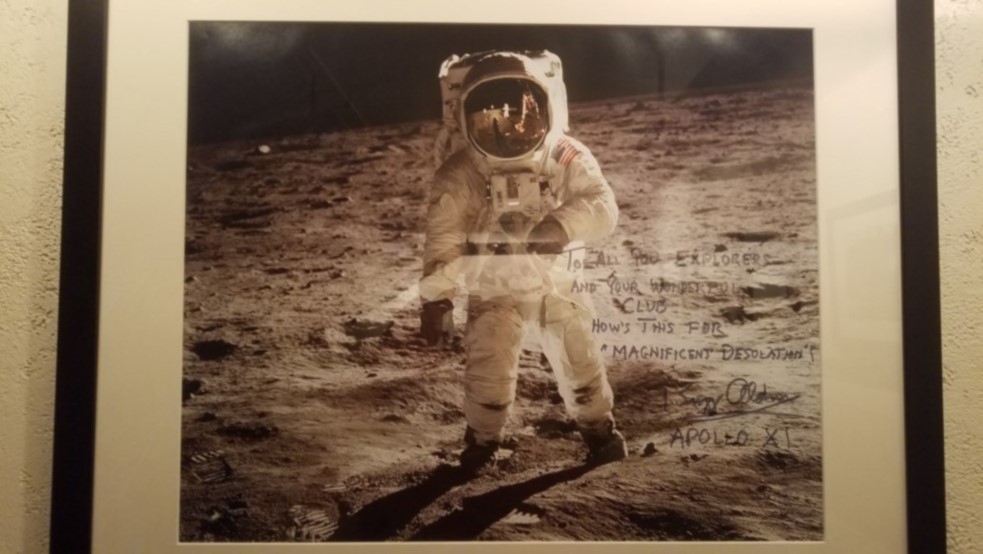
In this image, an inadvertent “selfie” of Neil Armstrong as captured in the reflection of Buzz Aldrin’s helmet, we see one of the only photographs of the first man to ever step foot on the Moon, and it was accidental! No satellite imaging, no high definition digital recording, not even a particularly captivating pose, just a man with some film in his camera snapping a photo of his coworker. Oh, and they just happen to be 200,000+ miles removed from the face of the Earth at the time. To be on the literal frontier of science, technology and human advancement, at the edge of the Abyss, and to capture it all with the click of a simple, mechanical shutter, it is a remarkable juxtaposition.

References

Bates, Marcia J. (2006). “Fundamental forms of information” Journal of the American Society for Information and Technology 57(8): 1033–1045. Retrieved from https://pages.gseis.ucla.edu/faculty/bates/articles/NatRep_info_11m_050514.html

Cooley, H. R. (2014). Finding Augusta: Habits of Mobility and Governance in the Digital Era. Retrieved from http://ebookcentral.proquest.com/lib/pratt/detail.action?docID=1524277

Jensen, Robert. (2006). “The myth of the neutral professional” in Questioning Library Neutrality, ed. A. Lewis. Library Juice, 89–96.

All photos taken by Ian Gregory 10-04-2019 at The Explorers Club https://explorers.org/

Reshaping Black Culture Through the Archives

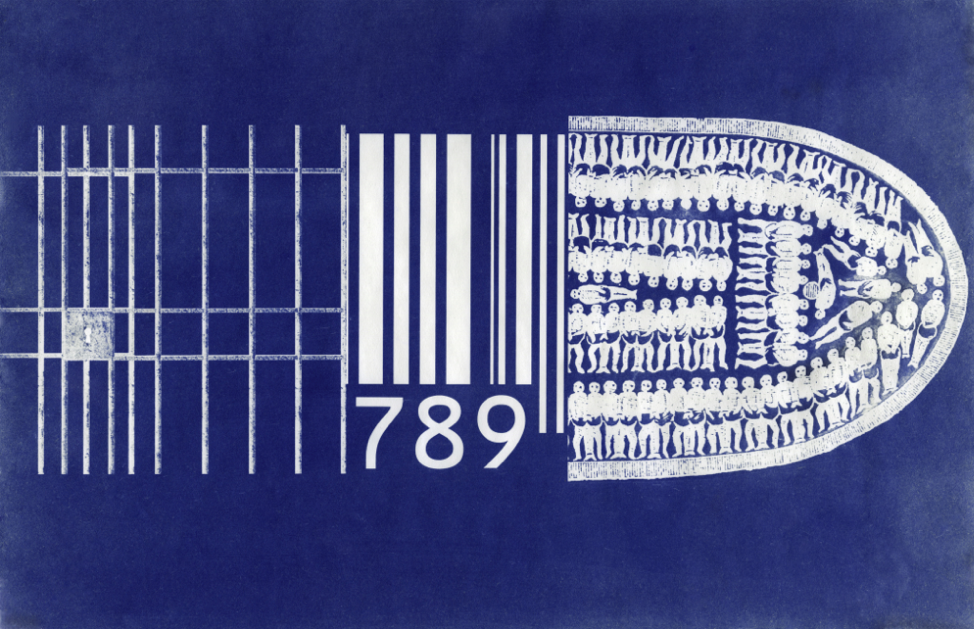
Terrie Boddie, “Prison Industrial”, 2018

On October 19, 2019 I attended the Black Portraiture[s] V:  Memory and the Archive, Past. Present. Future. Conference hosted by New York University.  I attended two panel discussions.  The first  panel I attended was entitled:  Archival Noise:  Black Women, Sonic Remains and Afterlives in Transatlantic Slavery Archives.  There were four presenters who each contributed to the panel by discussing how literature, sound, and various other forms of artistry conveyed the harsh realities of black women during and after the transatlantic slave trade.  The panel discussion was compelling, but I found there was a notable absence of the role of archives in their research.  Only one panelist, I. Augustus Durham in his presentation on “I Love “Lucy” I Think?:  The Makings of Kendrick Dinkinesh” made mention of “the archive”,  but only in passing when he said: “the artist’s (team of creatives) had a deep sense of “the archive”. (Durham, 2019).  His statement was referencing the symbolism used to create an artistic piece by the hip hop artist Kendrick Lamar.   He did not mention which archival records he was referring to, nor did he mention what archival analysis was utilized to arrive at such a conclusion.   As this was a panel of humanities scholars, this led me to believe there was a distinction being made between the “archive” and “the archives”, and I was immediately reminded of the misconception commonly held in humanities studies about “the archive”, and archival studies.

Michelle Caswell who is a writer, scholar, and archivist writes:  “For humanities scholars, “the archive” denotes a hypothetical wonderland…” (Caswell, 1).  This was implied in Durham’s statement in reference to the archive.  She goes on to state that there are two separate discussions taking place between archival studies scholars and Humanities Scholars:

“the archive” by humanities scholars and (of) archives by archival studies scholars are happening on two separate tracks in which scholars in both disciplines are largely not taking part in the same conversations, not speaking the same conceptual languages and not benefiting from each other’s insights” (Caswell 1-2).

It was very compelling to see this disconnect between the two disciplines actually taking place in academic discourse.

These separate tracks became even more evident during the second panel discussion of the day called:  “New Media, Techno, Archive, and Art.  Speakers on this panel discussed AI (Artificial Intelligence), big data, new media art, and addressed the biases embedded within these technologies.  The panelist I would like to highlight is Dorothy Berry who is an Archivist at Houghton Library at Harvard University.  Her presentation was entitled:  “Archives in the Age of Digital Reproduction:  Towards Discoverable Blackness.  In her presentation she discussed the importance of Provenance in archival study and ways it could be applied in archival preservation of the historical records of African Americans.  She stressed the importance of context in analyzing these archival records and the need for more collective description.  She then went on to discuss the embedded racism found in the Library of Congress subject headings, and why patrons of color can be more active pointing out these things for modification (Berry, 2019).

While listening to Berry I was again reminded of the power archivists have in shaping memory.  When dealing with marginalized communities whose histories and experiences have been largely misrepresented, applying  provenance, and cultivating proper context in archival preservation becomes an even more daunting task:

“The nature of the resulting “archive” thus has serious consequences for administrative accountability, citizen rights, collective memory, and historical knowledge, all of which are shaped – tacitly, subtly, sometimes unconsciously, yet profoundly – by the naturalized, largely invisible, and rarely questioned power of archives (Swartz & Cook, 4).

Berry’s presentation demonstrated the influence archivists have in shaping collective memory.  Berry also was able to convey the role racism plays (whether intentional or not) in affecting how African American archival records are archived. Berry’s presentation touched on issues of diversity emphasizing in her talk that 89 percent of archivists are white . She emphasized there was much need for community engagement (Berry, 2019).  In The Quest For Diversity in Library Staffing: From Awareness to Action, Jennifer Vinopal using the ALA’s 2007 Diversity Counts Report states:  “…a vicious cycle that the lack of diversity perpetuates: “[T]he lack of diversity in regards to race and ethnicity, age group, disability, and other dimensions…work [sic]to distance the very communities they seek to attract” (Vinopal, 2013).  This “vicious cycle” is reinforced by Berry’s call for more participation from people of color in bringing awareness to biases within the archives, specifically in the archival preservation of African American Culture. There is a sentiment within the African American Community due to the forms of racism endured such as Jim Crow, that has led African Americans to internalize the belief that they are not welcome in certain spaces.  I see this sentimentality being played out here, in reference to the lack of participation from the African American community, even in the reframing of African American culture through the archives.

As I mentioned earlier, I attended two panels each panel was very informative, and was very different from one another. The theme of the conference was memory and archive through the lens of the black experience.  The topics of discussion were about how these concepts intersect and how we can better understand, work through, and work with the power structures that govern our society in the United States and abroad.  Also, how marginalized groups can empower themselves with the use of modern technology to create, preserve, and reframe culture.  As the technological age continues to advance rapidly, we are continuously challenged to find ways to adapt.  Issues of privacy, racism, inclusivity, cultural preservation, and transparency are more important than ever.  These topics will continue to be of great concern as we continue to move forward. Through these panel discussions I was able to begin to identify themes from course discussions, and see how they manifest themselves through academic discourse.

Works cited:

Berry, D. (2019, October). Archives in the Age of Digital Reproduction:  Towards discoverable blackness.  Paper presented at the Black Portraiture[s] V Memory and the Archive Past. present. Future. NewYork University. New York, NY

Durham, A. I. (2019, October) I love “lucy’, I think?: The makings of kendrick dinkinesh.  Paper presented at the Black Portraiture[s] V Memory and the Archive Past. Present. Future. New York University. New York, NY.

Caswell, M. (2016) “The Archive” is not the archives:  Acknowledging the intellectual contributions of archival studies. Reconstruction:  Studies in contemporary culture 16(1). Retrieved from:  https://escholarship.org/uc/item/7bn4v1fk

Vinopal, J. (2013, January, 13). The quest for diversity in library staffing:  From awareness to action. In the Library with a Lead Pipe Retrieved from:  http://www.inthelibrarywiththeleadpipe.org/2016/quest-for-diversity

Schwartz, J.M., Cook,T. (2002). Archives, records, and power:  The making of modern memory. Archival Science, 2 , 1-19, Retrieved from: https://www.nyu.edu/classes/bkg/methods/schwartz.pdf

Illustration:  Boddie, T. (2018) Prison Industrial.

The Ever-Evolving Life of Archives

by Jay Rosen

I recently attended a presentation and panel discussion at this year’s Lapidus Center Conference on Enduring Slavery, hosted on October 10-12 by the Schomburg Center for Research in Black Culture at New York Public Library. The theme of this year’s conference was “Resistance, Public Memory, and Transatlantic Archives,” which I thought might connect to some of our previous discussions on archives, cultural preservation, and collective memory in the United States.

The particular session I attended was entitled, “Emerging Perspectives on Public Memory and Popular Representations of Anti-Black Violence.” The conversation was introduced by Jennifer DeClue, Assistant Professor in the Program for the Study of Women and Gender at Smith College, who also presented original research and moderated the subsequent discussion.[1] Other panelists included Dr. Tyler Perry, Assistant Professor of African American and African Diaspora Studies at University of Nevada, Las Vegas, and Dr. Allison Page, Assistant Professor of Media and Cultural Studies at Old Dominion University. Because the material presented in DeClue’s presentation was especially interesting to me, I’ve decided to focus exclusively on that here.

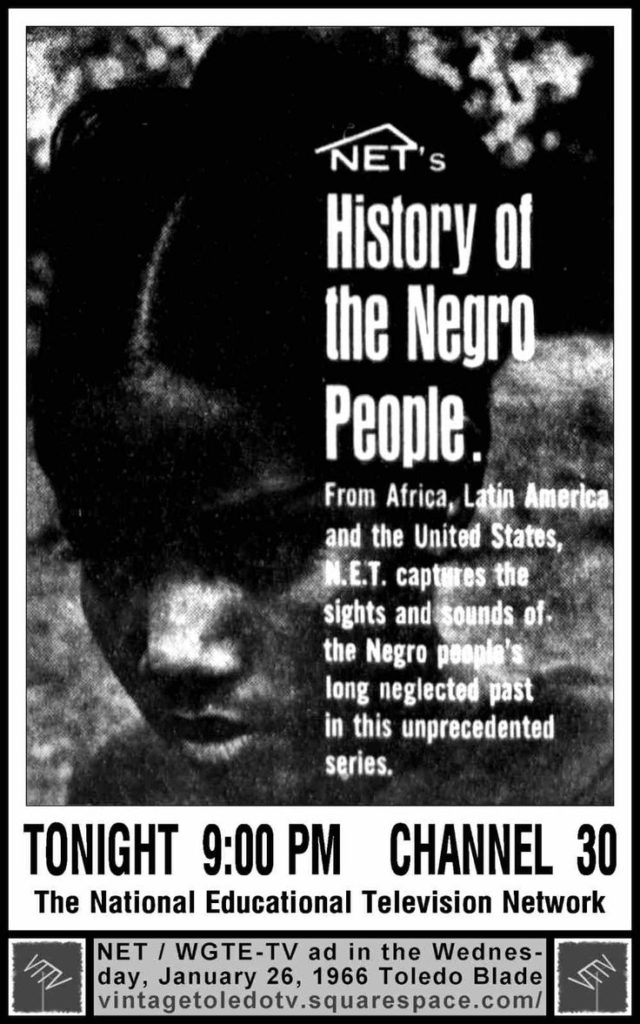
The title of DeClue’s presentation was “Staging Slavery: Public Television and the Performance of Slave Narratives.” Her discussion centered on “The History of the Negro People,” a 9-part televison series which aired on the public television network NET (now PBS) in 1965. The series explored lesser known narratives of black people in America and throughout the world, featuring episodes on ancient African civilizations, the racial history of the American south, and the experience of black people in Brazil, among other topics.

Poster for 1965 television series “History of the Negro People”

The episode discussed by DeClue is simply titled “Slavery.” Included in it are staged dramatizations of slavery that emphasize resistance; significantly, these dramatizations were based on the actual stories of enslaved people in America. The testimonies used in “Slavery” were collected as part of FDR’s Works Progress Administration (WPA) program in the 1920s. Though the WPA is mostly remembered for grand-scale public works projects like the construction of highways and buildings, it also included the Federal Writers Project, which facilitated the collection of American folklore and oral histories. As DeClue put it, a “database” of oral histories by formerly enslaved people was amassed through these efforts. The “raw material” embodied in these histories was then reanimated through the dramatic performances described by DeClue, and given a national audience through the medium of public television.

As previously mentioned, “Slavery” primarily highlighted instances of resistance to slaveholders and the institution of slavery itself. The episode included re-tellings of the stories of infamous rebels Denmark Vesey, Nat Turner, and John Brown, as well as narratives of lesser known enslaved people who dared challenge the “peculiar institution.” In chronicling American slavery through the lens of resistance and using the words of people who endured it,  the episode marks an “intervention into the dominant narrative of slavery,” shifting our public memory of slavery away from narratives of servility and complacency and towards tales of humanity and resilience.

The excerpts from “Slavery” that DeClue played for the audience highlight the potency of archives, as well as their insurrectionary potential. More specifically, they demonstrate that archives contain material that can be used to disrupt dominant understandings of history and uplift the narratives of marginalized people. As the Schwartz and Cook reading we were assigned earlier this semester suggests, archives have tremendous power in shaping our collective memory and identity, and can be used as tools to promote hegemony or resistance, depending on the materials available and the objectives of those who use them.   

At one point, DeClue mentioned that Federal Writers Project employees discovered that former slaves were less likely to be as forthcoming with white interviewers as they were with black ones. This unsurprising fact demonstrates that the archival record is anything but an unmediated collection of stories and documents. Rather, the records available to us today were shaped — implicitly and explicitly — by the people in positions to receive, create, and preserve them. As DeClue reminded us, it’s remarkable that so many powerful and subversive stories were collected by this project, given that most interviewers were white and were thus received less comfortably by black storytellers. What might this archival record look like if only black people collected these histories?

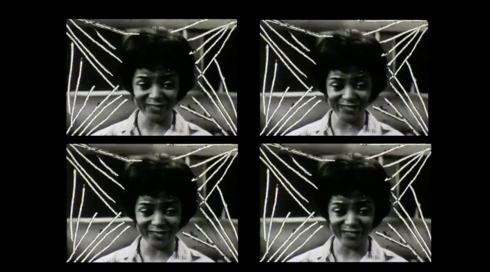
Still image from Ja’Tovia Gary’s “An Ecstatic Experience”

In closing out her presentation, Jennifer brought up the avant-garde short film An Ecstatic Experience,” created by Brooklyn-based artist and filmmaker Ja’Tovia Gary. The film repurposes footage from “Slavery,” overlaying etchings, drawings, and other markings over images from the 1965 segment. In manipulating this footage, Gary added yet another “layer” to the archive and underscored the fact that archival materials evolve over time and in response to current understandings of the issues they embody and reflect. I found it exciting (and a bit dizzying) to try and peel back the archival “layers” included in DeClue’s presentation. For one, there are the narratives collected by the Federal Writers Project — these testimonies themselves comprise a kind of “transatlantic archive,” as DeClue put it. There is then the archival repository represented in “The History of the Negro People,” now over fifty years old. From there “An Ecstatic Experience” was born, further commenting on and repurposing the “raw material” collected by the Federal Writers Project in the 1920s. Finally, there is DeClue’s own analysis of these “layers,” which has already been digitally archived on Vimeo, in addition to my own commentary on her recent discussion, now archived on WordPress. These various “layers” enliven my understanding of archival “provenance” as introduced in the Caswell reading assigned earlier this semester. They show how records and archives are far from static, but rather unfold over decades and in conversation with the past and present.

Works referenced / cited:

Bly, L., & Wooten, K. (Eds.). (2012). Make your own history: Documenting feminist and queer activism in the 21st century. Los Angeles, CA: Litwin Books.

Caswell, M. L. (2016). “’The Archive’ Is Not an Archives: On Acknowledging the Intellectual Contributions of Archival Studies.” Reconstruction, 16 (1), 1-12. Retrieved from: https://escholarship.org/uc/item/7bn4v1fk.

Schwartz, J. M., & Cook, T. (2002). Archives, records, and power: The making of modern memory. Archival Science, 2(1–2), 1–19. Retrieved from: https://doi.org/10.1007/BF02435628


[1] Side note: DeClue mentioned during her introduction that she is currently working on a book titled “Visitation: Towards a Black Feminist Avant-Garde Cinema,” which focuses on black women filmmakers who use archival documents and avant-garde filmmaking techniques to encourage different ways of perceiving black women. This project brought to mind Alana Kumbier’s article “Inventing History: The Watermelon Woman and Archive Activism.” Kumbier’s article analyzes Cheryl Dunye’s The Watermelon Woman, in which Cheryl — represented as filmmaker but also a character in the film — traces a fictional persona named Fae Richards largely in order to “create a documentary heritage for black lesbian cultural production to enable future products” (Kumbier 103). Thus, both women use archival materials and the medium of film to encourage nuanced and feminist depictions of black women.

Event in Review: NYC Media Lab Summit ‘19

Photo: Janet Liu 2019

My event in review is on the NYC Media Lab Summit that I attended on September 26, 2019. Organized by the NYC Media Lab, the summit brings together people from various industries and universities in NYC to discuss the emerging technologies of today and the future. The event was split into a morning and afternoon session that was held from 8:30 AM to 5:00 PM at the New York City College of Technology (CUNY) and NYU Tandon School of Engineering.

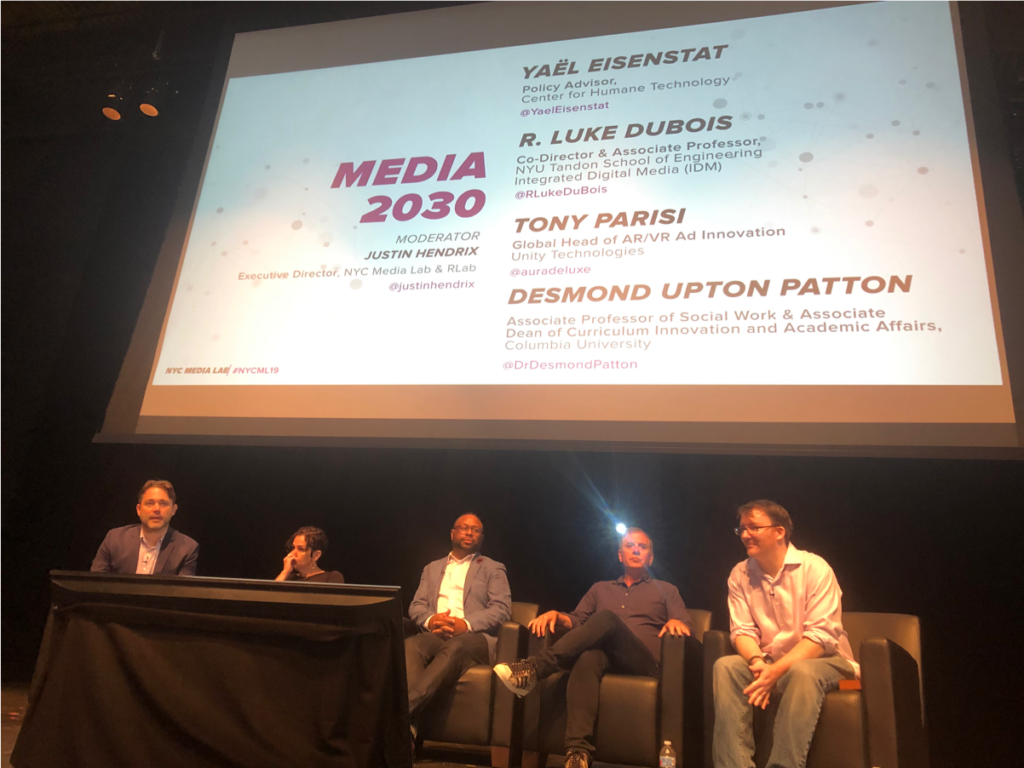
Media 2030 panel led by Justin Hendrix, Executive Director of NYC Media Lab.
Photo: Janet Liu 2019

The morning session began with an innovation panel discussing the challenges and future vision for Media 2030. The list of speakers includes Yaël Eisenstat, R. Luke Duois, Desmond Upton Patton, and Tony Parisi. It was inspiring to hear different professionals’ takes on what they thought will be the most critical challenges facing institutions in 2030. Even though the speakers come from different industries, it was surprising to hear all of their responses towards AI and algorithm bias. This made me think about Posner’s discussion on the inefficiency in having a binary mindset to make sense of the world, and how binary groupings in digital humanities projects are causing further marginalization of groups (Posner, 2016). It is concerning to learn of all of the bias we have in our society today, and how it will remain a critical challenge ten years later.

Following the panel were two keynote presentations given on AI and storytelling. The first was from Amir Baradaranand, an artificial artist and art-based researcher at Columbia University. The second was from Heidi Boisvert, CEO & Founder of futurePerfect Lab and Director of Emerging Media Technology at CUNY. It was fascinating to see AI creating immersive storytelling experiences and artworks. This made me think about Norman’s argument of machines as ‘rigid, inflexible, and fixed’ (Norman, 2018). We can see these traditional views shifting, as innovators like Baradaranand and Boisvert show us a vision where artists, creatives, and AI technologies can work together. Perhaps, as Norman imagined, humans and machines will form a complementary team and take on both a human-centered and machine-centered approach to learning.

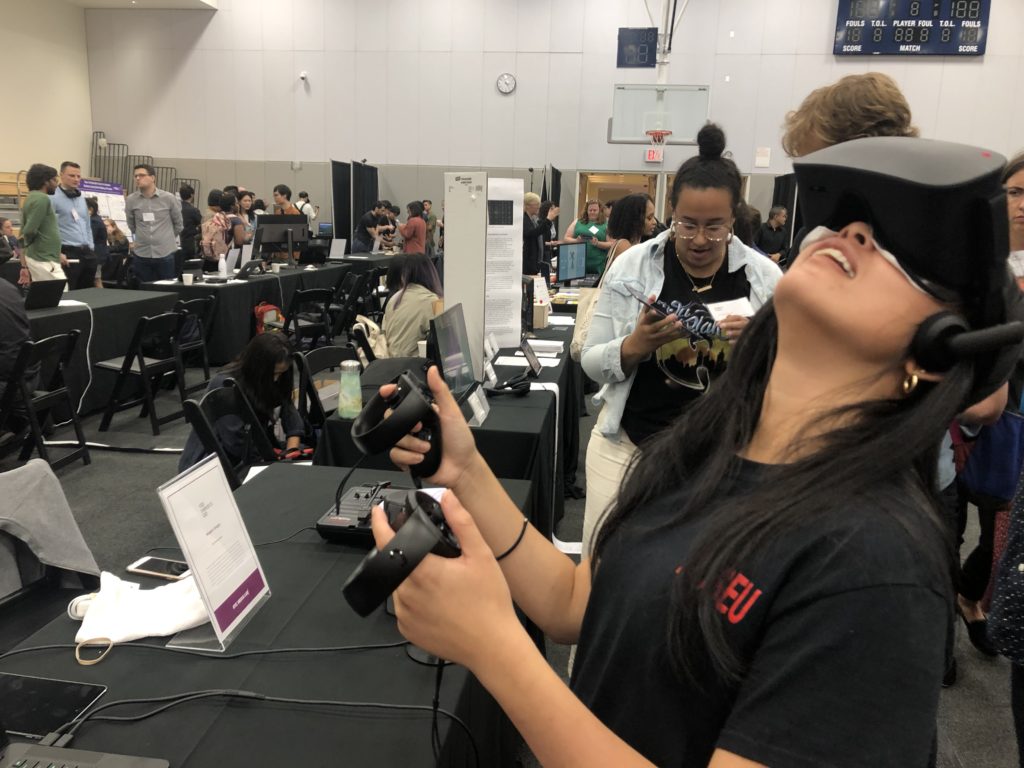
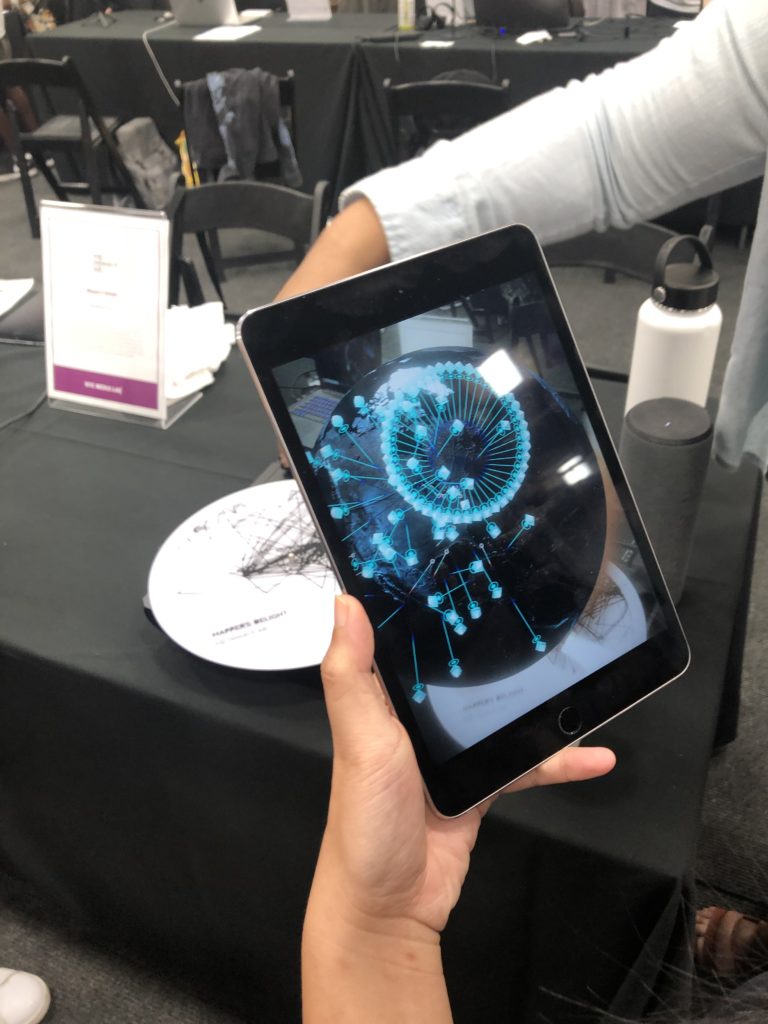
The afternoon session began with a Demo Expo that included 100 student prototypes. I was looking forward to this event the most as I wanted to see what kind of emerging technologies students were currently working on and excited about. It was immediately evident that there was a big trend in VR. I saw many VR products used for prototypes such as designing an online retail store, an immersive travel experience, and a chemical lab. One project that really stood out to me was the Hip Hop data visualization project, ‘Mapper’s Delight’ designed by Rap Research Lab. Instead of showing a list of lyrics, the lab explores the “global distances traveled by the lyrics contained in each rap artist’s career while exploring the secret flows of Hip-hop’s spacetime through a panoptic interface.” (“Mappers Delight VR,” 2017). It was cool and clever to see over 2,000 lyrics connected by geography and transformed into a virtual platform, which also brought an emotional engagement as I was able to find lyrics connecting me to Hong Kong. Projects like these make us think about new possible ways to provide meaning and context to big chunks of data.

Stuart Trafford’s workshop, “Magic Leap in the Enterprise: How Spatial Computing is Revolutionizing Education, Media, Entertainment and More.”
Photo: Janet Liu 2019.

The last part of the summit included a hands-on workshop where attendees had the choice of picking one out of the fourteen to attend. I decided to go with Magic Leap, a leading VR company presenting on extended reality, spatial computing, and how it is transforming the industries. I wanted to attend this workshop to understand why there is such a big fascination with these types of products. Stuart Trafford, the Education Lead of Magic Leap introduced its newest product called Magic Leap One, a mixed reality product that creates immersive experiences. One point that stuck with me was when Trafford said the experience of information is changing as technology has allowed these online experiences to be personalized instead of appealing to the masses. It was fascinating to see how MR products can be applied to future industries such as in hospitals and construction sites. This workshop inspired me to write my research paper on VR and understand if there will be a demand for such a product in future museums, as I still find VR products to be very gimmicky.

Overall, I was very impressed with the structure of the summit. I expected more students to attend as tickets cost a hefty $200 but students can attend for $30. I loved the order of presentations. It started with broad topics discussing the challenges and future use of emerging technologies, to the current uses demonstrated by students, and then to workshops that show specific examples of how these types of technologies are used. Also, it is important to note that the event relied on the WHOVA conference app, which allowed you to keep track of the full agenda, learn more about sessions, take notes, chat, and most importantly, sign up for workshops. Even though the app was really convenient, it made me think about the accessibility of information. How will the experience change for people who don’t have the app downloaded and can’t sign up for workshops? Will their experience be different since the event heavily relied on the app to connect with other attendees and speakers?

I appreciated how the summit not only showcased all the fancy cool products but also emphasized on the downsides and challenges technology brings. By doing so, the summit did a good job of providing transparency. One thing that really stuck to me was when Boisvert spoke of her research findings at Limbic Lab that shows how technology is rewiring our brain. As Boisvert comments, it will be important for us to take a human-centered approach to reverse the harmful effects caused by technology. This seems to be a central theme in the summit as well as our discussions from class. As Norman, and what other speakers have repeated throughout the summit, future designers and technologists will not only need training as technicians but will also need to receive training to learn what it means to be ‘human’ (Norman, 2018).

References

Mappers Delight VR. (2017). Retrieved from: https://rapresearchlab.com/#portfolioModal2.

Norman, Don A. (1998). Being Analog. Retrieved from: http://www.jnd.org/dn.mss/being_analog.html.

NYC Media Lab ’19. (n.d.). Retrieved from: https://summit.nycmedialab.org/

Posner, Miriam (2016). What’s next: The radical, unrealized potential of digial humanities. Retrieved from: http://miriamposner.com/blog/whats-next-the-radical-unrealized-potential-of-digital-humanities/.

Race After Technology

“Remember to imagine and craft the worlds you cannot live without, just as you dismantle the worlds you cannot live within”

RUHA BENJAMIN

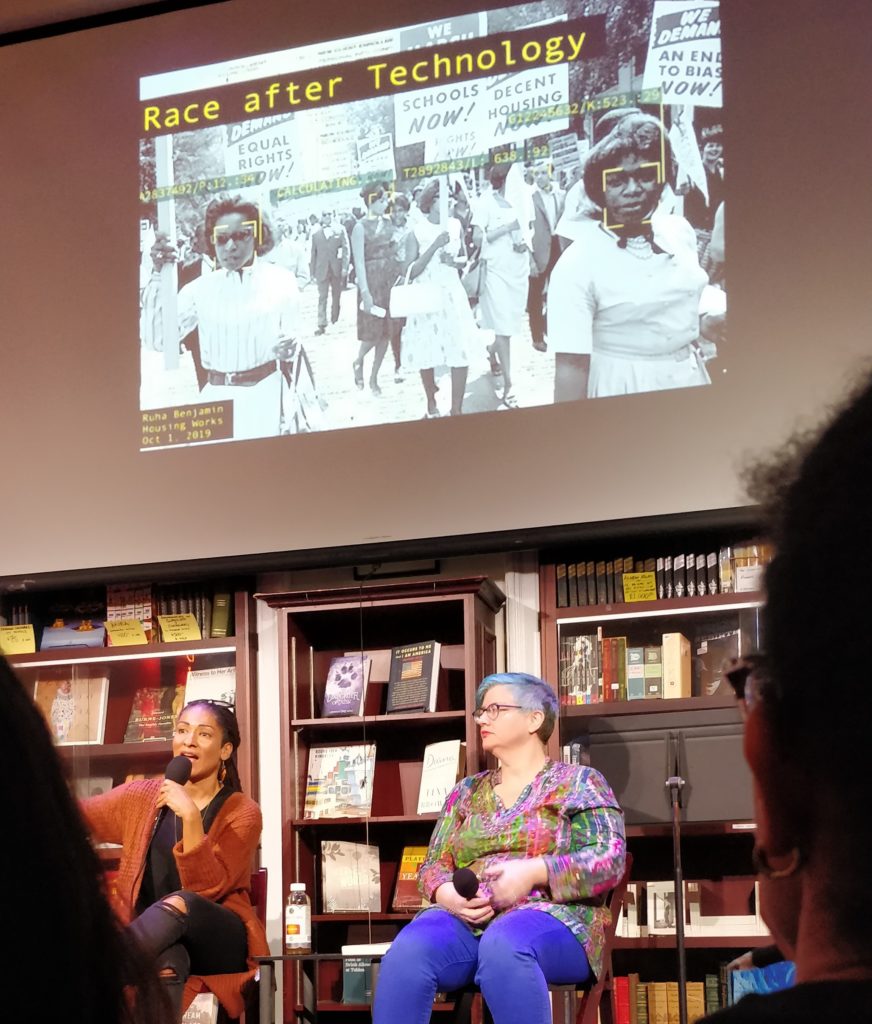
Ruha Benjamin, an Associate Professor of African American Studies at Princeton University, founder of the JUST DATA Lab, author of two books – People’s Science and Race after Technology, gave an eye-opening talk on the racist practices of technology. She began by giving a trailer of her latest book Race after Technology, moving on to provide some real-life examples of how racism in technology is exercised. She finally talks about the ‘New Jim Code’, also mentioning the various approaches undertaken in order to counter it. I was also able to identify correlations with the various readings done for the class, addressing it where relevant.

TRAILER OF THE BOOK “Race after Technology

As Ruha Benjamin gives a brief of her book Race after Technology, she brought forth her three provocations. The provocations, as she puts it, are as follows:

1.           Racism is productive or is it?

She states that racism is productive, not in the sense of being good, but in the literal capacity of racism to produce things of value to some, even as it creates havoc on others.

2.          Social inputs make some inventions appear inevitable.

According to Ruha Benjamin, when we think about how racist technology shapes us, we tend to limit this thinking to the social and ethical impacts of technology, but we fail to remember, how all this existed prior to the birth of technology. So, it’s not just the impact of technology, but the social inputs that make some inventions appear inevitable and desirable.

3.          People are forced to live in someone else’s imagination.

As Benjamin declares, imagination is not the afterthought where we have the luxury to dismiss or fantasize, but it is a resource, a battleground that involves the input and output of tech and social order. In fact, she states that most of the people are forced to live inside someone else’s imagination. In other words, racism among other axes of dominance helps produce this fragmented imagination, misery for some and monopoly for others.

EXAMPLES OF RACIST TECHNOLOGY

•           Citizen app

Ruha Benjamin continues to talk about the real-life practices of racism in technology. She gives an example of a relatively new application called Citizen. This app sends real-time crime alerts based on a curated selection of 911 calls. It also offers a way to report, live-stream and comment on a reported crime act. It shows incidents as red dots on a map so you could avoid supposedly dangerous neighborhoods. According to Ruha Benjamin, the Citizen app gave people the privilege to avoid crimes, rather than stopping it. Likewise, Citizen and other tech fixes for social problems are not simply about technology’s impact on societies, but also about how racial norms and values shape what tools are imagined necessary in the first place.

•           Racist Robots

Further, Benjamin talks about Racist Robots another apt example of how racism works in technology. There were a series of waves that seemed shocked at the idea of how artifacts can have politics. In contrast, some declared, technology inherits its creator’s biases. According to Benjamin, one of the challenges we now face is how to meaningfully differentiate technologies that are used to differentiate us. This coded bias and imagined objectivity is what she termed the ‘New Jim Code’.

THE NEW JIM CODE

Michelle Alexander’s analysis of the New Jim Code considers how the reproduction of racist forms of social controls and successive institutional forms entails a crucial sociotechnical component, that not only hides the nature of domination but allows it to penetrate every facet of social life under the guides of progress. Benjamin provides an example of a targeted ad from the mid-20th century, which entices white families to purchase a home in the particular neighborhood of Los Angeles. Developers were trying to do this by promising them beneficial restrictions, that restricted someone from selling their property to Black people or other unwanted groups. Followed by the rise of the Black Power movement, Fair housing act of 1968, that thought to protect people from housing discrimination when renting or buying a home. She states the four conceptual offspring of the ‘New Jim Code’, around which the chapters are organized. The offsprings of the New Jim Code, as she declares are:

  • Engineered inequity
  • Default discrimination
  • Coded exposure
  • Techno benevolence

There have been some strong restrictions on the New Jim Code. One of the most heartening revelations is that tech industry insiders have recently been speaking out about the most outrageous forms of corporate collusion that involves racism and militarism. She elaborates by citing an example where thousands of Google employees condemn the company’s collaborations on a pentagon program that uses Artificial Intelligence to make drone strikes more effective. This kind of informed refusal is certainly necessary as we build a movement to counter the New Jim Code. However, according to Benjamin, we can’t wait for the workers’ sympathy to sway the industry. Initiatives like Data for Black Lives and the Detroit Community Technology Project offer a more far-reaching approach, the former brings together people working in a number of agencies and organizations in a proactive approach to tech justice, especially at the policy level. One of the concrete collaborations that has grown out of Data for Black Lives was last year when several government agencies, including the police department and public support system, formed a controversial joint power agreement called Innovation Project, giving agencies broad discretions to collect and share data on young people with the goal of developing predictive tools to identify drug use in the city. There was an immediate and broad-based backlash from the community with the support of Data for Black Lives. In 2017, a group of over 20 localizations formed what they called “Stop the cradle to prison algorithm”. This coalition asks for a better process moving forward, and structural input into advancing upstream interventions. In “Finding Augusta” Heidi talks about how people are getting accustomed to Google which in return of their free service, stores your data and history in order to track users’ preferences and interests to get targeted ads, as the one mentioned previously by Benjamin.

CONCLUSION

She concludes by talking about Harvard Professor Derick’s radical assessment of reality through creative methods and racial reversals insisting “To see things as they really are……you must imagine them as what they might be”.

All in all, the talk was a great one with enlightening thoughts about technology’s racist side, something I had usually overlooked. Her thoughts were strong and to the point with solid examples to back them.