Knowledge Creation and Artist Archives: The Archivists Round Table of Metropolitan New York, A Two Part Review.

The Archivists Round Table of Metropolitan New York, Inc. is a unique professional organization, due in part to the wealth of cultural, academic, public & private institutions located in NYC that are home to professionals in the archives field. ART produces educational programs, provides support for professional development, advocates for historical preservation, and gives archivists the opportunity to network at social events. At the start of their fall season, ART hosted a two-part series revolving around art and archives pertaining to David Wojnarowicz. The first programNew Approaches to Artists’ Archives: The Artist Archives Initiative & The David Wojnarowicz Knowledge Base—was a talk given by NYU Professor and MoMA Conservator Glenn Wharton along with Special Collections Librarian Nicholas Martin at Fales Library and Special Collections, NYU Bobst. The talk was followed by a brief lecture from Hugh Ryan, curator of The Unflinching Eye: The Symbols of David Wojnarowicz, an exhibition at the Mamdouha Bobst Gallery comprised of archival material from the Fales Collection. The second programHistory Keeps Me Awake At Night: David Wojnarowicz Exhibition Tour—occurred the following week at the Whitney Museum of American Art. The tour was guided by Tara Hart, a graduate of Pratt’s MSLIS program who is currently the Archives Manager at the Whitney. The tour also featured an introduction to the Whitney and it’s facilities by the Director of Research Resources, Farris Wahbeh. I attended both of these events, including the networking and “happy hour” portions that followed.

Part I
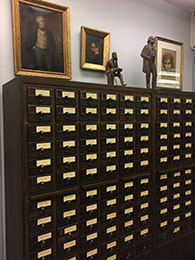
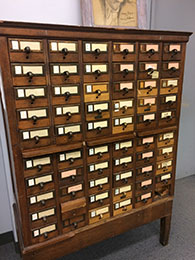
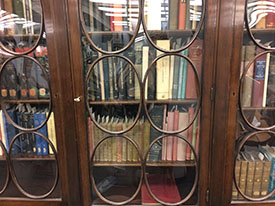
The Fales Library and Special Collections, located on the third floor of ElmerHolmes Bobst Library at NYU, is a cozy space featuring antique card file cabinets—some of the Fales Special Collections still utilizes the card catalog—and wooden bookcases with glass doors. Behind the bibliographical threshold lay the archives; notably, The Downtown Collection, which holds archival material related to the LES and SoHo art scene as it developed from the 1970s through the 1990s. Within this collection, amongst other treasures, are the David Wojnarowicz papers, ca. 1954-1992. Consisting of 128 linear feet of documents, from journals and interviews, to phone-logs, to art-objects, this collection contains the primary source materials for the topic of the discussion today, The David Wojnarowicz Knowledge Base (DWKB), the premiere project of the Artist Archives Initiative (AAI). 
The Artist Archives Initiative is an ongoing experiment in contemporary art which seeks to address a need for evolving information resources based on cooperative efforts between artists and scholars. In pursuit of this goal, the AAI produced the DWKB, not only with the artists’ papers, but by conducting interviews with artists, friends, and others who knew Wojnarowicz; inviting scholars to submit their research and writings; and by choosing MediaWiki software to build the database. MediaWiki software is open-source, allows for low-cost maintenance, provides a strong user community, and has a hierarchical menu that allows researchers to search the database “laterally” through text searches and links within articles to other pages, including more DWKB pages, outside resources, and references. 

I believe this project is an example of a strategic development in the application of archival materials towards increased accessibility, discoverability, and interdisciplinary collaboration. The next project that the AAI has underway is the Joan Jonas Knowledge Base. Joan Jonas is a performance artist who is still very active. She lives closely with her personal archive, and because of this, she can be directly involved in the development of her own Knowledge Base. The iterative aspects of performance art pose an interesting challenge for Wharton and co-creator Deena Engel; multimedia documentation and the potential for years or decades between performances of the same piece, adds an element to the project that was absent from the scope of the DWKB. Additionally, the Joan Jonas Knowledge Base will not be developed with the benefit of content from a pre-existing archive.  

In respect to the ART event itself, the talk with Glenn Wharton and Nicholas Martin was informational, conducted in conjunction with a slide presentation, and allowed for time at the end for questions. It was a pleasure to hear Hugh Ryan, the curator of the archive-based exhibition, discuss his kindred relationship with Wojnarowicz. He conveyed a deep understanding of the symbols of Wojnarowicz’ art that in part had developed through years of studying the materials on display.
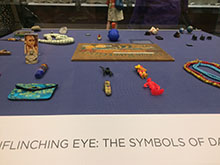
Downstairs in the Mamdouha Gallery, two tables had been prepared with concessions; wine, seltzer, fruit & cheese platters, and truffles that were handmade by the Program Coordinator, Amye McCarther. Treats were well-displayed and enjoyed by the event attendees. I made a point to discuss ART programming at-large with several professionals in attendance who gave reviews of past events along the lines of, “high-end”, and “always different, but always good.”

Part II

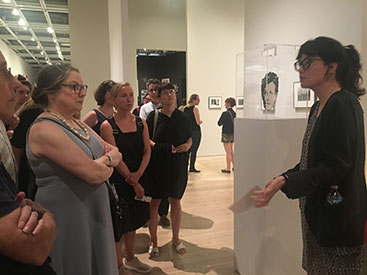
Meeting in the lobby of the Whitney, ART members and volunteers formed a group around the Director of Research Resources, Farris Wahbeh, who offered an abridged history of the museum, focusing on it’s origins and architectural provenance. Shortly after, the group followed Archives Manager Tara Hart up to the exhibition, David Wojnarowicz: History Keeps Me Awake At Night

Among the first works in sight is an archival object that Nicholas Martin would refer to as “the big loan” during one of my subsequent tours of the Fales Collection—a Rimbaud Mask circa. 1978, which may have been used in Wojnarowicz’ early photo series, Arthur Rimbaud in New York. Archival material represents a sizable portion of the work on display. To name a few examples, there is an audio recording of a 1992 reading given by Wojnarowicz at The Drawing Center; a black and white unfinished film that was borrowed from the Fales Collection; and a vitrine containing a pamphlet from the American Family Association and the annotated Affidavit for David Wojnarowicz v. American Family Association and Donald E. Wildmon. 
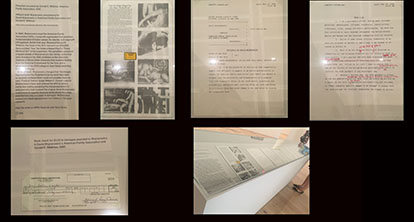
These documents, again, on loan from the Fales, are evidence of one of Wojnarowicz’ contributions to defending artists’ rights, and a sad reminder of the value that the American court placed on his art. At the end of the text accompanying the documents in the vitrine was a prompt for the viewer to engage with yet another archival component—to listen to Wojnarowicz discuss the trial and his art practice with Terry Gross in a 1990edition of Fresh Air.

It was apparent to me that collections of primary source materials were integral to the present-day curation and exhibition of David Wojnarowicz’ work. Additionally, the presentation of archival materials enabled audience members to hear the artist’s voice and to learn about the politics and realities facing Wojnarowicz and his community at the time.

After the museum, the ART group reconvened for refreshments at a nearby bar. I was able to engage in conversation with McCarther, a practicing digital archivist who once participated in a Joan Mitchell Foundation CALL pilot program in Houston. CALL, which stands for Create A Living Legacy, provides resources to the public, supports late-career artists considering organizing their professional records, studios, and archives, and educates emerging artists who share these concerns in assisting older artists. It’s clear that a program like CALL operates on the opposite end of the spectrum compared to a project like the Artist Archives Initiative. However, it was helpful to participate in industry-relevant discussions and to meet like-minded individuals.

Protecting the Power (Value) of Voices: The New University in Exile Consortium

On September 6th of 2018, I attended The New University in Exile Consortium at The New School, in Manhattan, New York. The New University of Exile website describes the program by stating that: 

“We are an expanding group of universities and colleges publicly committed to the belief that the academic community has both the responsibility and capacity to assist persecuted and endangered scholars everywhere and to protect the intellectual capital that is jeopardized when universities and scholars are under assault.”

The New School has a long history of helping refugee scholars. Starting in 1933, The New School’s first president, Alvin Johnson, created the first University of Exile. During the rise of Nazism and the increasing threat of intellectual prosecution, Johnson hired many European scholars as the Graduate Faculty of Political and Social Science. Johnson firmly believed that universities had to play a pivotal a role in protecting independent thought and research. He believed that it was a unendangered university’s responsibility to assist other universities that are under assault.

The New University in Exile has begun working again internationally with Scholar Rescue Fund, and Scholars at Risk, in the midst of new political and military attacks on scholars. In places like Turkey, Iran, India, Yemen, and Syria, universities are being weakened, shut down, and destroyed, forcing scholars to flee or face being prosecuted and jailed. The New University in Exile seeks to be a safe space for displaced scholars. The aim is to create a collaborative community in which these scholars can continue to do research and produce information. The New University has a growing membership of universities, primarily on the east coast, for now, that are joining in the fight for intellectual capital. 

During the program there was an in-depth conversation between Kati Marton, a Hungarian-American journalist, and David Miliband, the CEO of International Rescue Committee, that was mediated by the Director of The New School, T. Alexander Aleinikoff. Marton and Miliband discussed how they both where from families of refugees and how this movement was very important to them. One of the main topics that was being discussed dealt with the removal of access to information. Both Marton and Miliband feared that history is being lost with people. They described how “fake news” and social media has played a pivotal role in shaping ideas and opinions about topics ranging from refugees, political movements to advertisements. 

Marton discussed her growing fear of the relationship between media outlets and popular vote “demi-gods,” which tied directly into a conversation about the current American political position. Marton’s career as a journalist clearly amplified her worries on this subject, and she gave a clear opinion on America’s lost position as a sanctuary country. While discussing this topic, Miliband argued that we must keep recording all the facts and events to protect all voices.

Although, I agree with, and understand this sentiment, it also made me question the relationship between power, authority and context. Different poisons are going to have a different view of the value that is placed on an item over time. Value, as described by Michelle Caswell in her article, “’The Archive’ is not and an Archive: Acknowledging the Intellectual Contributions of Archival Studies,” is dependent on the way in which an item can attest to the events in which they emerged. Caswell states that “Like, ‘evidence,’ ‘value’ always exists for someone in a particular place at a particular time.” (Caswell, 2016, <p> 16) Therefore, the facts and events that are recorded today, may have different implications dependent on who saves them, how they are later represented, and who is viewing them in the future. 

I believe that the key point both Marton and Miliband were stressing though, had more to do with censorship and false media today. They were expressing a need for information access and reliability in today’s political environment in order to help save information capital. Information capital ties in very closely with ideas of information literacy. Information capital is the theory that agues that information has value. It alludes that sharing information is a means of sharing power. Although, the word value in this theory holds a similar meaning to the value that archivist Caswell mentions, I think there should be a distinction. Value as placed in the Information Capital theory places the importance on how information forms power, rather than how power is chosen in a material. It is important to note that The New University in Exile is working within the western tradition of knowledge. The power to make a record, to name, preserve, mediate, and access, (Schwartz & Cook, 2002, pp.5) is being placed in the hands of scholars and organizations. This does not however, change the importance stressed by Marton, Milibrand, and The New University in Exile, that the ability to have a chance to create information is powerful in its own right and should be a human right. 

At the end of the program we also heard from two scholars, that are currently working within the New University of Exile, describe their plight. Cem Ozatalay and Mohammat AlAhmad are professors that have fled their home countries and have begun teaching in America with the help of The New University in Exile, Scholar Rescue Fund and Scholars at Risk. Hearing these professors talk about the prosecution they faced and the struggles they endured to come to America was very moving. They talked about facing prison time for their thoughts and ideas and how they had to smuggle their families across borders to escape. Through these programs, these scholars were able to continue researching, learning and teaching. 

The New University in Exile is clearly making a stand that stresses the importance of creation and dissemination of information. The university as a mode of expressing and sharing ideas has been a long standing tradition in the western world. The act of a political power silencing voices, and the need to protect them, overrides my concerns about future value placed on the information produced by the voices, at this time. I, like Marton, and Miliband, believe that the most important thing right now is to create, so at least sometime in the future, there will be a possibility of both sides of history being present. 

Important websites for more information on this topic:

https://newuniversityinexileconsortium.org

http://www.scholarrescuefund.org

https://www.scholarsatrisk.org

References:

AlAhmad, M., Aleinikoff, A., Fanton, J., Mack, A., Marton, K., Miliband, D., Ozatalay, C., Van Zandt, D. (2018, September). The New University in Exile Consortium, The New School, New York. 

Caswell, M. (2016). “‘The Archive’ Is not an archives: On acknowledging the intellectual contributions of archival studies.” Reconstruction: Studies in contemporary culture, 16. Retrieved from https://esscholarship.org/uc/item/7bn4v1fk

Schwartz, J., & Cook, T. (2002). “Archives, records and power: The making of modern memory.” Archival Science, 2, pp. 1-19. 

Engaging Shared Heritage @ NYPL

Wednesday Sept 26 I attended the talk at NYPL on ‘Engaging Shared Heritage.’ Academics from around the world shared with each other the projects they are working on and the challenges they face. The panel on “Preserving Cultural Heritage” shared the different types of preservation work they were engaged in. The following panel, “Engaging through Research and Dissemination,” discussed how they connect their work to other cultural heritage institutions and to the larger public. Instead of briefly touching on each person who spoke, I am going to focus on the panelists whose research most aligned with my interests and what we are studying in Foundations of Information.


Challenges to Preservation

Dr. Annie Sartre-Fauriat explained the destruction of historic sites such as the Temple of Bel and Palmyra and the loss of artifacts because of the civil war in Syria is irrecoverable. The proposition Sartre-Fauriat made was to reconstruct the damaged heritage sites from a variety of different periods. She warned against what she called “a Disney style approach” but contested that since Syria has had such a diverse history that the reconstruction shouldn’t look like any one particular era. She explained they do have enough archival resources to create a deep reading of these sites’ histories, but she admits that they while they have unlimited ideas and potential, everything else they need is non-existent. Currently Russian mercenaries are in control of the area and people are quiet freely looting the world heritage sites. She said that at the moment there is virtually no control and no ability to organize any sort of enforcement.

Father Samer Yohanna, a priest from Salahaddin University-Erbil in Iraq, explained the lack of trust that exists at all levels of society in Iraq. He said that between fellow countrymen, neighboring countries, and Westerners there are few areas where large swaths of society can work together. They have had to move their collections 5 times and at the moment they are not disclosing their location to anyone outside of the organization. He stressed the need in Iraq for places of community that give people incentive to see their history as shared, and work to preserve it.  

Father Yohanna also stressed the danger of working with artifacts in the modern Iraqi political climate. This is something that I partly dealt with in my undergraduate thesis, so I was eager to hear his perspective. There is intense pressure for different societal groups to prove their place in Iraq’s history, and against influences that have come in from the West. Yohanna explains ownership of artifacts and control of the narratives that surround them is a volatile issue that makes doing archival work very dangerous in Iraq.

The perspectives represented at this event were a reminder that free unfettered access to information in the context of a civil society might provide healthy debate, but could serve as fodder for violence in an area with few formal avenues to scholarly interpretation. This reflects what we read in the Dabello article, albeit in a different context, about traditional expertise not being able to play the role as gatekeeper as it once did in the face of an active public (Dabello, 2009). Our ability to create a publicly shaped identity I think directly relates to the amount of trust society has in each other and our institutions. When asked about opening up the their online platforms to community input Yohanna and Stewart (mentioned below) said they both have a moderated comment section that often provides insight, but with an undereducated public and a turbulent political climate, maintained that primary interpretation should remain in control of those with library and archive expertise. Respect for expertise and the potential power of crowdsourced information is a tension that continues to come up in this course.


Digitizing Responsibly  

The next panelist, Columbus Stewart, was a Benedictine monk from a monastery I am very familiar with back in Minnesota. He works with Hill Museum Manuscript and Library (HMML). Their mission starting out was to protect Benedictine manuscripts in Eastern Europe directly after WWII. Since then they have expanded to preserving Muslim and Christian manuscripts across the Middle East. HMML began preserving manuscripts in Syria before the civil war broke out. One of his primary points was that we must do preservation work preemptively, especially for things as fragile as manuscripts, because it is often impossible to predict where conflict will break out. He cites their work in Mosul just before the civil war as evidence. Thus far they have digitized 40,000 manuscripts. From their website (https://www.vhmml.org) people can then export their own data sets. The only barrier to access they put up is the creation of a free account to access the images and the export function; people can access the index information without an account.

The key to their success has been working with local communities. He explained the general consensus that Americans find a way to monetize everything they touch. Distrust is something they always face, but their position as monks he said actually helps convince people they are not there to turn a profit. By working with locals they are able to gain a richer understanding of the texts. As a result the metadata that locals generate is far more accurate than what they would produce on their own. Drabinski illustrated this same point with the anecdote about the term “Kafir” in Zambian context (Drabinski, 2013). When digitizing any material we would be repeating past colonial mistakes if we continue to attest that description can be done neutrally. Father Stewart’s team takes this role very seriously. They train and pay locals to take photographs of manuscripts, teach them how to work with the data sets. This results in the spreading of expertise as well as the creation of rich digital databases.  


Archives and Peace

In the next panel, Vincent Lemire introduced us to Open Jerusalem which is trying to index as many archives as possible in Jerusalem and across the Middle East. Some of his points reflected what we have been discussing in class. For example he explained that with archives, unlike books, the producer is not the author and the contents of the archive is always composed of diverse material. They must find a way to describe the archive deeply while also applying a standardization that can be searchable in a database. Also because of the location and history of Israel, they are working with materials written in many different languages and described in different languages still during their various stages of provenance. For this reason they only focus on making the indexes digital, not the actual material.

Lemire explained that it is very difficult to have any mutual basis when inferences from the records lead opposing sides to drastically different conclusions. How they have overcome this, to an extent, is to start at the most basic irrefutable positions such as “this material is a book, it is written in Arabic, it is on such and such type of paper,” and build from there. He sees this as a practical, project-based form of peacemaking. While uninspired by the effects that formal peace talks have had on the region, Lemire argues that having to get through an insurmountable amount of archives forces people to develop a working relationship even if they still deeply disagree. McChesney stressed in “Digital Disconnect,” the importance of having public spaces in order for democratic civil society to flourish (McChesney, 2013). Panelists Yohanna and Lemire both echoed McChesney’s sentiment with the calls for spaces, such as a reading rooms, for people to be able to benefit from materials and develop a local concept of community.


Works Cited

Caswell, M. L. (2016). ‘The Archive’ is Not An Archives. Reconstruction 16(1).

Dalbello, M. (2009). Digital Cultural Heritage: Concepts, Projects, and Emerging Constructions of Heritage. Proceedings of the Libraries in the Digital Age (LIDA) conference, 25-30.

Drabinski, E, (2013). Queering the Catalog: Queer Theory and the Politics of Correction. The Library Quarterly: Information, Community, Policy, 83(2). pp 94-111.

McChesney, R. (2013) Digital Disconnect. New York, NY: The New Press.


Event information and feature image credit can be found at:  https://www.nypl.org/events/programs/2018/09/26/engaging-shared-heritage

Open Access in the Screening of “Paywall: The Business of Scholarship”


On Thursday, September 20th, I went to the NYU Cantor Film Center to watch the screening of the new documentary film Paywall: The Business of Scholarship directed by Jason Schmitt, a communications and media scholar at Clarkson University, New York. Paywall is a 65-minute film which seems to advocate for the need of open access (OA) practices that lack in the academic publishing industry focused on research and science. The documentary weaves two overarching inquiries: it examines the 35-40% profit margin associated particularly with Elsevier and other top academic publishers and compares this with the incomes of the most profitable tech companies like Apple, Facebook, and Google. The film also questions the high financial costs of subscription-based academic journals and how scholarship and innovation in general is affected by these costs when scholars, students, and researchers hit paywalls that deny them access to the most updated research.

The format of Paywall is presented through sequenced interviews of a wide range of scholars, publishers, and OA advocates from across the world. One of the key issues that strucked me of the interviews is when I learned that most scientific research is publicly funded by government agencies or universities, and yet this research is locked behind expensive paywalls and kept from access to the general public. It was also surprising to see why the academic publishing industry is extremely profitable. John Adler, a professor of neurosurgery at Standford University who appeared early on in the film, said “publishing is so profitable because workers do not get paid.” He referred to workers as the people who create the products for academic journals – authors and reviewers. This brings to question how come writers do not get paid for their services and how is this business model sustainable for them?

While the documentary do not delve into the perspectives of authors and scholars who provide their labor to academic journals, it examines the way top publishers have sustained their business model in the market. They have made themselves indispensable to their clients, in this case universities, with a set of policies that allow them to be excessively profitable. Some interviewees in the film including library professionals, explain that universities are required to keep in confidentiality the costs they pay for subscription-based academic journals. In this way, publishers can charge any rate to each university without revealing their different charging practices with other schools, which prevents others to compete against them. Universities also lack the power to decide which journals they should buy or should not because they need all the latest scholarship work that is controlled by legacy publishers such as Elsevier, Wiley, Springer Nature, and Sage.

These issues with control and power over information exerted by top publishers brought me back to Robert McChesney’s ideas in Digital Disconnect: How Capitalism is Turning the Internet Against Democracy when he discusses the political economy of communication (PEC). The author explains that the PEC examines the institutions, market structures, support mechanisms, and labor practices that define a media or communication system, and determines whether those practices are conducive or not to democratic values. For instance, McChesney analizes the case with Microsoft which has become a proprietary software company indispensable to society. The reading states that “Microsoft has been able to exploit the dependence of a wide range software applications on its underlying operating system in order to lock in its system permanently, allowing it to enjoy long-term monopoly-pricing power. Any competitor seeking to introduce a new rival operating system, faces an enormous ‘applications barrier to entry’ ” (p. 73). This business model of dependency and monopoly aligns with they way academic journals have also employ their power with paywalls. A model that interferes with the progression of a modern democracy.

Schmitt’s film also addresses the negative consequences of paywalls to broader societal issues. Two medical doctors from Nepal and Nigeria who participated in the interviews testified the experiences of students in their countries with subscription-based journals. They mentioned that paywalls deny students access to the latest literature and this prevents the professional development of students and contributions to their field to happen. This exclusion is due in part for the high costs of paywalls that do not correspond with the inequities of the currency of countries from the developing world. Therefore, this is harmful not only for them and researchers from the developing world, but also for scholarship itself. A vital aspect of scholarship is innovation and this flourishes when a great diversity of people and knowledges contribute to it.

Although most Paywall’s interviewees seemed to support the idea that society would be better if scholarly articles are distributed in an open access world, the documentary do not explore adequately the challenges that OA publishing would face – the costs and risks associated with it. Additionally, the film does not address the reasons why scholars choose to sign away their rights to their scholarly work to commercial publishers, instead of making their papers freely available to their academic institutions. This question is brought up in Siva Vaidhyanathan’s article Critical Information Studies: A Bibliographic Manifesto which states that academics frequently “overreact to perceived ‘threats’ that someone is teaching ‘their’ course or relying too heavily on ‘their’ data.” Vaidhyanathan also mentions that “[t]oo often, academic leaders forget their ethical duty to the community of scholars and world citizens at large. Their rabidly protect their ‘intellectual property’ to the detriment of the scholarly world (an the species) as a whole…” (p. 26). These issues helped me to be more aware of the complexities that scholarship work entails.

After watching the screening, there was a discussion among the audience mediated by NYU librarian April Hathcock. She started the conversation by asking us if this making-money business mindset belongs in to academic scholarship? Rather than providing answers in the room, there were more questions from the audience regarding advocacy, research efficiency, inclusivity, copyrights, commerce, quality, and innovation. A NYU PhD student referred the example of Sci-Hub, which was featured in the film, as a tool that helps him to find academic papers more easily and faster than the academic journals he is able to access through his university. He suggested that Sci-Hub’s website is more user-friendly and seamless. It was interesting to hear this perspective from a student who has the privilege to access to the most updated information in research from top subscription-based journals. His comment left me with questions regarding deficiencies of the website development and interface design of academic journals.

References

Paywall: The Business of Scholarship. Retrieved September 27, 2018, from https://paywallthemovie.com

McChesney, R. W. (2013). Digital Disconnect: How Capitalism is Turning the Internet Against Democracy (pp. 64-66, 73). New York: The New Press.

Vaidhyanathan, S. (2005). Critical Information Studies: A Bibliographic Manifesto (p. 26).

Non-relational Databases: Two Case Studies and their Potential for Collection Management Application

On September 18 Seth Kaufman, founder of Whirl-i-Gig, presented at the Code4Lib NYC meetup at the Metro offices. He demonstrated the Whirl-i-Gig projects ePandda and Inquisite which make use of non-relational database structures to store and access research data .

Kaufman began his presentation by explaining that relational databases have been the dominant structure for commercial databases since the 1970s, but they have limitations for certain applications.  Kaufman walked the audience through the process behind Whirl-i-Gig team’s development of two non-relational databases that were able to meet his clients’ research-centered needs in ways that relational databases could not.

Kaufman explained that document-oriented databases are based on the notion of a document rather than on joined records as in a relational database. With document-oriented databases, each document is “schema-less”. There are no pre-defined fields, every field can have multiple values, and there are no relationships or joins. According to Kaufman, the advantages of document-oriented databases are that they are fast, flexible, scalable, and are easily integrated with programming languages. For these reasons, Whirl-i-Gig decided to use a document-oriented database for a solution they eventually called ePandda (enhancing Paleontological and Neontological Data Discovery API).

Whirl-i-Gig built ePandda to meet the needs of paleontological researchers at Yale who needed to observe patterns taken from multiple data sets that span geological epochs. The ePandda API made existing paleontology databases interoperable in order to query across enormous data sets. Through ePandda’s http-based query language ElasticSearch, researchers could examine questions such as “When did brachiopods die?” which would lead to their developing theories about climate change more broadly.

Whirl-i-Gig’s other non-relational database project, Inquisite, uses a graph structure. It was developed to analyze data for NYU’s NewYorkScapes project. NewYorkScapes is a project that studies the history of urban cultures in New York City and makes collected data discoverable for research. In Kaufman’s own words, the role of Inquisite in the project is to “streamline the formation of open research communities and foster the acquisition, preservation, dissemination and reuse of research data.”

Inquisite uses a graph structure, a non-relational database format that has been around for decades but has seen a resurgence in recent years. Graph databases use nodes (entities) and edges (expressions of two related nodes) to create structure. In graph databases, the relationships themselves contain data which results in a simpler data model that is faster to query. Relational databases, on the other hand, rely on key structures to represent relationships. As the depth of these relationships increases, query performance can be slowed.

Inquisite makes use of graph databases’ simple structure and fast query ability to enable  project participants to use their mobile devices to gather and upload data (audio, video, and images). Inquisite then visualizes these create community-generated data sets as graphs, timelines and maps.

Kaufman’s presentation demonstrated innovative ways that academic research data can be expressed and accessed through non-relational databases. I was left wondering how these principles might apply to other content areas. I was particularly curious to know more about the potential of non-relational databases in collection management software for cultural heritage institutions.

Whirl-i-Gig is the creator of the open source collection management database CollectiveAccess which is used by dozens of art organizations, libraries and museums. I reached out to Kaufman to ask about the Whirl-i-Gig team’s choice of structure for CollectiveAccess and his perspective on the role of non-relational databases in collection management software generally.

Kaufman explained that CollectiveAccess is a typical relational database built with SQL. In his opinion, a document-oriented structure is not well-suited for collections databases. The main reason for this is their lack of structured relationships  which are necessary to represent collection content.

Kaufman considers Graph databases to be more promising for collection management software. The developers at Whirl-i-Gig considered a graph structure for the next major version of CollectiveAccess. Kaufman is confident that graph structures would function well for this purpose.

Though Kaufman describes query processing speed as one of the main reasons non-relational databases were chosen for Inquisite and ePandda, I wonder if it is graph database’s query intuitiveness that may be the greatest advantage for collection management databases for cultural heritage institutions. For example, the widely used collection management database TMS (Gallery Systems’s The Museum Systems) is a SQL-based relational database that has a non-intuitive query interface that requires specific training to understand. A collection management system built in the graph model might feel more natural for users to query because the relational structure itself is built using a syntax that more closely resembles the language people use to ask questions verbally.

An analogy of navigational instructions given to a driver can illustrate this concept. Relational databases are the equivalent of giving a driver a map. The driver needs to look at the map and understand how to orient themselves and then figure out for themselves which path they need to follow. A graph database is like giving the driver step by step directions, for example, “turn right at the next intersection and your destination is the third building on your left.” The argument for the efficiency of graph databases is that the query is more streamlined. Less time is wasted in an interface that needs to interpret the user’s query and then if the query was not possible, to re-interpret the result back to the user.

Despite the potential of graph databases to more effectively produce queries, Kaufman doesn’t expect to see graph databases used widely for collections because of the IT support required to implement and maintain them. Kaufman went on to explain that graph databases tend not to be well understood by IT professionals. Most cultural heritage institutions are not likely to allocate the resources required for the more extensive IT support. In his opinion, the familiarity and ease of relational databases for developers will likely cause them to remain the most prevalent database structure for collection management software for the foreseeable future.

References

Kaufman, Seth. 2018, September 18. Managing research data with non-relational databases.

Sasaki, Bryce Merkl. 2018, August 15. Graph Databases for Beginners: Why a Database Query Language Matters (More Than You Think). Retrieved from https://neo4j.com/blog/why-database-query-language-matters/.


Power in New Pedagogies at MoMA PS1’s Art Book Fair

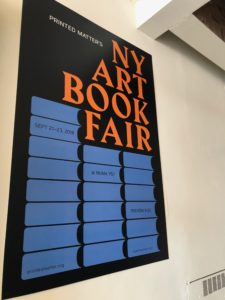
Across the board, I think it’s safe to say museums and other cultural institutions are working towards rectifying their troubling pasts and working towards a more inclusive future. Some museums are doing better than others in regards to seeing this goal into fruition. My visit to MoMA PS1’s Art Book Fair last weekend was a shining example of how museums can correctly and creatively invite underrepresented groups into their space to tell their stories. Two groups at the show,We the News  and Manufactoriel, really stood out to me as both engaged with issues of identity and place- the first through zines and social activism, and the latter through reimagining spaces through photography.

Lizania telling my friends and I about her work!

We the News

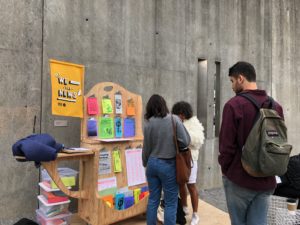
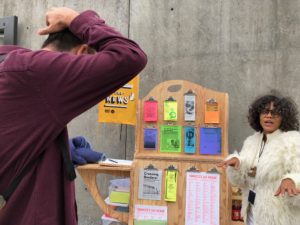
Lizania Cruz was the first artist I spoke to at the fair. I was drawn to the large prints that read “Go Home Yankees” in bright pink across a stark white background. Lizania’s booth was filled with provocative signage calling out white supremacy and colonialism in history as well as its lasting effects on the community here in Brooklyn. She said she’s very interested in exploring the Black Diaspora, the worldwide community of descendants from Africa. I picked up a zine titled “Navigating Nuances of Diasporic Blackness: Tensions within the Black Community” or “Navegando por los matices de la negritud diásporica tensiones dentro de la communidad negra”. Almost all of her publications are available in English and Spanish, which speaks to the intentional intercultural inclusivity within the black community. It’s also worth noting that these zines are typically free and distributed around the Bed-Stuy neighborhood by the We the News collective. In fact zines are a very important form of publications in the field of social activism. Scholar Anna Polleti articulates why the zine tradition is a critical example of disrupting what she describes as mainstream methods of story telling:

“Through the production of independent publications, zine culture seeks to erode the predominance of mainstream and commercial interests in particular cultural activities. The zine community is a form of alternative media, a subculture of story telling and knowledge sharing…” (Polleti 184).


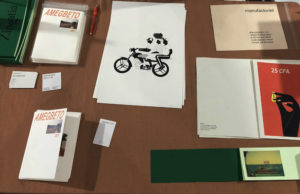
Artists Books from Manufactoriel- “Amegbeto” can be see on the left and Salwat’s book “Zingatia” on the right.

Manufactoriel

Manufactoriel is a “research proposition in African and Black Contemeporary visual culture, art, and style” (Manufactoriel 2018). I was able to speak with Salwat, an artist in the collective about the work on their table. Each art book responded to themes like the consequences of colonialism and identity politics. One book “Amegbeto”, which means “the one who refused” in Tongan, documents a bi-racial artist’s experience meeting her Tongan family for the first time. My favorite book on the table was created by Salwat herself. She is conducting academic research on a museum in Zanzibar that houses a collection important to Swahili maritime culture, yet the museum is in ruins as a result of decolonization. The museum has no funding and the records and objects left behind are falling apart and forgotten. After she received her master’s degree, Salwat created a book artists book to document the museum’s state of disrepair including some images of the galleries but many blank pages to symbolize the absence or lack of information and care given to the collections.

All in all, the Art Book Fair was not just a space for artists and independent publishers to present their work; it is also a space for underrepresented community’s to share their narratives in a public platform. This is especially important when thinking about the lack of representation topics like the black diasporic experience, or the consequences of colonialism have in major institutions. In a book of essays titled “As radical, as mother, as salad, as shelter: What should art institutions do now” edited by Paper Monument, seeks to address the looming question of how we rectify museums as problematic institutions in the current political environment. The book is formatted in a series of questions and author responses, my favorite question is “Can an art institution go from being an object of critique to a site for organizing? How?” The answers vary. Some think museums should “decentralize the art object and emphasize the process” (Basha 6) others are less optimistic that this change will occur describing efforts made by major institutions as “lip service”.  Although I am often wary of museums efforts to be more inclusive, I think MoMA PS1 is doing a great job. Hosting this type of event, outside of the gallery space, creates a different type of information environment that gives vendors like Lizania and Salwat to tell their stories. Not to say that museums are obsolete, or that curated collections are unimportant, but I only mean to suggest that in exploring alternative forms of art consumption through art books, zines, and free events, MoMA PS1 had the opportunity to engage with a larger community. Currently museums are in what feels like the beginning stages of recognizing and rectifying difficult realizations about the foundations and funding surrounding institutions, the next steps to making change are more difficult to identify. But perhaps in thinking outside of the typical pedagogical playbook of what museums have been and should be, we can create spaces that are more creative, thoughtful, and inclusive.

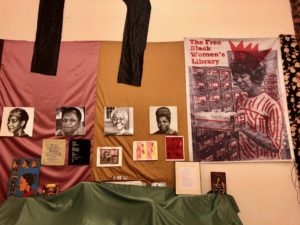
“The Black Women’s Free Library”
One set of the many cool posters plastered around the walls of the outdoor area.

References

About. (n.d.). Retrieved September 26, 2018, frmo https://www.manufactoriel.com/about-manufactoriel

Basha, R. (2018) As radical, as mother, as salad, as shelter: What should art institutions do now? Brooklyn, NY: Paper Monument

Liu, M. (2017, March 22). We The News. Retrieved from

We The News

Poletti, A. (2005). Self-Publishing in the Global and Local: Situating Life Writing in Zines. Biography,28(1), 183-192. doi:10.1353/bio.2005.0035