Event Review: Braiding Strands of Wellbeing: Reclaiming, Healing, and Sending Knowledge into the Future

In her talk, Braiding Strands of Wellbeing: Reclaiming, Healing, and Sending Knowledge into the Future, Dr. Sonya Atalay discussed anthropologists and archaeologists can and incorporate the local and indigenous populations’ cultural practices of sharing and preserving knowledge into their studies of these cultures. An anthropologist and Ojibwe (the Native American tribe also known as the Chippewa) keeper of knowledge, Dr. Atalay has conducted anthropology and archaeology research within indigenous populations in North America as well as the Middle East. Her work, including her books Community-Based Archaeology: Research With, By, and for Indigenous and Local Communities and Transforming Archaeology: Activist Practices and Prospects, has been focused on the development and implementation of participatory research, seeking to decolonize the language and practices used by non-indigenous researchers as well as justice for communities through the collection of indigenous artifacts. Dr. Atalay is currently working on her book, Braiding Knowledge, an ethnographic review of these projects and other engaged scholarship of indigenous communities to how collaborative knowledge production are transforming research practices and outcomes. Many of her concepts are similar to practices found in the Ethics of Fieldwork by the Program for Ethnographic Research & Community Studies, expanded and adapted to the fields of Anthropology and Archaeology.

The main example used in her talk was the ezhibiigaadek asin, which translates to “the place where knowledge is written on stone”, a Saginaw Chippewa heritage site archaeologists refer to as the Sanilac Petroglyphs.The carvings on the rock face represent history of the tribe as well as instruction on how to send its knowledge into the future. A sacred site, with important physical and cultural links to the surrounding area, cultural practices involve water art ceremonies where tribal elders bring river water to wet the carvings and share the histories and practices represented. The researchers working on the site, to protect the site for their own purposes, had covered the rock face with a pavilion and installed a fence to prevent erosion and vandalism of the carvings. Gated and only available to the public upon request of a scheduled visit the indigenous community could not access the site or conduct the water art ceremonies.

A place of knowledge for both tribe members and anthropologists, the difference in approach to accessibility and use of the physical site indicates the divide in perspective each group holds about the information the site contains and how to it should be studied. Not only did researchers not take into account the indigenous people’s desires for how the site is utilized but also the outcome and application of the research. A source of contention was the misinterpretation of one petroglyph archaeologists dubbed the hunter. The carving actually depicts shkabewis, a spiritual teacher sending information and knowledge into the future. Not only had the researchers misinterpreted its meaning, fitting the colonial narrative of Native Americans as hunters rather than purveyors of knowledge and information, the University of Michigan had copyrighted the image of the carving and used it in branding. they  as well as the the physical site, the information and knowledge it contains
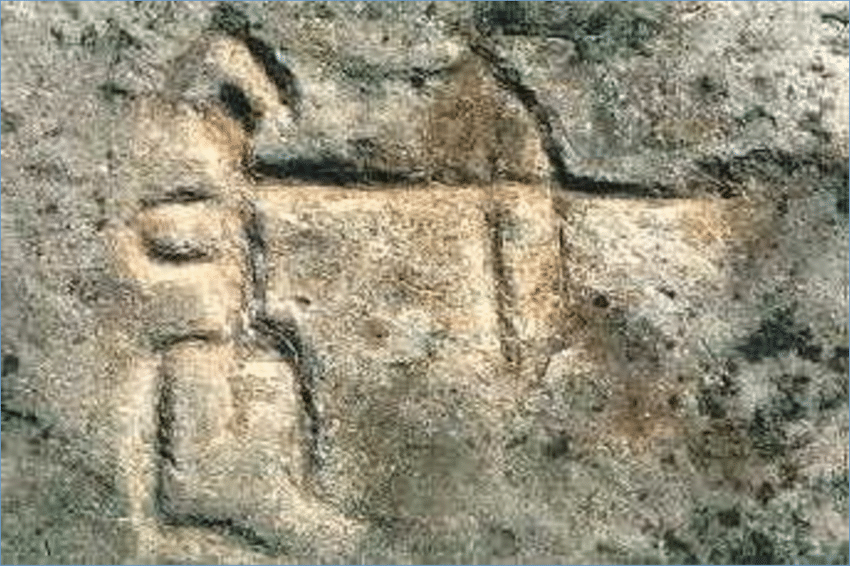
An image of the shkabewis carving taken from Dr. Atay’s Braiding Strands of Wellbeing: Reclaiming, Healing, and Sending Knowledge into the Future.

When the researchers began consulting the Ojibwe leaders, it resulted in a shift in practices, results and use of their work. By addressing some of the concerns PERC in the such as establishing a rapport with the participating group, learning indigenous knowledge needs and desires of application of the research and the representing the participants in a recognizable and respectful way. The Saginaw Chippewa gained more consistent access to the ezhibiigaadek asin as well as influence over the conduction and results of the fieldwork. The archaeologists gained a more accurate representation of the petroglyphs and people that created them.   

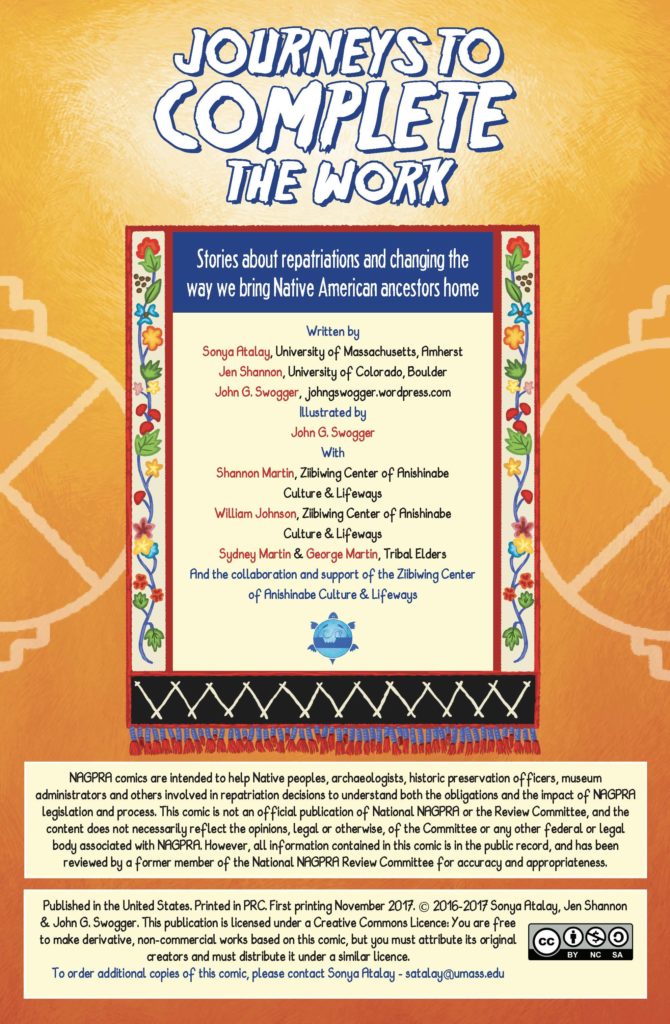
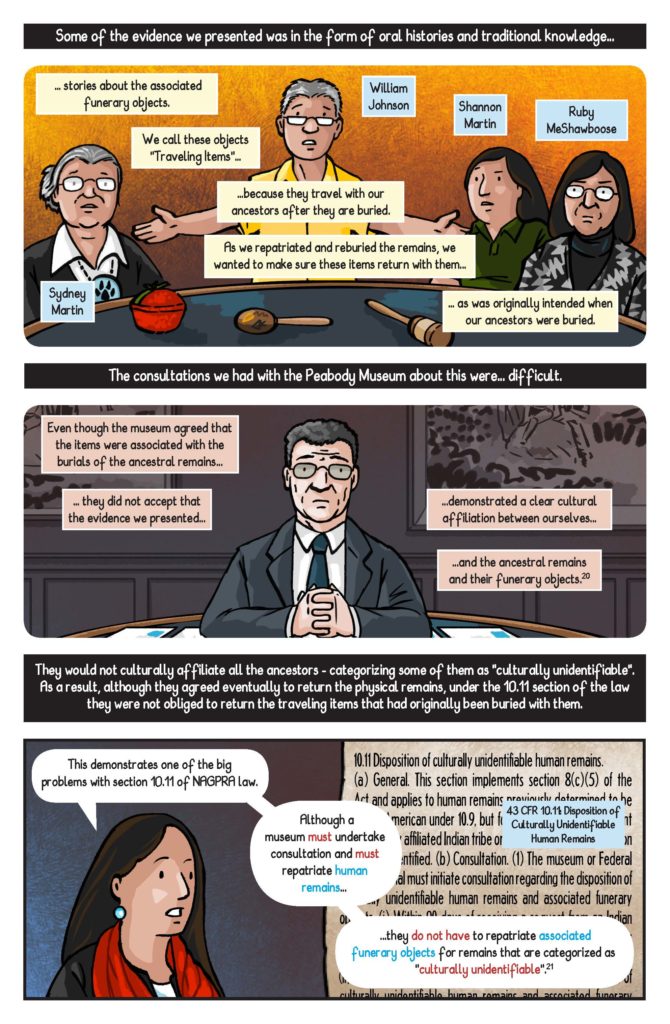
Dr. Atalay presented the ethnographic comic “Journeys to Complete the Work: Stories about Repatriations and Changing the Way We Bring Native American Ancestors Home (NAGPRA Comics: A Graphic Narrative)” she co-authored with John G. Swogger, and Jen Shannon, in collaboration with Shannon Martin and William Johnson of the Ziibiwing Center of Anishinabe Culture & Lifeways, and Tribal elders Sydney Martin & George Martin. The comic details the effort of anthropologists and tribal leaders to have the remains of Native American peoples, held by several museums, returned to their ancestors for proper burial on the basis of the Native American Graves Protection and Reparations Act. This comic, along with others Dr. Atalay has produced on similar topics, is a novel way for Ethnographers to share their research practices and results with the populations they study and the general public.
Dr. Atalay’s talk was an enlightening look at how ethical fieldwork in ethnographic studies, including the concerns outlined in the PERC document, can be practically applied to a variety of fields of study.

References:

PERCS: The Program for Ethnographic Research & Community Studies, The Ethics of Fieldwork

Atalay, S., Shannon, J., Swogger, J., (2017) Journeys to Complete the Work: Stories about Repatriations and Changing the Way We Bring Native American Ancestors Home (NAGPRA Comics: A Graphic Narrative) 
Event: Why No One is Looking at Your data


Department heads painstakingly compile reports and analyses filled with data which are sent to executives every week. The pages are barely skimmed, if read at all. Network and security operation centers line the walls with giant screens, displaying dashboards powered by expensive big data analytics. No one ever takes more than a passing glance on the way to lunch. If data is so essential, why is it so easily ignored? Many data initiatives fail to make a real impact.”

On April 10, 2019 I attended “Why No One is Looking at Your Data”, an event hosted by Meetup featuring Clare Gollnick, the Director of Data Science at NS1. Clare Gollnick started her career as a Neuroscientist and holds a PhD from Georgia Tech and a BS from UC Berkeley. As an expert on statistical inference and machine learning, she writes and speaks often on the intersection of data, philosophy, and entrepreneurship. She was previously Chief Technology Officer of Terbium Labs, where she led a diverse team of engineers and researchers. The team released novel data intelligence solutions which prevents credit card fraud while still protecting consumer privacy. Clare has published a number of academic papers on information processing within neural networks, validation of new statistical methods and the philosophy of science.

The presentation was focused on the difference between data and information, designing data dashboards and data products and “Why No One is Looking at your Data”.

Clare starts off her presentation with the scene from Douglas Adams’ novel series, The Hitchhiker’s Guide to the Galaxy to demonstrate how difficult it is to understand data without any context. In short, a race of hyper-intelligent, pan-dimensional beings had built an enormous supercomputer named Deep Thought, which calculated over a period of 7.5 million years to answer the meaning of: life, the universe, and everything. After 7.5 million years of calculation, the pan-dimensional people gathered eagerly to watch Deep Thought finally announce the answer they have been waiting for.

Scene from Douglas Adams’ novel series, The Hitchhiker’s Guide to the Galaxy.

The answer was “42”. But what does “42” mean? Data can mean absolutely nothing if you do not provide it with context.  

Practical suggestions were provided from the presentation such as choosing initiatives for investments, and providing valuable data to deliver useful and interpretable information. To understand the personal mental logic process while looking at data, Clare provided a demonstration and suggestions on how to make inferences.

The first and most obvious suggestion was to add units to the data. Using “42” as a random piece of data, adding kilogram (kg) to 42 would make 42 into 42kg. A kilogram is a SI unit of mass, an international standard, which scientists have based their definition of the fundamental unit of mass on a a shining platinum iridium cylinder stored in a locked vault in France. However, most people have not seen this cylinder, and they would be considered non- experts. Yet they are able to develop a concept of what a kilogram means by having shared experiences with other items labeled kilogram throughout their life. For example, people at the gym might have a concept of a kilogram based on the weights they would use for a specific workout done in the past. This method can be applied with any form of information, and can be built upon as well. “Cat” was then added to 42kg, further explaining the mental logic in understanding the context of 42 kg while visualizing a 42 kg cat. Claire further explains that a person with knowledge about cats (an expert) might visualize a larger cat, such as a leopard.

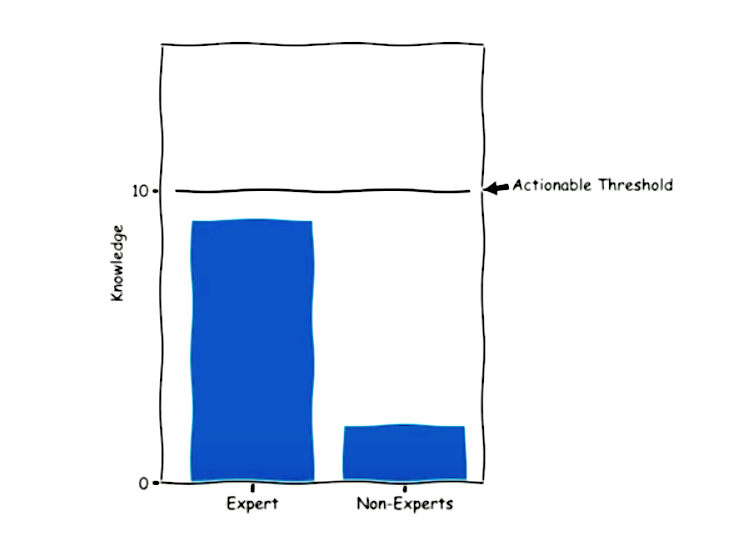
Segmenting the market or the audience into experts and non-experts may be the result of a single piece of data. An expert would be someone who has a solid understanding of the given information, whereas an non-expert would have considerably less knowledge.

Summary Statistics Inform Only Experts

Data results from the mental model might be different given the knowledge gap between the expert and non-expert. Experts use data more effectively, and therefore reach a “threshold” in which something is actionable. Given a single piece of data, the expert crosses that threshold and catapults into another stratosphere of other questions and other types of issues they might want to know about the data. Meanwhile, non-experts are unable to obtain the minimum knowledge required to alter their action. An expert with more familiarity of the subject might ask for the raw data because they know what to do with it, whereas the non-expert would be clueless. Clare emphasized that this dynamic creates challenges for those trying to design a product. The goal of a product should deliver repeatable and scalable value with consistent outcomes across the entire target market. When you end up in this middle ground, you are stuck with a wall of data which is not viewed or seen. Experts find data at the source while others attempt to interpret information on the dashboard.

Data Does Not Speak For Itself

The presentation take away was the difficulty in making sense of data when it does not speak for itself. This belief is addressed in Boyd and Crawford’s article, Critical Questions for Big Data: Provocations for a Cultural, Technological, and Scholarly Phenomenon”. Where Big Data provides ‘destabilizing amounts of knowledge and information that lack the regulating force of philosophy’ (Berry 2011). To understand data, there needs to be context. As mentioned in the the article Critical Data Studies: An Introduction by Andrew Iliadis and Federica Russo, data is apprehended through various levels of informational abstraction (Floridi, 2011). Big data is framed within levels of informational abstraction, where the product of positionalities constrain and afford a gateway into multiple data roles including abstraction which may be adopted, manipulated, or repurposed for any number of aims. This is a crucial part of giving sense to data. Choosing a level of abstraction from which to view Big Data alters the types of conversations that can be had about data, its aims, and functions (Iliadis, Russo 2016).

Conclusion

When you fail to recognize that data is difficult to understand, you can wind up with mismatched expectations between what is promised and delivered within a data project. Overall, the main suggestion was the need for inferences, or making a comparison to existing knowledge. Data can only inform once you already know something. You need knowledge to gain knowledge.

References:

Berry, D. (2011) ‘The computational turn: thinking about the digital humanities’, Culture Machine, vol. 12, [Online] Available at: http://www.culturemachine.net/index.php/cm/article/view/440/470 (11 July 2011).

Danah Boyd & Kate Crawford (2012): Critical Questions For Big Data, Information, Communication & Society, 15:5, 662-679 http://dx.doi.org/10.1080/1369118X.2012.678878

Floridi, L (2011) The Philosophy of Information, Oxford: Oxford University Press. https://doi.org/10.1111/1467-9973.00221

Gollnick, C. (2019, April 10). Why No One is Looking at Your Data. Lecture presented at Meetup: UX+Data, New York.

Iliadis, A., & Russo, F. (2016). Critical data studies: An introduction. Big Data & Society. https://doi.org/10.1177/2053951716674238