Event Review: The Evolution of the Black Queer Archive

On Thursday, October 17th, I attended several panels for the three-day conference Black Portraiture[s] V: Memory and the Archive Past. Present. Future. The stated purpose of the conference was to “explore the making of visual archives, the narratives they tell, and the parameters that define them as objects of study.” I listened to presentations and discussions about the particular difficulties of archiving when it comes to the records and materials of populations that have been historically oppressed, marginalized, and excluded from official archives.

I was especially interested in the panel I went to titled “Representation Matters — The Evolving Black LGBTQ Archive,” featuring speakers Jennifer DeVere Brody, Thomas Allen Harris, and Steven Fullwood, with moderator Katina Parker. All black, queer professionals with backgrounds in the arts, their particular experiences and expertises lent to a vibrant discussion about intersectionality and the importance of identity in archiving.
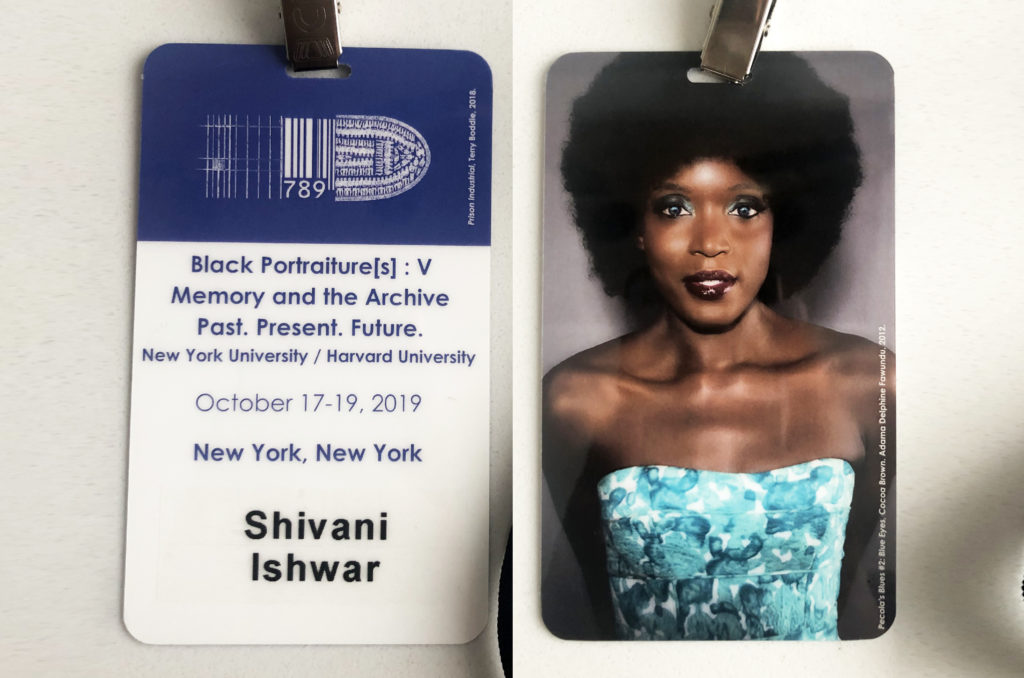
Identification badge with event information and logo on one side and a photograph of a black woman taken by Adama Delphine Fawundu on the other side.
The identification badge allowing access to Black Portraiture[s] V: Memory and the Archive Past. Present. Future. Photo taken by Shivani Ishwar. The photo on the back of the ID badge is “Pecola’s Blues #2: Blue Eyes, Cocoa Brown,” taken by Adama Delphine Fawundu in 2012.

Throughout their presentations, the speakers each emphasized the importance of maintaining a personal archive. When belonging to a community that has been suppressed from the “official” archive, especially when that community is a doubly-disadvantaged one like the black queer community, personal and “informal” archives are often the only way to preserve information about those communities. Something as simple as a family photo album can be a valuable resource in learning about the history of black queer people and communities, because when no one else is invested in the preservation and retelling of black queer stories, people in that community have to take charge of that preservation themselves.

The speakers presented many different examples of the way black queer people have been erased or understated in official histories: like Edmonia Lewis, a 19th-century sculptor brought up during Brody’s talk, “Out of the Future: A Black Queer-Femme Archive.” Lewis’ well-known aversion to dresses and probable affairs with women lead many to label her as a queer figure; but Wikipedia calls no attention to her preferred style of clothing, and simply describes her as having “never married.”

History is rife with these sorts of discrepancies, situations in which people’s identities aren’t fully acknowledged by formal archives. For people at the intersection of multiple marginalized identities—in this case race, sexuality, and sometimes gender—often the narrative prioritizes one identity over another. One might be a black historical figure, or a queer one, but rarely both. It’s in situations like these, Harris argued, that personal archives are most important. His presentation, “Queering the Family Album,” discussed how personal archives can be a powerful tool for families to better understand their pasts.

In black households in the U.S., Harris noted, homophobia and transphobia are common sentiments. But many family photo albums contain evidence of queer ancestors: an aunt who dressed like a man, a cousin in drag, a great-uncle who never married. These stories are suppressed on one level, but the physical evidence of a photograph is difficult to refute. In this way, personal, informal archives can provide an important link between the present generation and past ones; and, by extension, between future generations and the current one.

Harris’ discussion of the intersection of black and queer identity reminded me strongly of Sasha Costanza-Chock’s article “Design Justice” (2018). The importance of intersectionality is discussed in depth in Costanza-Chock’s article, where they argue that especially for people whose identities are marginalized on multiple levels, like those of race, gender, and sexuality, it’s important to recognize all of those identities as interlocking parts of the person. Without acknowledging the way that different identities interact with each other, one is left with an incomplete picture of an individual.  
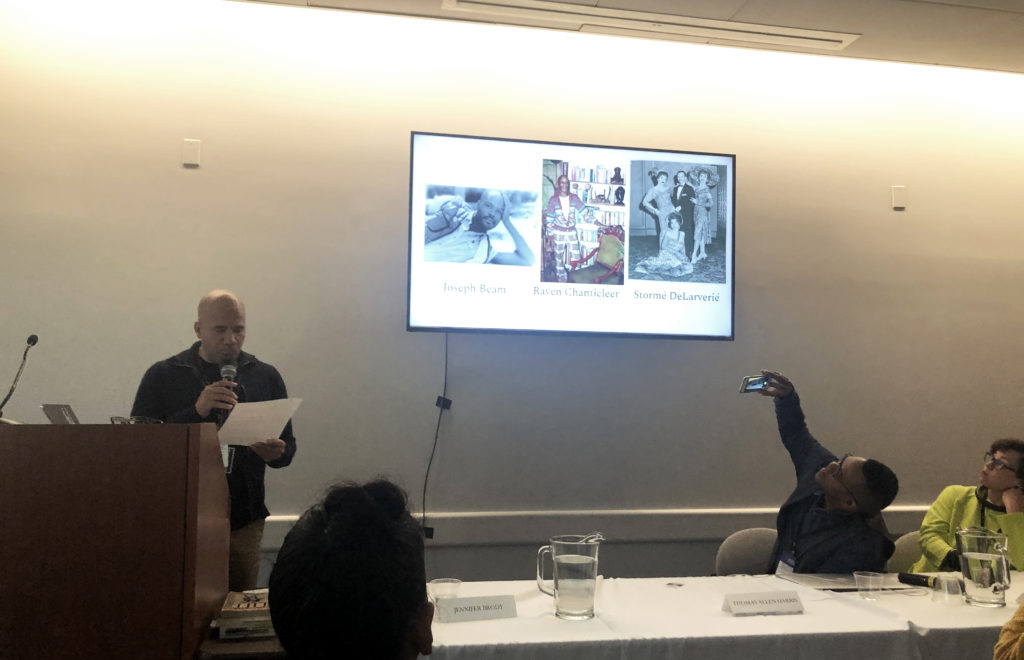
Steven Fullwood presents black queer historical figures Joseph Beam, Raven Chanticleer, and Stormé DeLarverie.
Steven Fullwood’s presentation, “Notes on Archival Visual Representations of Black LGBTQ Life.” Photo taken by Shivani Ishwar.

Personal archives, though, are often difficult to access specifically because they’re so informal. Fullwood’s talk, “Notes on Archival Visual Representations of Black LGBTQ Life,” touched on this challenge, discussing the way that so many personal archives are “collections doomed to the waste bin of history.” Whether it’s the destruction of records, an incomprehensible system of organization, or the inevitable damages of time, these personal archives are more often lost than they are preserved.

The themes of Fullwood’s presentation reminded me of several readings, including Michelle Caswell’s “‘The Archive’ is not an Archives” (2016) and Marcia J. Bates’ “Fundamental Forms of Information” (2006). Fullwood’s discussion of how personal archives are often poorly preserved speaks to Caswell’s point on the power of the archivist. Because information degrades over time, the decision of what gets preserved is left to whomever has access to the personal archives in question. Even if those records won’t be included in an official narrative, their continued existence is a far better fate than total destruction.

Even when information has degraded, Bates’ discussion of “embedded” information can illuminate why those damaged records can still have value. A water-stained photograph, for example, may speak not only to the great-grandmother in the picture, but also the flooded house her descendants lived in. In this way, personal records continue to accumulate and communicate information even beyond the “recorded” information, in Bates’ terminology, that was initially intended. This is why Fullwood advocates for people to maintain catalogues of their own archives—photos, documents, home video, and so on—so that they may still be interpreted and shared generations later, with all the added information that comes with time.

Also related to Caswell’s discussions of the power of archiving was Parker’s short presentation on the communicative potential of archives. She talked about the way archives create community and identity for a collective group of people: whether it’s of a society, as in official archives, or of a family or a group of friends, as in personal archives. In being excluded from archives, marginalized groups are excluded from their communities, which is what makes their own personal archiving so powerful. It’s a way to reclaim their narratives, their lives, from those who would rather their stories not be shared with the broader consciousness.

Parker emphasized that archiving is an important way to communicate across time and space; whether a photo is sent to friends hundreds of miles away or discovered in a dusty attic after decades, this communication acts as a touchstone for black queer people to connect with one another. As Caswell acknowledges that the archivist has power over how the story is told for future generations, Parker’s discussion presented the potential of having marginalized people as the archivists, the tellers of their own stories.

All of the speakers, in their discussions of intersectionality and power, time and space, came around to the same concept: that of legacy. Ultimately, being able to preserve and share personal archives is a way for marginalized groups to share their own legacies with the world. In times when official archives would exclude black queer stories, causing future generations of black queer people to doubt their own existence and history, the offering of an alternative archive allows the black queer legacy to live on.

References

Bates, M. J. (2006). Fundamental forms of information. Journal of the American Society for Information Science and Technology, 57(8), 1033–1045. doi: 10.1002/asi.20369

Black Portraiture[s] V: Memory and the Archive: Past. Present. Future. (n.d.). Retrieved from https://www.blackportraitures.info/.

Caswell, M. (2016). ‘The Archive’ is Not An Archives: Acknowledging the Intellectual Contributions of Archival Studies. Reconstruction, 16(1).

Costanza-Chock, S. (2018). Design Justice: towards an intersectional feminist framework for design theory and practice. Proceedings of the Design Research Society 2018. doi: 10.21606/drs.2018.679

Edmonia Lewis. (2019, October 16). Retrieved from https://en.wikipedia.org/wiki/Edmonia_Lewis.

Henderson, A. (2012, February 17). Edmonia ‘Wildfire’ Lewis: A black lesbian who sculpted freedom and independence. Retrieved from http://gayhistoryproject.epgn.com/historical-profiles/mary-edmonia-wildfire-lewis-a-black-lesbian-who-sculpted-freedom-and-independence-read-more-pgn-the-philadelphia-gay-news-phila-gay-news-philly-news-mary-edmonia-wi/.

Intersectionality. (2019, October 18). Retrieved from https://en.wikipedia.org/wiki/Intersectionality.

Jackson, N. (2010, November 12). Taking Care of Your Personal Archives. Retrieved from https://www.theatlantic.com/technology/archive/2010/11/taking-care-of-your-personal-archives/66425/.
Blog: Person, Place, and Thing

Heidi Klise

Cultural Heritage Preservation

Cultural heritage and heritage preservation are significant components of information studies. A beautiful line from the movie The Monuments Men does a good job of explaining why it is important to preserve heritage. George Clooney’s character Frank Stokes declared, “You can wipe out an entire generation, you can burn their homes to the ground and somehow they’ll still find their way back. But if you destroy their history, you destroy their achievements and it’s as if they never existed. That’s what Hitler wants and that’s exactly what we are fighting for.” (1) The protection of heritage has been tasked to the United Nations Educational, Scientific, and Cultural Organization (UNESCO). UNESCO divides heritage into two categories, tangible (physical items, monuments, geography, etc.) and intangible (oral stories, traditions, events, etc.). My research paper will delve into examples of heritage preservation by refugees in new communities. For this assignment I want to highlight non-refugee related examples of tangible heritage: the Hawaiian mountain Mauna Kea, the journal of a WWII prisoner of war, and Swiss archaeologist Paul Collart.

Person: Paul Collart 

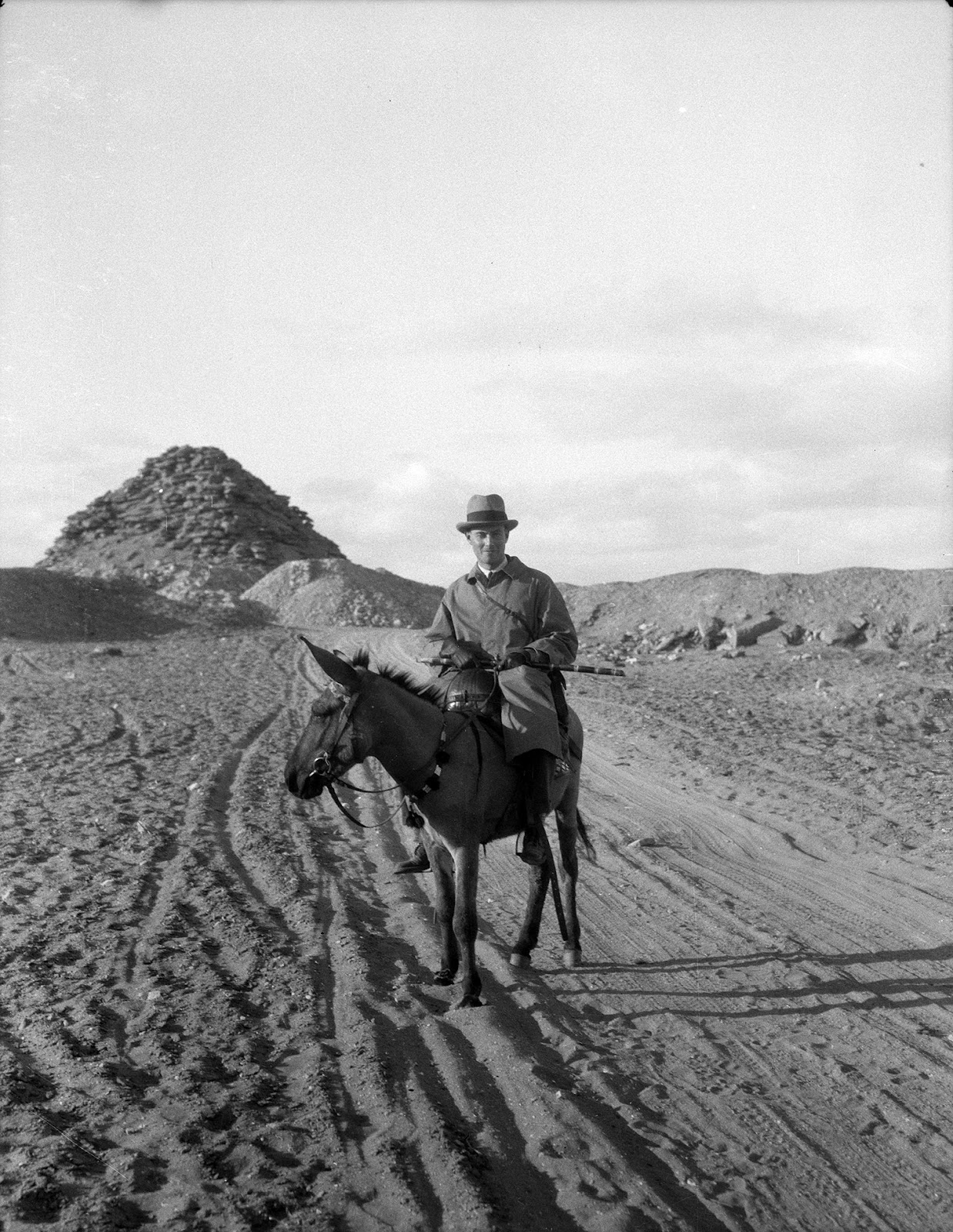
This coming Wednesday at NYU there is a talk called, “Heritage in Peril: Digital Approaches to Preservation.” I will be unable to attend due to class but I wish I could as it is a topic of particular interest. The keynote talk will be presented by a professor from the University of Lausanne (Unil), which, according the the event invite, “is home to the Collart Collection, the world’s most comprehensive archaeological archive of the Temple of Baalshamin in Palmyra, Syria.” (2) The temple was destroyed in 2015 by ISIS. The collection is named in honor of Paul Collart, a Swiss architect and professor at Unil, who UNESCO entrusted with the inventory of the cultural property of Syria and Lebanon. (3) Collart also led the excavation of the Baal Shamin temple in the 1950s, which was classified as a UNESCO world heritage site in 1980. It’s a mark of the 50s that a Swiss man and not a Syrian was entrusted with the cultural property of two Middle Eastern countries. However, the photographs that he took during the excavation are even more important now that the real temple has been destroyed. In a video from Khan Academy, Dr. Salaam al-Kuntar and Dr. Steven Zucker discuss Palmyra. Dr. al-Kuntar says, “[A]nd then we start asking ourselves, what is the meaning of a world heritage site if that site cannot be protected?” (4) This brings up an interesting point about heritage sites, they are protected from development but what resources does UNESCO have when sites are at risk? And if militaries are entrusted to protect sites, that leads to a larger conversation that is somewhat addressed in The Monuments Men, is a life worth sacrificing for art or architecture?

The image of Collart is from archnet.org. (5)

Place: Mauna Kea

Mauna Kea is the peak of a dormant volcano on the Big Island of Hawaii. From base to top, it is the highest mountain in the world at 32,696 feet, of which 4,205 rise above sea level. (6) The summit is sacred to native Hawaiians and is believed to be a home to the gods. There has been a long-standing struggle between builders and locals since the first telescope was built by the University of Hawaii in 1970. (7) This past summer, protests stopped construction of the proposed Thirty-Meter Telescope (TMT), which would be the 14th built on the summit. 

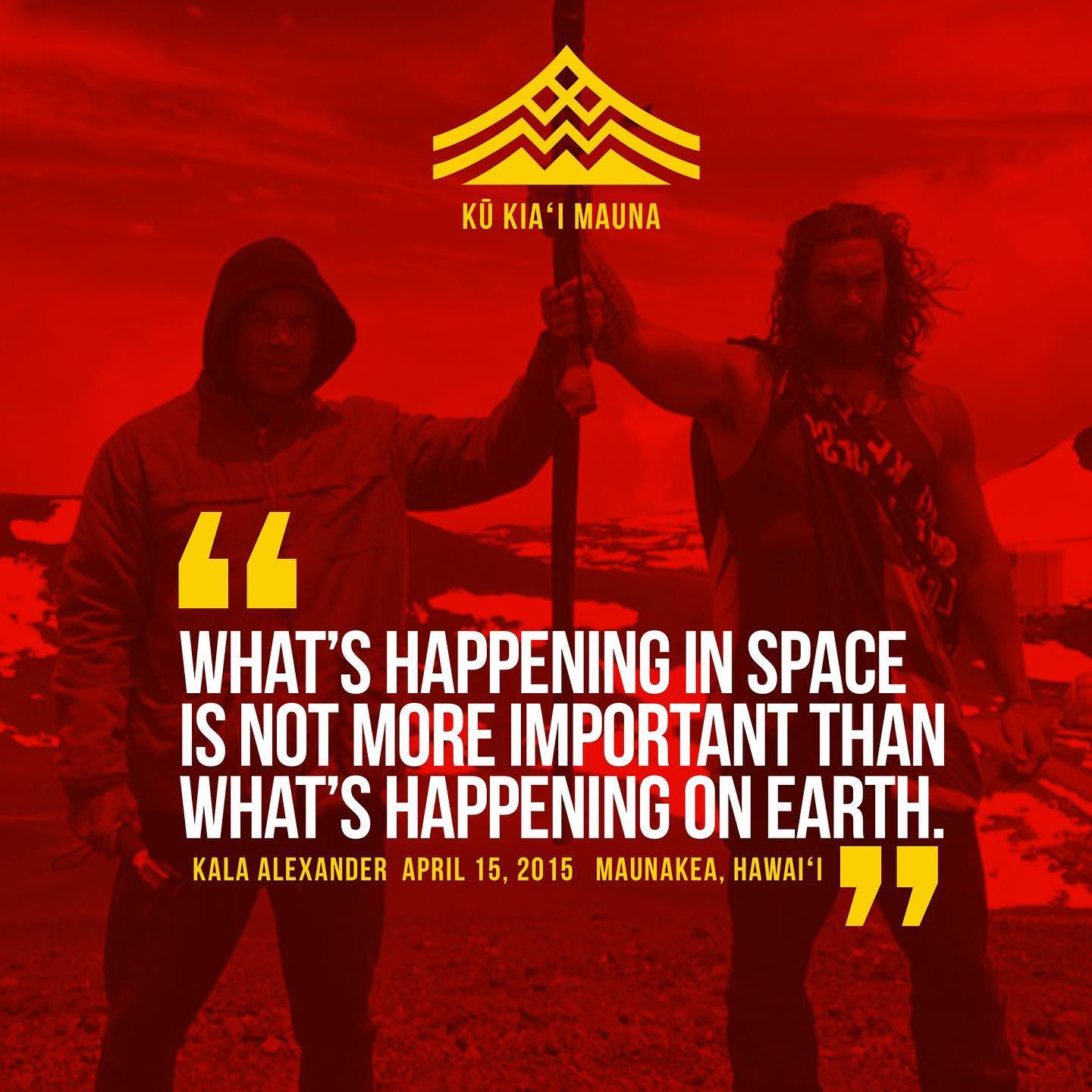
Since mid-July, native Hawaiians, transplants, celebrities such as Jason Momoa, and others have set up camp and blocked the access road to the telescope area. Organized largely on social media, the “we are Mauna Kea” protests have even taken place in cities such as Las Vegas and New York City. I read an instagram post from actor, local, surfer, and business owner Kala Alexander that said something to the effect of, ‘we’re not anti-science or against learning more about the stars, what we’re against is the further desecration of our sacred Mauna Kea.’ What’s interesting is that the University of Hawaii has largely been at the forefront of observatory construction. Information about a lawsuit by the Office of Hawaiian Affairs explained, “the state and the University of Hawaiʻi have continuously neglected their legal duties to adequately manage the mountain. Instead, they have prioritized astronomical development at the expense of properly caring for Mauna Kea’s natural and cultural resources.” There have been rumors of another equally appeasing TMT location in the Canary Islands of Spain, but not much has been reported. 

(image from Kala Alexander’s instagram page)

What is also interesting, is that two of the other volcanoes and sacred locations on the Big Island, Kilauea and Mauna Loa, lie in Volcanoes National Park and are under protection due to their dedication as UNESCO world heritage sites. Why was Mauna Kea not included? Remember the ‘S’ in UNESCO stands for ‘scientific.’ Mauna Kea Observatory is listed in the category of astronomical heritage, “The smooth shape of the isolated mountain, along with its high altitude, produces astronomical image quality that is among the best of any location on Earth.” (8) So, who decides for what purpose something should be preserved? In this case it was the UN, but in other cases it could be information professionals and archivists. I am reminded of Shwartz and Cook’s article about archives and power, “records are also about power,” they wrote, “They are about imposing control and order on transactions, events, people, and societies[…]” (9) The discrepancy between the Hawaiian volcanoes’ protection is an example of the potential bias within preservation, and how the bias can be directed by the controlling body that funds preservation. The “We are Mauna Kea” movement 

Thing: Secret Journal

            During research for my undergraduate thesis about my grandpa’s WWII story, I found a unique and rare book: a collection of journal entries and sketches by a man who was in the same prison camp as my grandpa. I use the word rare because the only new copy on amazon.com is selling for $860 (there’s also a copy for sale on Etsy.com). In the archives of the Air Force Museum on Warner Robins Air Force Base in Georgia, I also found scans of the pages, and other drawings and handwriting, in a folder about my grandpa. 

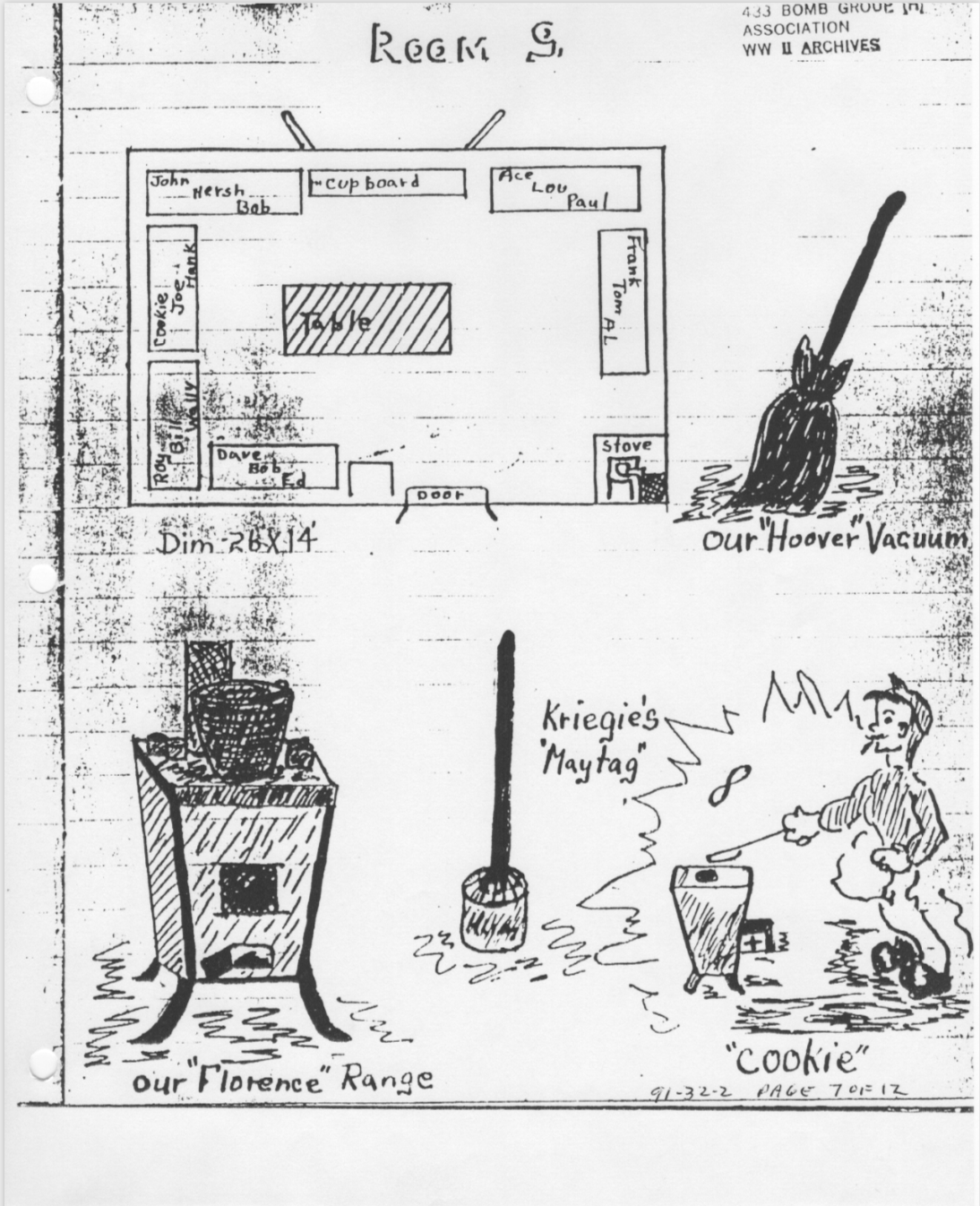
            Prisoner of War: My Secret Journal, (10) was written by Squadron Leader B. Arct from 1944-45, during his time as a POW at Stalag Luft I in Barth, Germany. It is a compilation of artifacts including handwritten journal entries by Polish Air Force Officer Bohdan Arct, hand-drawn maps, a detailed list of the contents of Red Cross parcels, weekly rations from the German guards, and an illustrated chart of how those rations and parcels depleted towards the end of the war. There are also lines written by the other men in Arct’s bunk room that include poems, journal entries, songs, and notes much like those at the end of a school yearbook. The many instances of cartoons and different men’s handwriting alone make this book a precious source for preservation. Sure, this book exists but who knows how many copies were made, those that I’ve found are difficult to acquire, and as the 90-year old former POW’s pass on it becomes harder to find more information. For example, one man wrote his Canada address for Arct to find him later, it’s doubtful if the man or his family still live there. There’s also a note from a New Zealand soldier named Kai Ora, all of the time I’ve spent researching WWII over the years and I had forgotten that New Zealand was involved. 

The image seen here is from my Grandpa’s folder in the archives and is similar to the drawings in Arct’s book.

I feel the heavy sense of information overload from this one book alone. It is such a unique and precious resource, but I don’t know what to do with it. In the spirit of information sharing, I’ve wanted to create a website to upload research from my thesis and bits of my interview with my grandpa so that others searching for information about their ancestor might find a little more. However, the copyright for this book is strict and I don’t know how to contact the rights holders-Arct’s descendents. The following poem is from the book and was also written in a small notebook that my Grandpa made while at Stalag Luft I (covers from butter tins and pages from cigarette packages). I remember that he became choked up when he read it to me during our interview. 

High Flight by John Gillespie Magee Jr., 1922-1941

“Oh I have slipped the surly bonds of earth And danced the skies on laughter silvered wings, Sunward I’ve climbed and joined the tumbling mirth of sunsplit clouds and done a hundred things you have Not dreamed of—wheeled and soared and spun high in the sunlit silence. Up, up the long, delirious burning blue I’ve topped the windswept heights with ease Where never larks or even eagles flew, Hovering there I’ve chased the shouting winds Along the footless halls of air, And while with silent lifted mind I’ve trod the high untrespassed sanctity of space, Put out my hand and touched the face of God.”

1. Clooney, George (Producer & Director). (2014). The Monuments Men [Motion Picture]. United States: 20th Century Fox. 
2.  Heritage in Peril: Digital Approaches to Preservation. (n.d.). Retrieved October 20, 2019, from http://as.nyu.edu/ancientstudies/events/fall-2019/heritage-in-peril–digital-approaches-to-preservation.html
3.  Paul Collart. (n.d.). Retrieved October 20, 2019, from https://archnet.org/authorities/8232
4.  Palmyra: the modern destruction of an ancient city. (n.d.). Retrieved from https://www.khanacademy.org/humanities/ancient-art-civilizations/palmyra/v/palmyra-destruction
5.  Exhibition from the Archive of Paul Collart Includes Previously Unpublished Images of Palmyra | Aga Khan Documentation Center. (n.d.). Retrieved October 20, 2019, from https://libraries.mit.edu/akdc/2018/02/07/exhibition-from-the-archive-of-paul-collart-includes-previously-unpublished-images-of-palmyra/
6.  Society, National Geographic. (2013, April 8). Mauna Kea. Retrieved October 19, 2019, from http://www.nationalgeographic.org/media/mauna-kea/
7.  Mauna Kea. (n.d.) Office of Hawaiian Affairs. Retrieved October 19, 2019, from https://www.oha.org/maunakea/
8.  UNESCO Astronomy and World Heritage Webportal – Show entity. (n.d.). Retrieved October 19, 2019, from https://www3.astronomicalheritage.net/index.php/show-entity?identity=44&idsubentity=1
9.  Schwartz, Joan M. & Terry Cook. (2002). “Archives, records, and power: the making of modern memory,” Archival Science 2: 1–19.
10.  Arct, B. (1988). Secret Journal: Life In A World War II Prison Camp. Great Britain: Webb & Bower.


Event Review: NYC Media Lab Summit

On September 26, 2019, I attended the NYC Media Lab Summit held in downtown Brooklyn. The mainstage program took place at the New York City College of Technology (City Tech CUNY) for the first half of the day. The second half of the day was dedicated to interactive demos and workshops and took place at both City Tech and the New York University (NYU) Tandon School of Engineering.

NYC Media Lab describes itself as dedicated to “driving innovation and job growth in media and technology by facilitating collaboration between the City’s universities and its companies” (About – NYC Media Lab, n.d.) Pratt Institute is part of NYC Media Lab’s consortium with goals “to generate research and development, knowledge transfer, and talent across all of the city’s campuses” (About – NYC Media Lab, n.d.), which also includes The New School, School of Visual Arts, Columbia University, NYU, CUNY, IESE, and the New York City Economic Development Corporation. Member companies of NYC Media Lab include Bloomberg LP, Verizon, The New York Times, and NBCUniversal, to name a few.

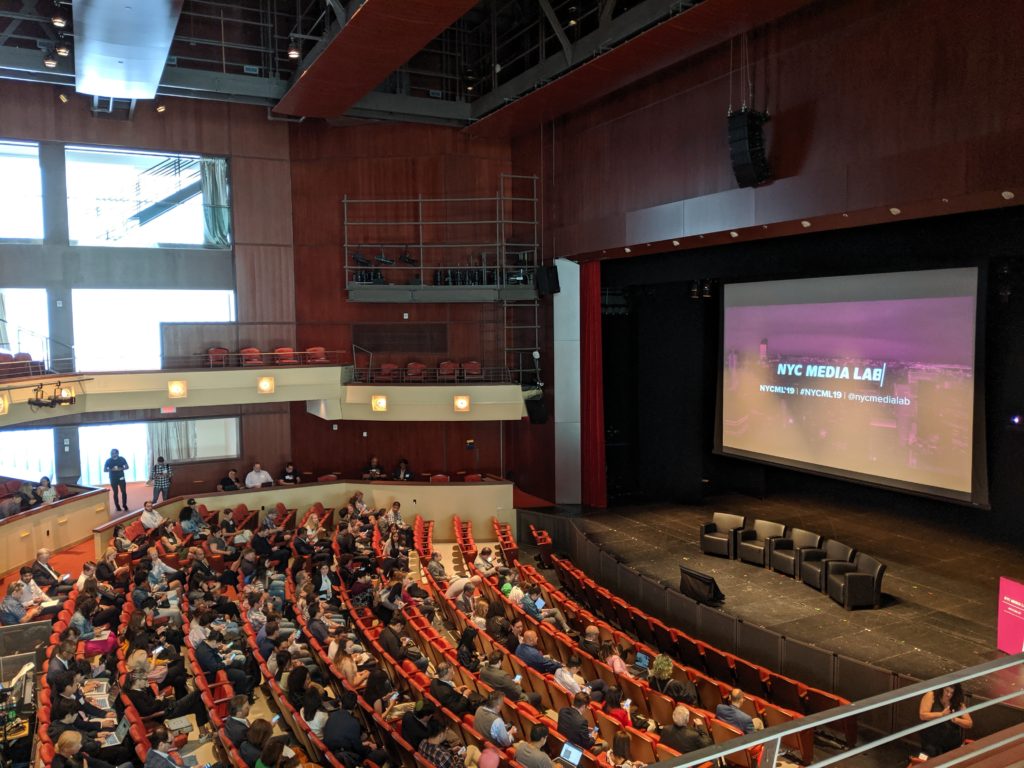
The Media Lab Summit held itself like a typical conference, where you check in to receive your name badge upon arrival and are treated to coffee and pastries. Then everyone takes their seats before the main program begins in the auditorium where the Executive Director of the program, Justin Hendrix, makes his welcome address and does introductions.

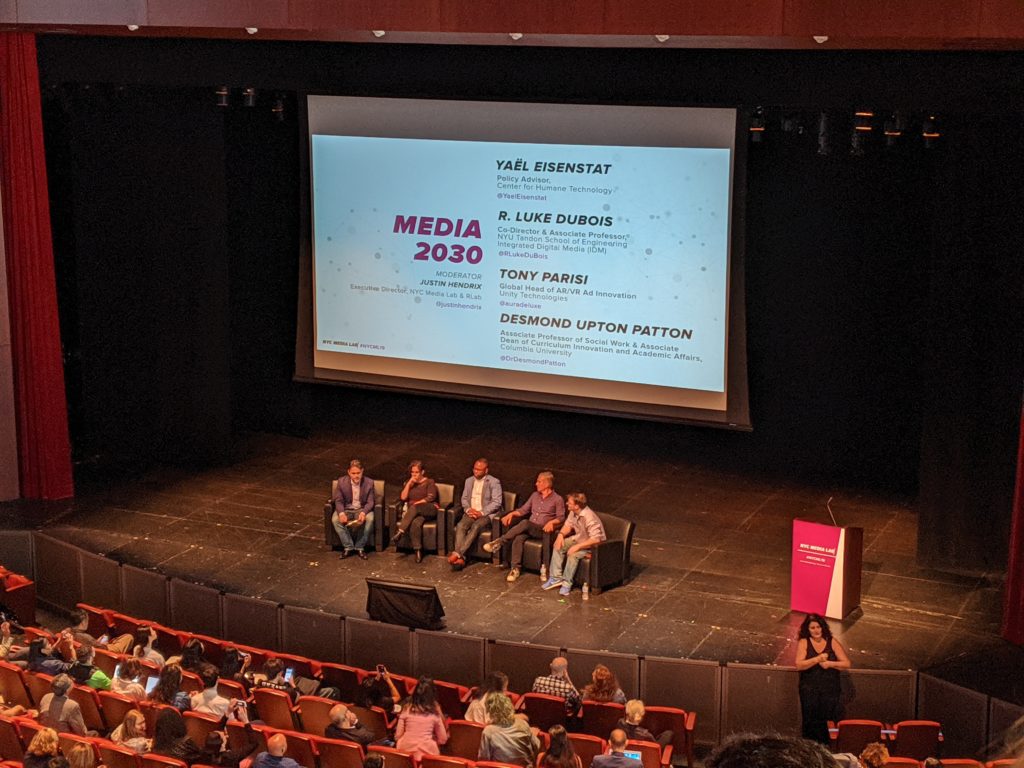
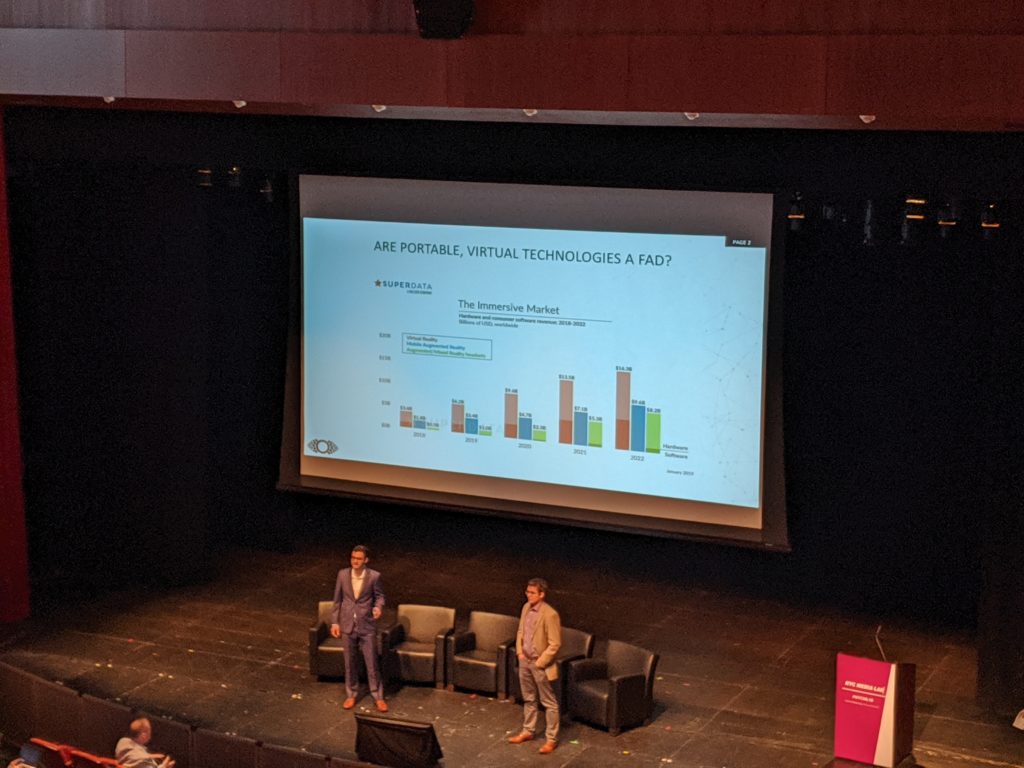
Innovation Panel discussion

Up first was the Innovation Panel, which featured speakers Yael Eisenstat, R. Luke Dubois, Desmond Patton, and Tony Parisi. The panel featured a mix of academics and professionals who all addressed the topic of artificial intelligence, or AI. It was interesting to hear that everyone agreed that AI is the future but that they all held concerns about whether it will be accessible to all. Another potential issue that was brought up in relation to AI is what seems like our current overdependence on data. One panelist raised serious concerns about this overdependence and worried whether this could lead to the complete disregard of an innate human characteristic, which is critical thinking. All panelists agreed that critical thinking is essential and sees it playing a key role throughout the use of AI and other technological advancements.

What I ultimately took away from this Innovation Panel was that critical thinking is needed now more than ever. I think we have always understood that critical thinking is crucial as it is what keeps us human. AI is capable of making decisions for us, but the ability to be able to critically think about the potential impacts of our decisions and asses our judgments remains entirely human. This emphasis on critical thinking reminded me of the Phoebe Sengers reading in which she also discusses machine culture but stresses that science and the humanities need “to be combined into hybrid forms” as “neither is sufficient alone” (Practices for Machine Culture, n.d.). Like the panelists, Sengers recognizes the strengths in both and how each can complement the other, especially in AI.

Next up were the showcases. The showcases were meant to present and demonstrate projects, prototypes, and startups created by students and faculty from NYC Media Lab programs. Two of the showcases that stood out to me the most were a subway accessibility app for the blind and a retina technology startup.

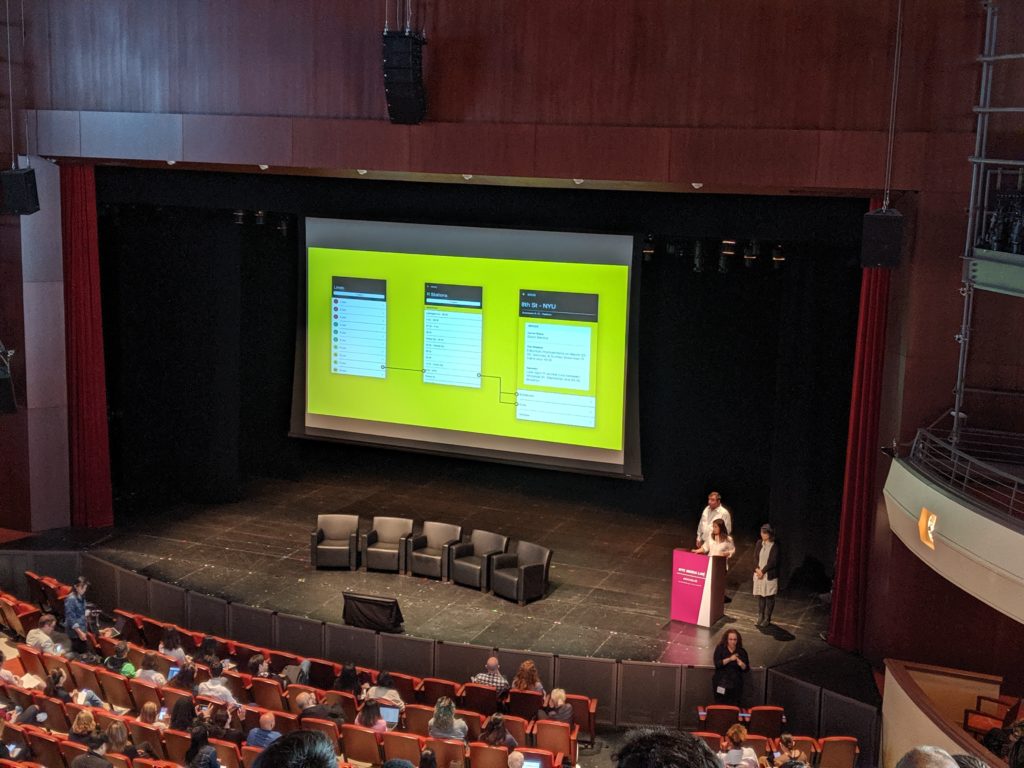
Access to Places presentation

Students from NYU’s Interactive Telecommunications Program created an app called Access to Places with the goal to make subway stations much more accessible for the blind. The app utilizes iOS’ text-to-speech voiceover technology to provide information such the location of entrances and exits, service delays or changes, and arrival and departure times. Notifications also help the blind to navigate around station layouts.

Retina Technologies presentation

Retina Technologies was formed by medical students at the Icahn School of Medicine at Mount Sinai. The startup aims to change the way people access ophthalmologists in both urban and rural areas. Through the use of virtual reality headsets, the startup hopes to increase access to ophthalmologists for those who cannot easily visit one in rural areas while also improving the patient experience for those in urban areas.

Access to Places and Retina Technologies both stood out to me the most because of the users that they were designing for. Instead of creating a product that catered to the majority of the population, they reached out to those with specific needs that often get neglected in the startup and tech conversations. I immediately thought of the Sasha Costanza-Chock paper on “Design Justice” and the discussion on who designers are actually designing for. The majority of startups and apps tend to assume the average user is able to access or use a product without any accommodations, much like how Costanza-Chock discusses that designers “assume” that “a user has access to a number of very powerful privileges” (2018). Visiting an ophthalmologist or getting onto the subway without any trouble are privileges that most designers tend to assume users have. Access to Places and Retina Technologies decided to instead focus on the needs of these specific user groups rather than create another app or startup that assumed they were just like every other user.

Many innovative and creative projects were demonstrated, and I was in awe over it all, but it was the discussions that were held that enlightened me. What I took to be the overall theme of the Media Lab Summit was accessibility and the continued mission to make this collaboration between media and technology available to all. I still believe that technology has this amazing potential to change and impact lives, but we must make it available to everyone to see it happen. The Media Lab Summit and our class discussions and readings only continue to highlight this necessity and how we as information professionals cannot simply ignore it as technology advances.

References:

About – NYC Media Lab. (n.d.). Retrieved from https://nycmedialab.org/about.

Costanza-Chock, S. (2018). Design Justice: towards an intersectional feminist framework for design theory and practice. DRS2018: Catalyst. doi: 10.21606/drs.2018.679

Sengers, P. (n.d.). Practices for Machine Culture: A Case Study of Integrating Cultural Theory and Artificial Intelligence. Retrieved from http://www.cs.cmu.edu/afs/cs/usr/phoebe/mosaic/work/papers/surfaces99/sengers.practices-machine-culture.html.

Event: Art/Museum Salary Transparency Project

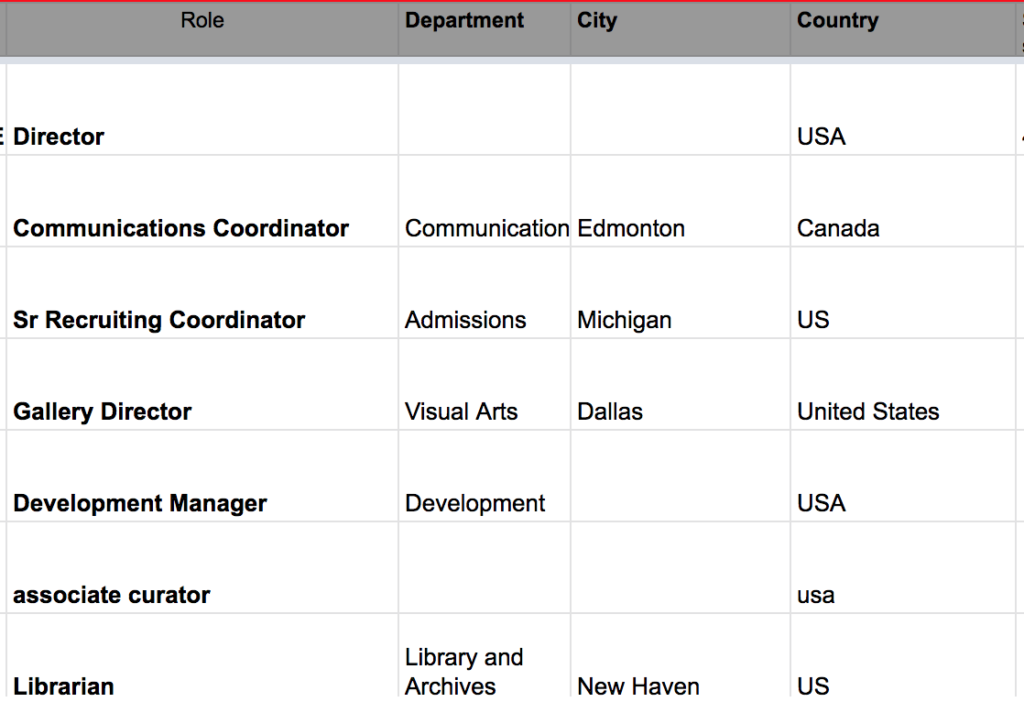
Art/Museum Salary Transparency Project (2019) [Screenshot from spread sheet]

The event I attend for this blog post was hosted by The Center for Humanities Graduate Center, CUNY. The Center aims to create cross-departmental collaboration and encourage creative work between the humanities at CUNY. Through free exhibition and public programming, the Center also aims to engage with a “diverse intellectual community” across the city (“About,” n.d.). The event was the first in a semester long working-group in conjunction with an exhibition titled, Institutional Apparatuses, or, Museum as Form. The working-group aims to focus discussions on how “museums reflexively grappled with their ethical obligations” and the growing movement within the field to shed light on and critique these political and ethical dynamics (“About,” n.d.). Each bi-weekly discussion will feature guests from various cultural institutions, from the Artist Director of Rhizome to a curator at The Studio Museum.  Institutional Apparatuses, or, Museum as Form is organized by two fellows at CUNY, Kirsten Gill and Lauren Rosenblum. 

I attended a discussion between main speaker Michelle Millar Fisher, Curator of Contemporary Decorative Arts at MFA Boston and Nikki Columbus, a curator who’s known in the art world for having sued MoMa PS1 over discrimination. The title for the working-group was, Michelle Millar Fisher and the Art/Museum Salary Transparency Project: Administration and Wage Labor in the Contemporary Museum.

In line with themes of transparency, it should be noted that Fisher and I worked in separate divisions at the same time at the Philadelphia Museum of Art (PMA) before both leaving this past summer, her for MFA Boston and me to attend Pratt. We were both still employed at the PMA in May when she co-organized the Art/Museum Salary Transparency Project, an open-source spreadsheet for art workers to anonymously post their institution of employment, salaries, and demographic details. Since the release and sharing of the spreadsheet there has been continual momentum in the museum–and I believe the cultural heritage field at large–to hold institutions accountable for how they manage internal structures and their staffing. The event and discussion applies to the information field thematically, as information professionals, art handlers, and curatorial assistants, to name a few, all play behind-the-scenes roles within their institutions of employment. The information mechanisms that Michelle and her collaborators used to disseminate their call to arms are also examples of how information tools like Google Sheets and platforms like Twitter can impact social networks. 

Fisher FaceTimed from her office in Boston to participate. The discussion began with a brief backstory on what motivated her to create and share a public spreadsheet of museum positions and salaries. Anyone that has worked in a large museum (though not limited to museums) has experienced the “economic inequalities manifest[ed] in cultural institutions,” as well as the lack of transparency in salary distribution and demographic diversity (Small, 2019). The goal of the open-source spreadsheet was and is to encourage salary transparency in the cultural heritage sector while also “contribute to further diversifying the field across socioeconomic categories” (Small, 2019).

The Art/Museum Salary Transparency Project is not the first example of a collective push for salary transparency. POWArt released a Salary Survey in 2018 and published their results as an info graphic in 2019.  Nor is it the first Google Sheet to be used within an industry to address issues of concern. The “Shitty Men in Media” list from the #metoo movement was a Google spreadsheet, collating isolated events by victims and shared to warn others. Beyond my conceptual interest in these conversations, I’m also intrigued by how the ease of access to collaborative document editors like Google Sheets has empowered users to make and share databases. The past few week’s readings on UX and HCI also beg the question, what were the original design intentions of Google Docs and Sheets? Did the designers at Google predict these political examples of use?

Collaborative document editors like GoogleDocs and open-source text editors like Etherpad in a way embody the founding essence of the World Wide Web. These collaborative documents are situated in a linked network of users. Granted, like most database systems, an information system needs to be put in place to ensure consistency. When the Art/Museum Salary Transparency Project came out any anonymous user could edit and add to the document. It was exciting to see the rows of anonymous animal avatars grow and new fields of information multiply.  But it also served as an example of collective chaos when every user is also an editor. Eventually the co-founders created a separate submission form for entries and suggestions, and the original Google spreadsheet is public for viewing only.  Note: the submission form mitigates the need for having a Gmail account to participate.

The evolution of Fisher’s and her co-creators’ document is an apt example demonstrating a knowledge organization system trying to democratize salary, benefits, and demographic statistics. It focuses on a survey-based method to create a bottom-up approach to distributing analytical data. However, considering Sasha Costanza-Chock’s article on Design Justice, it should be acknowledged that with any designed system there are still flaws. Context can be lost when trying to make data conform to a set format. Employees from museums may worry that their employers might react negatively to participation. Fisher noted herself that she was lucky to have secured a position already at the MFA Boston, when the spreadsheet was posted—some her co-creators at the time and even now are still anonymous for fear of employment retaliation. 

Further broadening the scope and range of their project, the co-creators started a Twitter account @AMTransparency that has become a centralized informal museum job posting watchdog. A few months ago, the account called attention to The Morgan Library for “replacing essential roles that should be good paying jobs” with volunteer job postings, one requiring a Phd in medieval art history (@AMTranpsarency, 2019). The Morgan Library later removed these postings from their website. Art+Museum Transparency is pushing for museums and the cultural heritage sector at large to be held accountable for the labor their institutions are built on.

Another facet of the evenings discussion focused on internships for credit, which some consider as a loophole for labor under NY State Labor Standards. We touched on this briefly during our class exercise discussion on a code of ethics for students at Pratt. Should the Pratt listserv repost unpaid internships and volunteer work? Does circulating these postings help to encourage institutions to continue to function on unpaid labor? Personally, my biggest hesitation from completing an advanced certificate is the required practicum and internship for credit. For the Archives track, I understand that this is a larger conversation with SAA certificate qualifications, however paying to intern in any context is a financial barrier for many students. 

In conclusion, though the event was focused on art museums, the topics discussed apply to many facets in the information field. Museums also include archives and libraries, and make up a large portion of the cultural heritage sector. The discussion also acted as an informal case study of how users can adapt designed tools like Google Sheets as new forms of community building and methods of disseminating knowledge. Yet there are still important questions about who will be responsible for documenting and preserving the open-sourced used of spreadsheets like the Art/Museum Salary Transparency Project.  Will collective documents like this live in an archive? What will the metadata look like for a document with so many co-creators built on anonymity?

Sources

About. (n.d.). Retrieved October 12, 2019, from The Center for the Humanities website: https://www.centerforthehumanities.org/about

GPAS Curriculum | Society of American Archivists. (n.d.). Retrieved October 12, 2019, from https://www2.archivists.org/prof-education/graduate/gpas/curriculum

Michelle Millar Fisher and the Art/Museum Salary Transparency Project: Administration and Wage Labor in the Contemporary Museum. (n.d.). Retrieved October 12, 2019, from The Center for the Humanities website: https://www.centerforthehumanities.org/programming/michelle-millar-fisher-and-the-art-museum-salary-transparency-project-administration-and-wage-labor-in-the-contemporary-museum

Small, Zachary (2019, June 3). Museum workers share their salaries and urge industry-wide reform. Retrieved October 12, 2019, from https://hyperallergic.com/503089/museum-workers-share-their-salaries-and-urge-industry-wide-reform/

Transparency, A. + M. (2019, August 11). A volunteer departmental research assistant for the manuscripts department. Phd required. Reading knowledge of French and German. Accruing that experience takes time and debt. You’re a major NYC museum. What’s going on @MorganLibrary, are you hurting for money?? Let’s see… /2pic.twitter.com/zEIzXpNTAX [Tweet]. Retrieved October 12, 2019, from @AMTransparency website: https://twitter.com/AMTransparency/status/1160592964374212608


Event: World Interaction Day hosted by IxDA

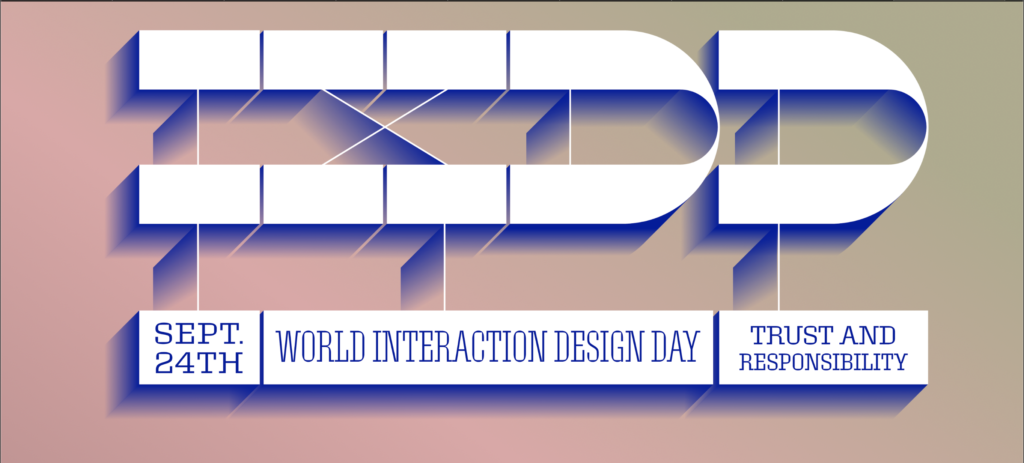
Interaction Design Association (IxDA) celebrated World Interaction day on September 24, 2019. World Interaction Day is an annual event hosted at various locations around the globe where designers come together to show how interaction design improves the human condition. Presented in partnership with Adobe, the theme for this year was Trust and Responsibility. I attended this annual event hosted by IxDA in New York.

The event kicked off with an introduction by Scott Belsky, the Chief Product Officer at Adobe. He spoke about how good interactions build trust. As designers, we get to influence a crucial part of the user’s experience therefore when we design we need to take responsibility for the interface we create. Users trust the design. Whenever you click a button on a website you expect a result but when you don’t obtain what you expect, you feel deceived. People are more likely to determine the trustworthiness of a website based on its design than reading the website’s privacy policy. How likely are you to close a website because of the number of click baits on the home screen? Have you ever felt cheated when an ad doesn’t look like an ad? Belsky says that as designers our core obligation is to be the voice of the users. Designers should understand their users well especially their needs and concerns and create interfaces that fulfill these needs and concerns. 

Mark Webster the Director of Product at Adobe spoke about Trust and Responsibility in Voice Design. The adoption of voice technology in virtual assistants is rapidly growing, especially with the emergence of Alexa and Google Home. Most users of voice enhanced technology claim that voice improves their quality of life( 94%). Although more than half of them (around 49%) find using voice technology unintuitive. This reminded me of the last time I used Alexa and asked her to find the English equivalent of ‘dhania’ and she responded with “I don’t understand”. Did I not articulate enough or was she unable to find what I asked? Webster talked about how designers can play an important role in eliminating problems like these. Voice technology can improve the human lifestyle in many ways. It is an opportunity to allow illiterate people access information, it can help the aged and most of all help people with motor disabilities with their day-to-day activities. The only issue is because voice interaction is so unintuitive it results in uncertainty about all of these things. How is voice going to help people with motor disabilities if the user doesn’t know what the virtual assistant has understood? Voice processing works in three parts – The technology senses speech, the speech is processed according to the various algorithms(natural processing) and then and output is delivered. Current technology has been able to implement the first and last part pretty efficiently but ‘natural processing’ still has a lot of limitations. This is where the role of a designer would be crucial as the designer can understand these limitations, combined with the knowledge of the user’s intent, decide on how to make the experience more intuitive thus enable users to build trust with these technologies. 

What do we really mean when we say ethics? Dr. Molly Wright Steenson, Senior Associate Dean for Research in the College of Fine Arts at Carnegie Mellon University elaborates on how designers can incorporate ethics in their design process. Since designers are good at investigating the context of the problem and use human-centric methods to understand the needs of the users and stakeholders, they should be directly involved with data. Framing the design problem is not the only task of the designer but how and what data to collect and use is also a design question. Dr. Steenson emphasizes how the ethics framework should stop looking like a checklist and be a vital part of the product life cycle. This reminded me of the PERCS chart we read earlier which talked about the ethics of fieldwork which according to me can be applied to the design process. Even Costanza-Chock and Sasha’s reading Design Justice talks about how designers should warrant a more equitable distribution of the design’s benefits and burdens and be aware of the cultural and traditional implications of designs.

This talk was followed by Milena Pribic the Advisory Designer of Artificial Intelligence Design at IBM who addressed the issues of ethics in AI. She talked about what it means to build a healthy relationship between two people when one of them is AI. She defined a framework for AI ethics used at IBM that can be incorporated by designers while designing interactions for AI. Trust and transparency are important when it comes to designing for AI. She provides a guideline on how to handle client data and insights to ensure they are protected. They include: 

  • The purpose of AI is to augment human intelligence
  • Data and insights belong to their creator
  • New technology, including AI systems, must be transparent and explainable

The event concluded with questions from the audience regarding the topics discussed. This was an eye-opening event for me because I realized as a designer there are numerous factors I should consider when I create my design. Design is not just about solving a problem but also considering its impact. Am I protecting my client/user information? Am I being inclusive of the different communities affected by my design? Am I able to build trust with the users of my design? As a designer have I successfully addressed the needs as well as the concerns of my users? This event made me realize what my responsibility is as a designer and what measures I should take to ensure my designs are trustworthy. 

REFERENCES

  1. Massachusetts Institute of Technology, & Costanza-Chock, S. (2018, June 28). Design Justice: Towards an intersectional feminist framework for design theory and practice. Presented at the Design Research Society Conference 2018. https://doi.org/10.21606/drs.2018.679
  2. Pribić, M. (2018, September 6). Everyday Ethics for Artificial Intelligence. Retrieved October 15, 2019, from Medium website: https://medium.com/design-ibm/everyday-ethics-for-artificial-intelligence-75e173a9d8e8
  3. What We Really Mean When We Say “Ethics”—Molly Wright Steenson | Open Transcripts. (n.d.). Retrieved October 11, 2019, from http://opentranscripts.org/transcript/what-we-really-mean-when-we-say-ethics/
  4. How Good Interaction Design Builds Trust. (2019, September 18). Retrieved October 11, 2019, from Adobe Blog website: https://theblog.adobe.com/how-good-interaction-design-builds-trust/
  5. IBM’S Principles for Data Trust and Transparency. (2018, May 30). Retrieved October 15, 2019, from THINKPolicy website: https://www.ibm.com/blogs/policy/trust-principles/
  6. Voice Assistant Statistics & Trends, 2019—UX Survey. (2019, July 22). Retrieved October 11, 2019, from Adobe Blog website: https://theblog.adobe.com/voice-assistant-statistics-trends-2019

IBM Design Thinking Workshop Report

On Oct. 4, 2019, I attended a Design Thinking Workshop held by IBM CIO Design and Pratt Institute for Pratt students. The purpose of this workshop was to introduce the concepts of Design Thinking and conducting some applications on user experience(UX) design.

8 Facilitators from IBM CIO team in this event: Chelsea Calhoun (Content Designer), Dana Chang (Manager), Kelly McGowan (Visual Designer), Shannon Andrea (UX/UI Designer), Soo Yun Kim( Visual/UX Designer), Veronica Moyer (Visual Designer), Youn Lee (UX Designer).

Soo Yun Kim was the principal lecturer, and she started with an ice-breaking activity: attenders were asked to design an alarm clock in 3 minutes and displayed and introduced their works. In the second task, attenders were asked to design an alarm clock for waking people in the morning. This time, when people talked about their designs, they were more confident and spoke with more logic reasoning. This event led us to think about how to design and who we design for, which inspired more innovative outcomes.

 Discussed the definition of design with attenders, she declared that design was a discipline that required education, work, and practice to reach proficiency, demanded clarity of vision, blended science, and arts, entailed iteration with real users, and thrived with collaboration. After introducing the IBM company, she illustrated their CIO Mission, “We Make Work Better”: leading with design to drive simplicity and ease of use, engineering the systems that run the business, and innovating to transform the business. Design thinking was the key for them to achieve the mission. She elaborated that design thinking was a framework for approaching problems through collaborative activities. It required a focus on user outcomes, diverse and empowered teams, and restless reinvention. As they mentioned, these principles could guide them to see problems and solutions as an ongoing conversation. The interesting part of these principles was that they use an “infinite” symbol to represent a model Loop, a continuous cycle of observing, reflecting, and making. Repeating this process could help the design team to think about any design problem in multi-direction and through periods.

Design and develop process is always dynamic since the information in this world is transient, and people change their needs every second. Still, the design is key to people’s collective liberation, but most design processes today reproduce inequalities on the matrix of domination. Therefore, the idea of design thinking to collect diversity and repeat the Loop cycle with more participants with intersectionality involved could definitely empower the community, not merely on one single product.

The next part of the workshop was to let attenders practice design thinking through a task. We were offered with the problem to solve with design thinking, “Design a better way for students to find the right classes and professors”. Before we found a partner to start interviewing each other about our experience in choosing classes, we were offered several interview tips

  • Don’t suggest answers to your questions, 
  • Don’s be afraid of silence, 
  • Be aware of nonverbal cues, 
  • Stay on the same path of a question, 
  • Ask “WHY”. 

Those tips extracted from abundant field research experiences with ethics and techniques are very important. To get valuable results from research and interview, it’s essential to concern about the formation, conduct, and communication. Developing the proposal and conducting suitable behaviors are the foundations to build trust with and receive proper feedback from the interviewees.

For the interview, we ideated interview questions, paired up with another person, and interviewed each other in 15 mins. With the interviewing results we got, all attenders were separated into six groups. Each group got one IBM facilitator to help with building up the solution, and our group worked out the procedure with Kelly. First, we needed the empathy map to gather the ideas from the interview into four sections: say, think, does, and feels. During this process, the lecturer explained what made a good empathy map:

  • It is based on real research, 
  • It explores multiple user dimensions, 
  • It is verified with users or even co-created with them, 
  • It captures both the positive and the negative.

Based on those guidelines, we noted the top pain points on sticky notes and placed them on board. Then group the similar ones, we found some big ideas, the main concern, and pain points.  Next, we used the green and pink dot stickers to vote the most valuable and feasible one. To sort out the solution for that big idea, every group needed to discuss a scenario and storyboard it. Finally, each group should make a presentation to show the result. Our group focused on the pain point that new students hardly had access to class feedbacks from the fellow students, the big idea our group valued most, and made a storyboard of how a new student forum could help through Q&A, while other groups with their big ideas offered solutions like visualizing more professor information and providing the class syllabus and requirements more directly.

This workshop was short for students to finish all the steps and run out a solution, but it gave us an overall idea of how to use design thinking in the application. At the end of this 3-hour workshop, there was the question period. Dana Chang, the design manager reasserted the importance of design thinking not only in design but all through the industry. Also, she talked about the shift of the methods and techniques of research, design and develop, and the excellence of using qualitative research and quantitive research cooperating together with the addition of the new schism based on design thinking. Although those design methods are innovated through time, design thinking is always important. Other designers also shared their experiences in this design industry, and many of them had changed their positions once or twice. It seems that this industry is really dynamic and exuberant, and people are always willing to adjust to new challenges.

Through this workshop, I could understand design thinking in the context of fundamental principles of research, which collects the true needs of the target users. The research is a vital process to learn a certain topic you are working on, both in general and in detail. How to get the information now and in the long run is a problem that leads to the request of ethical jobs. Showing respect, asking for consents, and building trust should be assured if researchers want to protect an interview-friendly environment for both interviewees and interviewers.

Reference

  1. https://www.ibm.com/design/thinking/page/framework/loop.
  2. Costanza-Chock Sasha, “Design Justice: towards an intersectional feminist framework for design theory and practice”, 2017.
  3. PERCS, The Program for Ethnographic Research & Community Studies, “The Ethics of Fieldwork”.

Event: “Apollo” at NYPL Performing Arts Branch

On Thursday, October 10th, I attended an event at the Performing Arts Branch of the New York Public Library called “Apollo.” The event was part lecture part film, and it was led by two leading scholars on dance, Alastair Macaulay and Robert Greskovic.

A little bit of background first. The ballet “Apollo” is a lesser-

known ballet. It’s an obscure work that is known for having very famous collaborators, Igor Stravinsky and George Balanchine. Both of these names are very recognizable in the classical music and ballet world, respectively. However, “Apollo” as a work is not. I personally had never heard of this particular ballet, and I consider myself to be pretty well versed in the world of dance. It premiered on April 1928 with original choreography by Adolph Bolm but was later reworked by Balanchine. Bolm’s choreography is pretty much usurped by Balanchine’s, and no one uses choreography that wasn’t originally created by Balanchine.

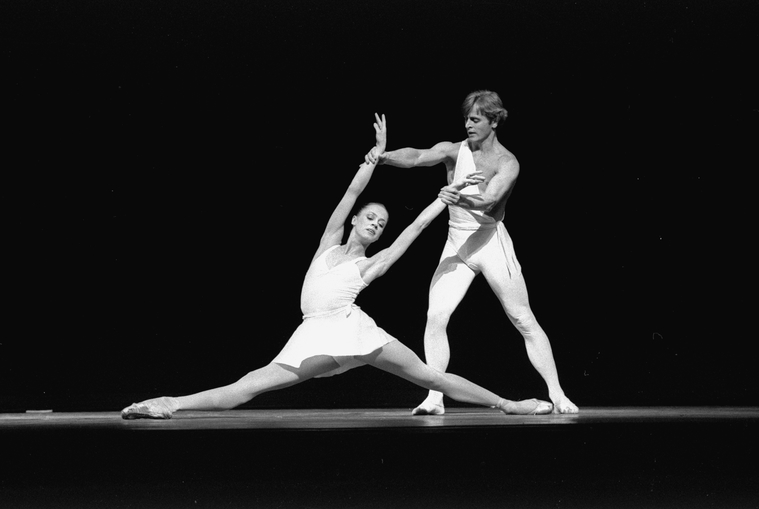
The story of the ballet is centered on, no surprise here, the god Apollo. Apollo comes to life and is greeted by three Muses, Calliope, Polyhymnia, and Terpsichore. Each of the Muses gives Apollo a different gift. They give him the gift of poetry, rhetoric, and dance respectively. They dance with him both as a group and individually.  At the end of the ballet, Apollo ascends back to Mount Olympus in the heavens with the Muses being left behind.

According to one of the presenters, Macaulay, this ballet is simultaneously about making art and the creation of art. It’s about the “growing up” of art. He talked in-depth about how in later iterations of the ballet, Balanchine would say that he wanted to get rid of the narrative entirely. Thus, in the production of the ballet with Mikael Barisnikov dancing the role of Apollo, he eliminated the Prologue section of the ballet and also changed the ending. According to MacCaulay’s lecture, Balanchine was apparently known for saying that in his mind, Apollo was always meant to be a work in progress.

So how does this fascinating obscure piece of dance fit into what we are dealing with as information professionals? For me, I found this event and piece of ballet history fascinating because of the way that the information about it was being cataloged and collected and later on, archived. Prior to this event, there was a three-day seminar with NYPL employees, the two men leading the event, and also some of the dancers who danced in the various productions that the show has been through throughout the years. Their information was collected via the archival video that was taken. The people who couldn’t be there at the seminar i.e. other dancers such as Mikael Barishnokov who contributed their information via one on one interviews with MacCaulay and Greskovic.

So the ultimate question is, how is all of this information being cataloged and then archived? I noticed before the lecture started, a video camera was set up in the back of the auditorium where the lecture was taking place. The employees running the lecture must have planned in advance for this archival footage to be taken. They must have wanted to save the presentation as a whole. However, how are the lecture itself and the interview material from the various collaborators being saved? For example, some people might not think it’s important to have the lecture notes that MacCauley wrote saved, cataloged and archived but some may. I personally would be interested in seeing those notes, but I know that many people wouldn’t. It relates back to some of

our earlier readings that dealt with archiving, such as Schwartz’s article, “Archives, Records, and Power.” The article deals with whoever is archiving the material at hand is the one with the power. If I was the one taking in this collection of information (video, lecture notes, PowerPoint slides), then I would ultimately have to create a narrative about the materials at hand. I would be able to organize the information in a certain way and make a certain narrative around the materials. Schwartz says,

“Whether over ideas or feelings, actions or transactions, the choice of what to record and the decision over what to preserve, and thereby privilege, occur within socially constructed, but now naturalized frameworks that determine the significance of what becomes archives.” (3)

In looking at this particular ballet and how these two scholars were recording what was important, I thought it was interesting that they chose certain images and certain video clips over others. I know that I clearly missed a bunch of material in the three-day symposium that took place weeks prior because we only saw short clips from it, but I do think it’s interesting on what was preserved and what was not. Obviously, this is a lesser-known ballet, but it has big important names in the dance and classical music world. If this was a lesser-known ballet with no big names attached, would it still be archived in as much detail? Would anyone care to have a three-day symposium on this material? I’m not really sure. Schwartz also says that “control of the archive – variously defined – means control of society and

thus control of determining history’s winners and losers.” (4) Would we ultimately classify this ballet into the winner category because these two dance scholars ultimately deemed it important to one, host a three-day symposium on and two, host a public lecture on it?

In conclusion, I feel that going to this lecture prompted me to think about a variety of issues in terms of being an information professional. It makes me think about how we’re archiving material and how we’re using it to move forward in our profession. I stand by my question of who wins here and who loses? Do we have an answer to what is getting saved, cataloged and archived or is it ultimately just random? I still feel that this ballet is one of the more obscure ones, and I know that I’m glad that I know about

it and its’ history but I’m not one hundred percent sure that I would choose to save the information about this ballet over another one that is also obscure but with less famous collaborators.

Sources

NYPL Performing Arts Lecture series. Attended on October 10th, 2019.

Sponsored by the NYPL Performing Arts Branch.

Cook, Terry & Schwartz J.M (2002). Archives, Records, and Power: The Making of Modern Memory. Archival Science. 1-19.

Apollo (ballet). In Wikipedia. Retrieved October 15th, 2019 from https://en.wikipedia.org/wiki/Apollo_(ballet)

Event Review: The Future of Design and How We Can Prepare

I attended a talk called ‘The Future of Design and How We Can Prepare’ at Pratt Institute School of Information. It was conducted by Lee-Sean Huang, a Design Education Manager at AIGA (American Institute of Graphic Arts). AIGA is a professional membership organization of around 2,500 committed designers who promote a better understanding of design in the government, business and media. They host multiple events that inspire designers across all industries and enhance professional development by providing learning  opportunities. The events are usually aimed at community engagement related to the future of design. Huang took us through the concept of AIGA and their strategies with the help of a sideshow. He used engaging videos and structural diagrams to give us a clear understanding of what they stand for. He began by introducing himself, the company’s efforts, their predicted trends and lastly concluded with a question and answer session.

He commenced with topics related to research and community engagement with an emphasis on their ethical guidelines. When it comes to publishing research or creating social content, designers aim to work with the users and not for the users. This brings to life a whole new concept of ‘Co-Design’. Thus, treating users as a part of the design team and using their research with consent, initiating a bond of trust. This directly relates to point numbers twenty-one and twenty-eight of PERCS “The Ethics of Fieldwork” that discusses the idea of informed consent agreements. However, Huang didn’t continue to discuss a valid point raised in the reading, which is how a designer must handle the situation when their critical subject of research changes their mind, leaving their endeavor futile.

Huang also discussed and compared the changing employment structure in the realm of design. He identified the current phase as a design boom and validated it with labor statistics. While fields like graphic design witness a significant drop in employment, software design had a 24% increase. Software design is entirely based on programming and algorithms suggesting immense dependability on machines and databases for design in the future. This raises concerns and links to Nobel’s “Challenging the Algorithms of Oppression” where she talks about critical/privately owned information in the threat of being leaked to the general public. Huang goes back to the olden times and talks about how career growth in the design field was hierarchal – people had to study the basics of design i.ie work their way form the bottom to the top. Whereas, today, people from different backgrounds directly enter the field from anywhere in between. 

After discussing the future of design employment, Huang moved on to 7 trends that will possibly shape the future practice of design. These trends aim at enlightening designers about the course design is talking/will take shortly. Most of them have a few aspects that relate to our class discussions. The first one is ‘complex problems’ which urges designers to think in terms of systems- understanding problems in their physical, psychological, social, cultural, technological, and economic spheres. Thus, focusing more on the potential impact of design. This partially relates to Kincheloe and Peter McLaren’s critical theory that is grounded in the awareness of contextual and social belief systems, so insights are based on a full and truthful understanding.

The second trend is ‘curation/aggregation of content’, this works around the idea of information overload. How the emphasis shouldn’t be about making the content but on the flow of content. This links to Rozenwig’s information overload theory where the infrastructure and medium to manage all present and future digital information is questioned. The third trend is ‘Bridging Digital and Physical Experiences’ which is about creating seamless and unified experiences. Experiences should be designed keeping in mind what users do before and after using an app. This will bridge gaps between the online and offline environments. 

The fourth trend is ‘core values matter’, this focuses more on a company’s ethos and whether it’s products/services represent the same. It urges businesses to create and understand the value of their social equity. This is relevant when we talk about large technology companies and their responsibility towards users regarding their data. Whether or not they should try and increase their social equity by being transparent and seeking informed user agreements. Zuboff’s theory of the public is reduced to mere ‘bystanders’ is a result of companies lacking a moral based ethos. The fifth trend is ‘Resilient Organizations’ which focuses on how to achieve and  maintain a company’s position with an emphasis on innovation. Innovation related to strategic decisions, research data, and business models among the rest. 

The sixth trend ‘Making Sense In The Data Economy’ explores five technologies that are instrumental in data collection – sensors, IoT, big data, the cloud, and AI. Although, unlike most of our class discussions this doesn’t take about the ethical/ lack of privacy aspect. He focused more on individual and organization interaction –  where organizations aim at improving daily customer operations. And lastly, the seventh trend  is ‘anticipating design outcomes’ which is based on research. Huang emphasized on how designers need to justify design decisions through research. Reiterating McGrath’s thought of research always serving as “empirical evidence”. And similar to McGrath’s “generalizability” research strategy, Huang talks about the fundamental generalizable nature of research across a variety of applications and contexts. He concluded this trend stating “designers are problem seekers and not problem solvers”. This in many ways cemented the whole generic aspect of research. 

Besides this, Huang also spoke about the ‘six-word story’ technique to communicate  thoughts aimed to have a greater impact on users. He emphasized on how designers strive to be concise to leave a more dramatic impression. An interesting example he used of six-word stories is “Time machine reaches future. Nobody there”. This indeed made an impact. The examples were extremely inspiring and makes me think of ways I could use this technique to present unique research facts/insights.

The talk ended with AIGA’s future plans. Huang spoke about their upcoming podcast, elaborating why they decided on this medium to voice their vision. Podcasts usually have an effortless conversational and verbal touch along with being cost-effective and accessible. Post  this, there was an open question and answer session. Some students raised questions about the leadership in design while others brought up the generalist v.s specialized future of design. Huang believes that a design generalist would probably be more versatile and fit more design roles in the future. Most of us agreed with this, as to work with technology it’s essential to familiarize ourselves with other design aspects that are points of confluence. Huang seemed extremely approachable and helpful. He was friendly and encouraged discussion. The talk was more participatory rather than him doing all the talking. Overall, this experience was an eye-opener for design as a future discipline and that we should prepare to efficiently  acclimatize ourselves to this change.  

REFERENCES

Elon University. Program for Ethnographic Research & Community Studies. The ethics of fieldwork module. Retrieved from www.elon.edu/e-web/org/percs/EthicsHumans.xhtml

Noble, Safiya. “Challenging the Algorithms of Oppression.” YouTube, uploaded by PdF (2016).

Kincheloe, Joe L., and Peter McLaren. “Rethinking critical theory and qualitative research.” In Key works in critical pedagogy, pp. 285-326. Brill Sense, 2011.

Rosenzweig, Roy. “Scarcity or abundance? Preserving the past in a digital era.” The American Historical Review 108, no. 3 (2003): 735-762.

Zuboff, Shoshana. “Big other: surveillance capitalism and the prospects of an information civilization.” Journal of Information Technology 30, no. 1 (2015): 75-89.

McGrath, Joseph E. “Methodology matters: Doing research in the behavioral and social sciences.” In Readings in Human–Computer Interaction, pp. 152-169. Morgan Kaufmann, 1995.