Ruha BenJamin vs. The New Jim Code

By Char Jeré

Ruha Benjamin’s talk on Race After Technology: Abolitionist Tools for the New Jim Code was just as raw as the topic itself. It came with no filters, no disclaimers and no trigger warnings— it wasn’t for the precious, it was for the people whose lives depend on such brutal honesty. This moment with Benjamin felt like an astral projection, the experience catapulting me from a space where darkness was being vilified to a place where it is now finally embraced. During this talk, it seemed like Benjamin was shepherding us out of our own black boxes of internalized racism and into clarity. After her three provocations, I was called to take a left out of my body and a right into my imagination—the directions were simple but you still needed to know them, as a right out of my body could have led me back into someone else’s imagination, essentially up the creek without a paddle. Benjamin stated that, “Most people are forced to live inside of someone else’s imagination”, citing Adrienne Marie Brown’s book Emergent Strategy: Shaping Change, Changing Worlds, as an inspiration. As Brown explains in her book, “I often feel I am trapped inside someone else’s capability. I often feel I am trapped inside someone else’s imagination, and I must engage my own imagination in order to break free.”. Power does indeed lie in the ability to imagine but what happens when you have an old, tiresome imagination that turns innocent people into potential threats, “superpredators” and even worse, demons? These words have all been weaponized by top political figures, from Hillary Clinton to killer cops (like Darren Wilson) against African Americans for centuries. Officer Wilson described Michael Brown as a demon before he brutally shot and killed the 18-year-old on the streets in Ferguson, Missouri in 2014. Audre Lorde would call such things “imagination without insight” in her essay “Poetry is Not a Luxury”.

A photograph from the exhibit on African-American progress, on view inside the Palace of Social Economy at the 1900 World’s Fair in Paris. (Library of Congress)

I started thinking more deeply about my daily interactions with intrusive, white-bred artifacts; Benjamin quoted Langdon Winner as saying “Artifacts have politics.”. The residues of white inferiority have been scattered strategically around us and are the default within the design and ultimately, within the system. White bias exists in so many facets of our daily lives that it often becomes disturbingly inconspicuous. Kara Walker states that with monuments and memorials, “…there’s this very peculiar quality that they have of being completely invisible— the larger they are, in fact, the more they sink into the background.” The effects of this phenomenon (white inferiority) were having fun double-dutching and hopscotching through my genes like school kids on summer break. Right there in my cold metal folding chair, I sat realizing that every new technology’s job was not only to reintroduce us to new trauma but to preserve the intergenerational trauma in my DNA. The matrix of oppression could be explicit but it could also be obscure; it could be abrasive while also being agreeable, moonlighting as a “serve and protector”. It was as disruptive as light is to darkness but useless against reason and true innovation. Ruha Benjamin pushes us to examine our interiority, so we no longer need to put up with the mediocrity of settler colonialism. She wants us to liberate ourselves so we can start truly innovating change. We are now impenetrable and have received our reparative vaccinations against white redundancy that have been killing and stagnating us for centuries. It is time to finally welcome modernity. In Safia Elhillo’s book The January Children, she references a quote by Adonis, “How many centuries deep is your wound.”. This was not a question–it was a critical examination of race, ethnicity, class and gender through rhetoric. My question is: when they colonize Mars, will racism still be en vogue?

I am the God of war! ARrrrrghhhh!!!!!

“THERE ARE BLACK PEOPLE IN THE FUTURE.” Alisha Wormsley’s billboard exclaims, hovering over an area in Pittsburgh that has seen rapid changes from “re-development” projects and gentrification. We are in the future just by existing in this present moment but for me it is not just about being there, it’s about where we are there. During the talk-back, people who were living in public housing explained that their landlord installed facial recognition software without their consent. They also expressed concern about their right to privacy. New technology has never been empathetic to the needs of marginalized people, which means that designers do not envision us in the future. Firearms, steam engines, the Cotton Gin and the internet are all examples of how technological advances keep oppression well-fed. As Benjamin shifted her talk from the well-documented problems of white technological setbacks to solutions on how to mobilize against these “New Jim Codes”, she states this: “Like abolitionist practices of a previous era, not all manners of resistance and getting free should be exposed…calls for abolition are never simply about bringing harmful systems to an end but also about envisioning new ones…”.

(Image courtesy of Jon Rubin)

People who have been marginalized and made the most vulnerable are constantly working and fighting to adjust their user settings, in turn causing them to consistently relive their own trauma. Benjamin declared, “The nightmares that many people are forced to endure are the underside of elite fantasies about efficiency, profit, and social control.”. Her declarations are the tuning forks of knowledge–they are our first post-apocalyptic radio broadcast that blares the coordinates of liberation. Benjamin shows us that there are more of us out there, imagining and creating outside of the logics we had internalized; we are building our own micro-revolutions. She reassures us that nothing is permanent, especially not oppression. In thinking about what some historians call “slave-breeding”, or coerced sexual-reproduction (eugenics) during slavery in the Americas, instead of UXD, I started repeating “HXD, HXD…HXD,” for Human Experiment Design, or more specifically, the process of manipulating human behavior and genetics through brutality, mortality, and corporeality. People have been and still are being domesticated like animals and plants, which has real-world implications. The whip, the gun, the white man and capitalism are all clinging tightly to our cells like a gene mutation.

There was a sense of urgency in Benjamin’s voice that activated the ancestor memory card deeply embedded within my DNA, sending RNA and Cas9 by way of gene-drive technology to isolate trauma, cut it out and be rid of it once and for all. The idea of eliminating white inferiority from our genetic coding is liberating but to think that we possess the power to free our ancestors who came before (and will surely come after) has started to consume me. She pointed to Pierre Bourdieu as saying that, “the way you know you have a powerful system is that you no longer need the conductor, people just orchestrate themselves. You internalize it and [that’s how] we keep it going.”. She goes on to say that colorism is not perpetuated in the black community or other communities of color by a white man standing there and saying “you are better, you are worse, you are more valued…it’s through the internalization of the logic that we continue to reproduce amongst ourselves.”. Suffering is a trillion-dollar, sadistic business that finds joy and comfort in exploiting pain—capitalism relies heavily on its reproduction through the germ cell lineage. We have no choice but to disrupt this industry by denying it access to the next generation.  

The night of the talk, Benjamin felt like Morpheus from the Matrix but she didn’t give us the option to be complacent anymore; there was only one pill. The doors of the Housing Works were the threshold of the linear perception of time; walking through them meant there was no going back. We were all accountable because we were now all armed with the knowledge and inspiration to bring about our own insurrections. There was an energy in the room that I hadn’t felt since my radical Black feminist seminar in undergrad, which was both optimistic and restorative. When Harriet Tubman walked by a plantation singing “Steal Away” and “Sweet Chariot”, that was her way of communicating that it was time to move and time to break free. Likewise, when Ruha Benjamin took the stage, her provocations were like the songs of the Underground Railroad, her last being the most profound: “The imagination is a contested field of action, not an ephemeral afterthought that we have a luxury to dismiss or romanticize but a resource, a battleground, an input and output of tech and social order.”.

Sources:

http://ennemareebrown.net/tag/imagination/

Lorde, A. (1984). Sister outsider: Essays and speeches. Trumansburg, NY: Crossing Press
https://www.smithsonianmag.com/history/first-time-together-and-color-book-displays-web-du-bois-visionary-infographics-180970826/

https://hyperallergic.com/436763/alisha-wormsley-the-last-billboard-pittsburgh-there-are-black-people-in-the-future/

A Review of Pratt SI’s Alumni Panel

On October 14, I attended an Alumni Panel hosted by Pratt’s School of Information. The panel consisted of three recent graduates from the School, each in different roles in the information community. They were:
Carlos Acevedo, the Digital Asset Manager at The Jewish Museum
Kate Meizner, a UX Designer & Data Analyst at Google
Anna Murphy, an Upper School Librarian at the Berkeley Carroll School, an independent school in Park Slope.

ASIS&T @ Pratt, the Association for Information Science and Technology, put on the panel in conjunction with Professor Irene Lopatovska’s INFO 601 classes. It was mostly students from her class who filled the room, but there were several other School of Information students in attendance as well. In general, the panel had a very casual feel as it was a small audience in the same room our class is held. The panelists went down the line answering questions about their time as graduate students and their transition into their respective fields. This panel was set up as a way for current students to see how our predecessors have managed to gain careers after graduation and give advice to current students who may be worried or not sure where to go after their impending graduations.

Mr. Acevedo, who has done Digital Asset Management for the Jewish Museum for three and a half years now, began by saying that the first two years of his position were taken up by introducing a DAM system and the last year has been spent managing that system. His team is small and he is the only one managing the DAM on the team. Mostly, that makes Mr. Acecedo’s work independent but he does have a lot of cross-departmental meetings and works closely with the Director of Digital, JiaJia Fei. Ironically, he noted, his project management style is very analog for a position that is so technology-based. To organize himself, he uses a large whiteboard that he splits into different sections corresponding to different tasks he is doing on long and short term bases. Because he meets with so many people from different departments, he makes sure to use formal Google calendar invites to set up meeting times, but uses Slack for more informal communication. When asked what the most challenging part of this job is, Mr. Acevedo noted that there are many projects around the museum he knows he can tackle based on his knowledge of best practices, but often these are out of his control due to departmental lines, budgets, and the will of the Board of Directors. The most rewarding part is when he can solve problems around him that have seemingly impossible solutions.

For Kate Meizner, her position as a UX researcher is very different. She is constantly collaborating with the twelve others on her team, which changes every year and a half. She describes her job as a bit of chaos; her duties range from running two research studies at a time to interviewing customers to surveys, analyzing data, and coordinating team strategy. In the mornings before everyone goes about their tasks, her team does a morning stand-up so everyone can let their coworkers know what they are working on that day, what needs to be accomplished, and who needs to meet to get that done. It can be a challenging workflow, as often non-UX people are invited to make UX decisions. Ms. Meizner also noted the lack of a central project management tool. She utilizes Google Sheets frequently, as well as GoToMeeting which is a remote desktop program, Qualtrics surveys, Tableau, Python, and R. Some current projects are deciding what her team strategy will be for the next two and a half years and analyzing data visualization studies, which last from three weeks to a month. For her, the most challenging parts of her job are new teams which makes finding your place in an organization that is constantly changing difficult, as well as figuring out how to get things done. Yet the most rewarding parts are understanding how research propagates in products, hearing how her work helps others improve their own workdays, and especially when she gets to apply knowledge learned at Pratt.

Anna Murphy’s job is on the Library Science side of the School of Information. As a high school librarian, she has no typical day. Her work ranges from teaching short workshops to students, researching projects for teachers, and conducting an eighth-grade technology class. She is constantly working with children, being centrally located in the library. There is almost no one in the school Ms. Murphy does not work with, so communication is especially important. Many times proposals for projects or workshops are very casual, maybe even just a mention in the elevator, so Google Sheets and Trillo, a task management system, are essential to staying on top of every interaction. For her, the most challenging part of her job is having to advocate for the students first. As an independent school, there is a lot of bureaucracy. She feels she must often work backward from what reading is. However, the most rewarding part is when the students engage with the books she buys for them and feel comfortable in the space of the library.

One of our readings that I was reminded of during this event was John Gehner’s article “Libraries, Low-Income People, and Social Exclusion.“ Especially when Ms. Murphy was talking about how her students come from extremely diverse backgrounds, I felt she was exemplifying what the article says is part of the duty of librarians. Many children who have troubled home lives can find refuge in their school libraries. “Action 3: Remove Barriers that Alienate Socially Excluded Groups” is practiced by Ms. Murphy when she talked about making a comfortable space for her students. She makes sure to not judge them on whatever topic they are interested in, as well as buying books that will pique their interest. She practices “Action 4: Get Out of the Library and Get to Know People” by teaching the technology class, doing classroom visits, and coaching a sports team to nurture a relationship with students outside of the library bounds.

I saw elements of the “Design Justice” article in what Ms. Meizner spoke about. She noted that many times non-UX designers will be on her projects and they fail to see potential problems that she would as someone who takes everyone into consideration, rather than just the mainstream population. She talked about making sure to pay attention to how her work is influencing others, similar to design justice’s mantra of “how the design of objects and systems influences the distribution of risks, harms, and benefits among various groups of people.”

Overall, I found this panel to be extremely helpful in my path through graduate school. It is always reassuring to hear the stories of others who have come before. By hearing how these three graduates earned their degrees, how they obtained their jobs, and how they use their knowledge gained at Pratt Institute in their work every day.

Sources:

Costanza-Chock, Sasha. “Design Justice: towards an Intersectional Feminist Framework for Design Theory and Practice.” DRS2018: Catalyst, June 28, 2018. https://doi.org/10.21606/drs.2018.679.

Gehner, John. “Libraries, Low-Income People, and Social Exclusion.” Public Library Quarterly29, no. 1 (March 15, 2010): 39–47. https://doi.org/10.1080/01616840903562976.

Review on Big Data Debate: Big data destroys what means to be human

I watched a Big Data Debate held by the Cambridge Union posted on November 16, 2018, through its Youtube channel. The topic was “big data destroys what means to be human”. This 3V3 debate was very informative and offered me an excellent opportunity to hear the voices from people in different academic or industrial fields about how they think about the pros and cons of the big data and effects on the humanities.

On the proposition side, Jeremy Pitt, the professor of intelligent and self-organizing systems at Imperial College, gave a constructive speech, pointing out that big data facilitated lots of design choices to destroy things what meant to be human. Collecting and analyzing real-time data from people, the big companies would asymmetrically control the means of social coordination, peer production, and digital innovation with little public accountability and transparency. Therefore, it would lead to a global monopoly of just a few players and a few platforms dominating each aspect of social and commercial life. He asserted that in this way, big data destroyed humanities both collectively and individually. Surveillance capitalism emerged and reduced the opportunities for successful collective actions. For individuals, big data diminished human’s ability to create narratives, generate ideas and have unmodified emotions through the algorithms.

Pitt’s speech had many solid points on the current situation, the trend of using big data, and many threats under the emergence of big data. As the first speaker, he lay the foundation for the whole debate on this big data topic. His speech also reminded me of Keller and Neufeld’s book, “Terms of service: understanding our role in the world of big data”, which narrated a world profoundly influenced by the big data. If people shared their data and lived permanently on the grid, they would lose the right to tell their own story. It is terrifying to me, because when everyone in the world agrees to live in a world that uses data to define people, I will have no choice to be a human I want to be.

However, Harry Ellison-Wright, the third-year student from Claire College, disagreed that big data would drive us to that world. He declared that big data would not destroy what meant to be human, but showed people what it meant to be human. Moreover, there were lots of beneficial example of using big data, such as cavendish laboratory, invented vaccinations to save thousands of lives. Even though someone used big data to quantify human’s greed, lust, envy, prejudice, addictions, and darkest secrets, big data actually demonstrated people’s shortcomings and deepened people’s understanding of themselves.

Then, Angus Groom from the proposition side who had a background in economics at Trinity College pointed out that something human owned for a very long time but now under the threats of big data, such as relying on our brains. Then he reemphasized that using computers instead of brains would finally treat privacy, power, and politics. To against Angus, Vesselin Popov, who studied human online behavior and psychological assessment in Cambridge, declared that we need to use big data and also employ precautionary principles. The problems the proposition side accused onto the big data actually were caused by the lack of education, the ability to scrutinize the monopolies, and the regulations on the big institutions to exploit people’s vulnerability. Vesselin claimed that big data did not take away our opportunities to make collective actions. Moreover, e-voting platforms even brought political power to people at a lower level or grassroots level, not only the elites.

After the floor speech provided various examples against each other, Joy Jia, a law student at Queen’s College, and Ken Cukier, a technology editor, had a final round. Joy strongly asserted big data could not be separated from its uses, and big data was valuable did not mean it was harmless. When big data offered people convenience, it also destroyed many vital parts in humanity, especially the emotion. Taking out the emotion out of the decision-making process, the existence of big data impeded human to self-determine, which harmed humanity fundamentally. In contrast, Ken stood for big data was, in fact, a product of our humanity and facilitated us to see further, learn the patterns of the world, and save the world. Also, he disagreed that big data made the power concentrated, because we lived in a world that everything was becoming concentrated. 

This debate ended, but the discussion on big data still exists. When we think about the opportunities and challenges from big data historically and broadly, we can find big data is just another turning point in human evolution that our lives have changed dramatically. I agree that “humanity” will develop with social movements. How people behave and think is primarily depended on our resources and limitations. We cannot deny that we are so limited that we need technology to help us live in this world, and big data is one of the most powerful ones that human created to empower ourselves and improve our society. Also, I admit that any superpower can induce the dark sides of human nature, but people should never give up the chance to make the world better because of the potential risks. What we should do is not blaming how big data destroy what means to be human, but finding solutions to protect our humanity. 

One floor speaker raised the example of the gun debate, whether it’s the guns that kill people or people kill people. I think this example can lead us to a solution that we should set regulations and make laws on big data issues, just as what we did for the gun. Specifically, to relieve people’s most worrying about the privacy, biased data, and asymmetric control of big companies, one possible solution could be increasing the data transparency that people can decide whether they want their data to be used and learn how their data are used. In my perspective, the most fundamental humanity that can not be destroyed is the freedom to know and choose. In this case, big data technology needs to be encouraged to make more contributions.

Reference

  1. Big Data Debate, Cambridge Union. Nov, 2018.  https://www.youtube.com/watch?v=b3Uw1iu6xaA.
  2. Michael Keller and Josh Neufeld, Terms of service: understanding our role in the world of big data. Oct. 30, 2014. http://projects.aljazeera.com/2014/terms-of-service/#1.

Algorithmic Awareness as Activism

As part of the Association of College and Research Libraries (ACRL) Digital Scholarship Section (DSS) Open Data Week 2019, I participated in an open research discussion group: “Open Data Activism in Search of Algorithmic Transparency: Algorithmic Awareness in Practice,” led by Montana State University (MSU) researchers: professor Jason Clark and research assistant Julian Kaptanian.

At the time of the discussion, Clark and Kaptanian were in the process of concluding an IMLS-grant-funded research project entitled “Unpacking the Algorithms That Shape User Experience.” The ACLR DSS presentation built off modules and workshops that Clark and Kaptanian had run in the past year as part of the IMLS research project, exploring how building user competencies and empowering technology users on a personal level is a form of activism. You can learn more about the grant project here.

A ‘Symptom’ of Technology

Clark and Kaptanian grounded the discussion by characterizing algorithms as a ‘symptom’ of routine technology use. Like a cough to a cold, algorithms can be the less than desirable phenomena that shadows the data generated from our daily computer-mediated transactions. However seemingly inexplicable, algorithms have real consequences.

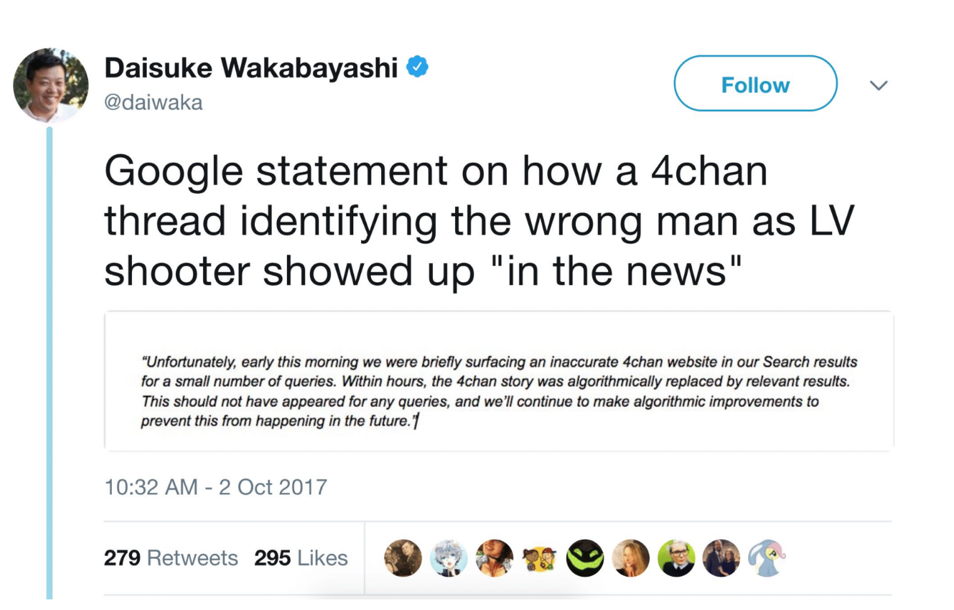
To illustrate this point, Clark recounted how online platforms amplified the incorrect online identification of the Las Vegas shooter in 2017 by pushing 4chan reddit users conspiracy theories in the online search results following the mass shooting. Within hours, an innocent man faced online harassment and blacklisting, an ordeal to which Google and Facebook simply responded ‘the algorithm did it,’ begging the question: what’s behind an algorithm? (Figure 1.)

Figure 1. Wakabayshi, Daisuke (@daiwaka). October 2, 2017, 10:32 AM, Tweet.

Clark defines algorithms as the “computational processes embedded into our software” that in turn “predict, recommend, and speculate about our interests” in our all digital interactions. This is to considerable effect and risk as Gillespie warns in “The Relevance of Algorithms,” “as we have embraced computational tools as our primary media of expression, and have made not just mathematics but all information digital, we are subjecting human discourse and knowledge to these procedural logics that undergird all computation.” (Gillespie, 2014, p. 168) Clark then asks what if the “ghost in the machine” was understood by technology users and an “interrogation of algorithms” was a fundamental element of the digital environment? (p. 169)

Open Data and Algorithmic Awareness

Clark grounds this call to action in the EU General Data Protection Regulation (GDPR) “right to explanation” or “meaningful information about the logic involved” in an algorithmic decision. Clark posits GDPR is an international opportunity to demand algorithmic transparency and therefore positions digital literacy as a form of activism.

Clark and Kaptanian led a series of “algorithmic awareness” exercises that they piloted with MSU undergraduate students. First, they broke down the core functions of an algorithm including searching, filtering, ranking, and parsing information through illustrating the “weighted graph” of how Facebook ranks your connections online which in turn shapes your Facebook feed, a theoretical concept which is readily understandable to a user of social media.  

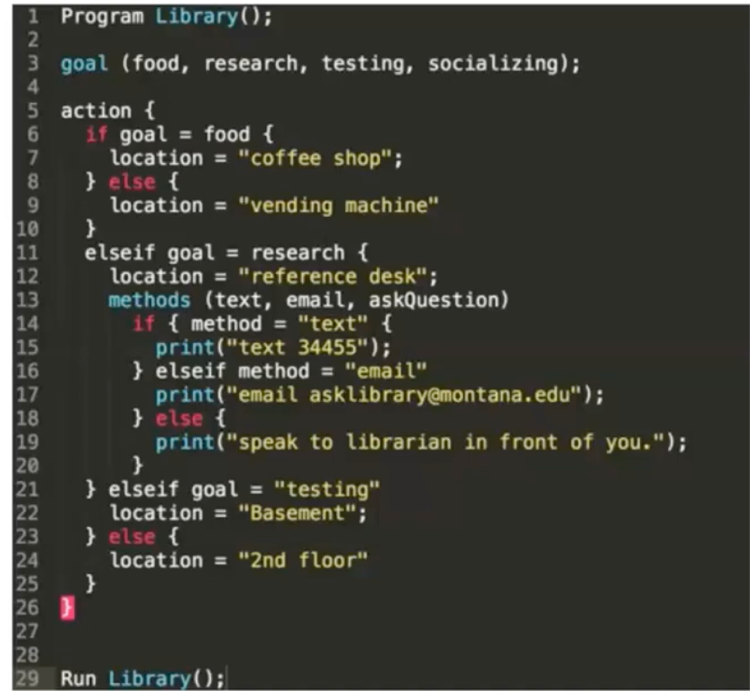
In the next exercise, Clark and Kaptanian aim to demystify the technical aspects of the algorithm by utilizing ‘pseudocode’ through which participants are asked ‘program the library’ or code different goals with the possible actions within a library to reach those goals. For example, the goal of ‘research’ could be achieved by the possible actions: ‘reference desk’ and ‘computer lab.’ They also introduced ‘methods’ as an added layer for achieving the task, like ‘emailing a librarian,’ as a tangible approach to the if, and, or logic underlying all code (Figure 2).

Figure 2. Clark, Jason, 2019, Github algorithmic awareness pseudocode template.

Despite the moderator’s best efforts to explain the technical structure of code through the tangible and familiar spaces of the university library, the exercise in practice proved difficult for the participants, requiring double the time to complete than the suggest 5-7 minutes. However, it was the follow-up questions to the exercise that proved the most valuable in understanding the limitations or code. Kapitanian asked the group who we envisioned as our audience in generating our code and we all answered differently. Some participants envisioned students, other’s faculty, staff or even an outside visitor. Collectively we came to discuss, however bound by brackets and formulaic syntax, our ‘code’ was still limited by our embodied experience enacted within social structures. Therefore, despite their neutral appearance, algorithms and the information they retrieve are subjective (Bates, 2006, p. 11-12).

The presentation concluded with a brief discussion of data profiling, and the steps users can take to understand what personal data is stored in platforms like Facebook and Google by walking participants through how to view and download their digital profiles. For many in the discussion, this exercise was nothing new and limited because their Ad Personalization feature in Google was already turned off.

‘Pedagogy for an Algorithm’

Moreover, the discussion “Open Data Activism in Search of Algorithmic Transparency: Algorithmic Awareness in Practice,” both highlighted the urgent need to build algorithms awareness into digital literacy efforts and while offering tools for educators and students to build that competences and ultimately framing that as activism.

The survey circulated at the close of the event, further emphasized these points. The survey solicited the level of resources and education around algorithm awareness at my current institution as well as asked at what grade level I thought it appropriate to introduce digital literacy.

My response: elementary school, or as soon as students begin to start to seriously engage with the internet.

At a moment when society is attempting to take a step back to fully understand the ‘ghost in the machine,’ it is important to see the opportunity in building digital literacy as a safeguard against current risks and advocate for change or open data in the future.

Works Cited

Bates, M. J. (2006). “Fundamental forms of information.” Journal of the American Society for Information and Technology 57(8): 1033–1045. https://pages.gseis.ucla.edu/faculty/bates/articles/NatRep_info_11m_050514.html

Gillespie T. (2014), “The relevance of algorithms” in Media Technologies: Essays on Communication, Materiality, and Society, eds. T. Gillespie, P. Boczkowski, and K. Foot. Cambridge: MIT Press, 167–194. https://www.microsoft.com/en-us/research/wp-content/uploads/2014/01/Gillespie_2014_The-Relevance-of-Algorithms.pdf

Figures Cited

Figure 1.

Wakabayshi, Daisuke (@daiwaka). “Google statement on how 4chan thread identifying the wrong man as the shooter showed up “in the news.” October 2, 2017, 10:32 AM, Tweet.

Figure 2.

Clark, Jason, 2019, Github algorithmic awareness pseudocode template. https://github.com/jasonclark/algorithmic-awareness/blob/master/modules/one/library-pseudocode-exercise-template.py