Month: November 2019
Person, Place, Thing: Grumpy Cat, Shopping Malls, and IKEA Assembly Instructions
Person: Grumpy Cat
In late September 2012, a cat photo was posted on the internet. This happens every single day. But this cat photo was different; it was the first internet appearance of Grumpy Cat. More than likely, you know exactly which cat I am referencing. How can this be? In 2015, CNN estimated that there were over 6.5 billion cat photos on the internet. With seemingly endless cat photos, how can you and I both know Grumpy Cat?
There is no denying Grumpy Cat’s internet fame. In fact, it is a photo of Grumpy Cat (real name Tardar Sauce) that appears at the top of the Wikipedia page, “Cats and the Internet”. But how did we get here? This is too brief a writing to discuss the many specific mechanics that create internet fame. However, we can certainly say that internet fame is impossible without sharing information.
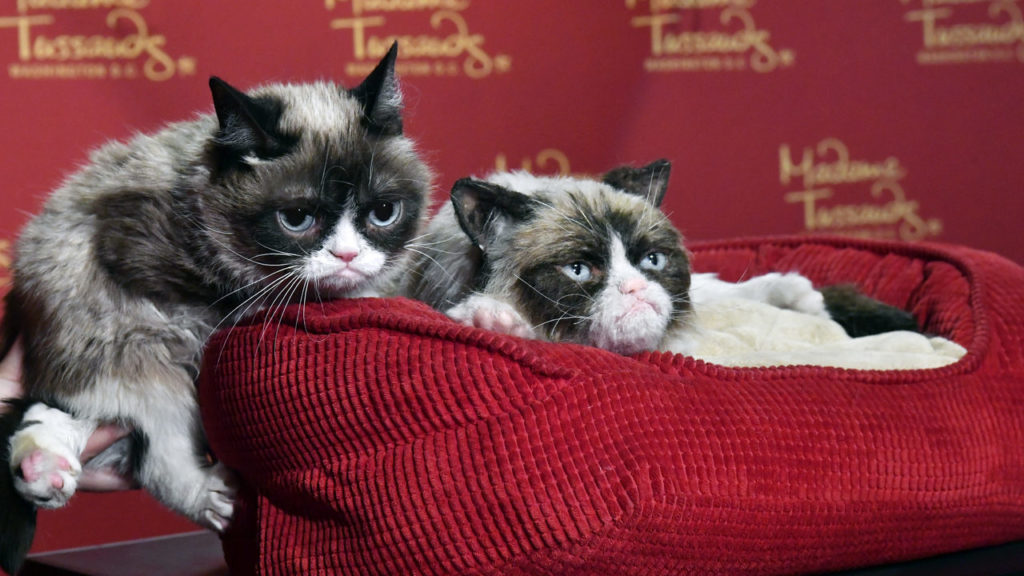
The first photo of Grumpy Cat was posted on Reddit, where users edited it into memes almost instantly. With each new iteration, a new audience was exposed to Tarder Sauce, growing her online presence. From there, it became a phenomenon. Grumpy Cat memes exploded to other parts of the internet.
The internet allows for rapid sharing of information; whether it is the sharing of current events, personal anecdotes, or cat photos. We are able to learn, research, and share faster and easier than ever before.
It is arguable that images and memes in particular are shared more than anything else online! Some only reach specific audiences, remaining within the network of its creator. Many are impossible to track the image’s source, such is their rapid spread. However, once in a while, an image or concept emerges that identifies with all, much like Grumpy Cat.
Place: Shopping Malls
Shopping malls, the ultimate retail destinations of America. Most are arranged in a similar fashion: with large “anchor” stores at each end, with smaller stores in aisles, and often a food court in between. Many malls, particularly the largest, have multiple levels. With such large interior spaces, wayfinding in shopping malls is extremely important. Shoppers need to know not only the location of each store, but the location of bathrooms, food, escalators, and exits.
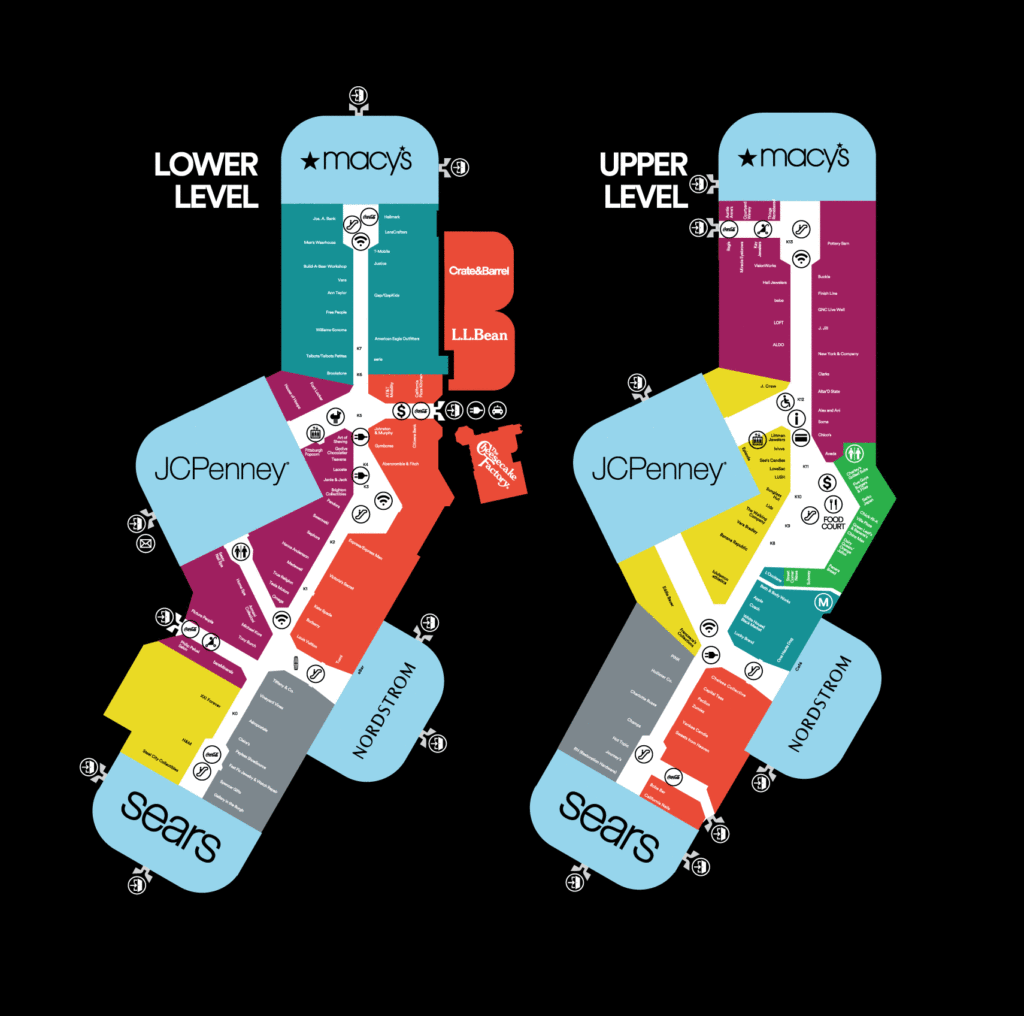
How this information is communicated to the shopper can make or break one’s experience at the mall. The shopping mall wishes to encompass every retail desire one may need, but facilitating the ability to find it is necessary. All malls employ some sort of directory; most look like a simplified floor plan displaying the location of each store and amenity.
Some directories separate stores into categories, ie. Women’s Clothing, Men’s Clothing, Gifts, Kiosks, Food. Others choose to list stores alphabetically, or break down locations by zone. Signage in the aisles usually centers around the anchor stores, and therefore requires knowledge of the general direction you are heading.
In my own experience, directory signage is often few and far between, requiring the shopper to retain the information presented to them. Thinking back to the suburban mall my friends and I used to frequent in high school, the signage was sparse, and escalators were tucked away such that you could only use them if you had prior knowledge of their location.
Given this, one must consider: are malls intentionally making wayfinding difficult for shoppers? By wandering around a mall looking for a specific store, one is more likely than not to enter other stores along the way, adding additional purchasing opportunities. All this wandering will likely make you hungry, requiring you to purchase food at the mall. And god forbid you forget where you’ve parked!
Thing: IKEA Assembly Instructions
If you’ve ever purchased furniture from IKEA, you may know all too well that IKEA assembly instructions can be difficult to decipher. IKEA is infamous for requiring their customer to assemble their purchase; in a bid to reduce costs, most furniture comes flat packed, with assembly instructions explaining the process.
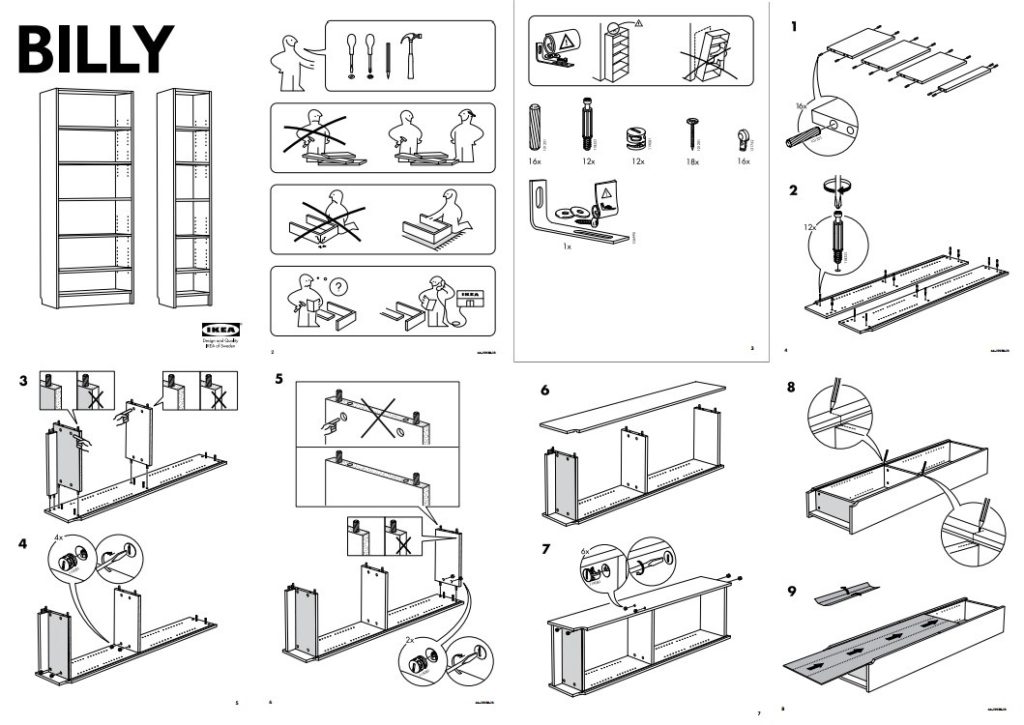
These illustrations precisely outline assembly steps with accurate scale drawings of the pieces and hardware necessary for each step of the task. The consumer must correctly identify each part and utilize it in the correct way at the correct time. Given this complexity, there is no doubt that these illustrations are highly designed, tested, and optimized before released to the public. In fact, IKEA dubs its instruction designers who are responsible for distilling product assembly into its most basic steps “Communicators”.
IKEA communicators take care to not overwhelm the consumer by making the installation instructions only as detailed as necessary. However, by relying on the customer’s observation and interpretation skills alone, it is possible that mistakes will be made. Of course, if all else fails, there is always the option to pay an additional fee for IKEA’s assembly services!
Now, why – if IKEA furniture requires assembly by the average person – do the instructions use only graphics to convey the necessary information? IKEA’s products are sold in 38 countries across the world. Creating installation instructions graphically eliminates the need for translation. In their mind, the information literacy of the consumer is the only barrier to successful assembly. For some, this is a skill in need of practice.
IKEA’s corporate youtube account revolves around design inspiration and product announcements, inferring that the company’s communicators believe their instructions to be sufficient without tutorial videos. However, countless third-party youtube videos exist explaining assembly for nearly any IKEA product imaginable, with individuals sharing their own experiences, tips and tricks. Through this dissemination of information, individuals help to fill in what they perceive to be an information gap – space that IKEA has left.
Person, place, thing: Ada Lovelace, Brooklyn Public Library, Personal Computer
Person: Ada Lovelace
Ada Lovelace (1815-1852) was an English mathematician and writer known to have written the first algorithm ever, way before computers existed. She worked with Charles Babbage (1791-1871), the inventor of the Analytical Engine, a project for a mechanical general-purpose computer. In 1842 Babbage asked Ada Lovelace to translate a review made by an Italian mathematician of his Analytical Engine. The result was the translated review plus a set of notes explaining how the machine could work and what kind of computing it could make. One of the notes was a detailed method for computing the Bernoulli numbers, a calculus of math theory, using the Analytical Engine. This set of instructions to be done by a specific machine to produce something more than a calculation is known as the first algorithm and because of it, Ada Lovelace is also known as the first computer programmer.
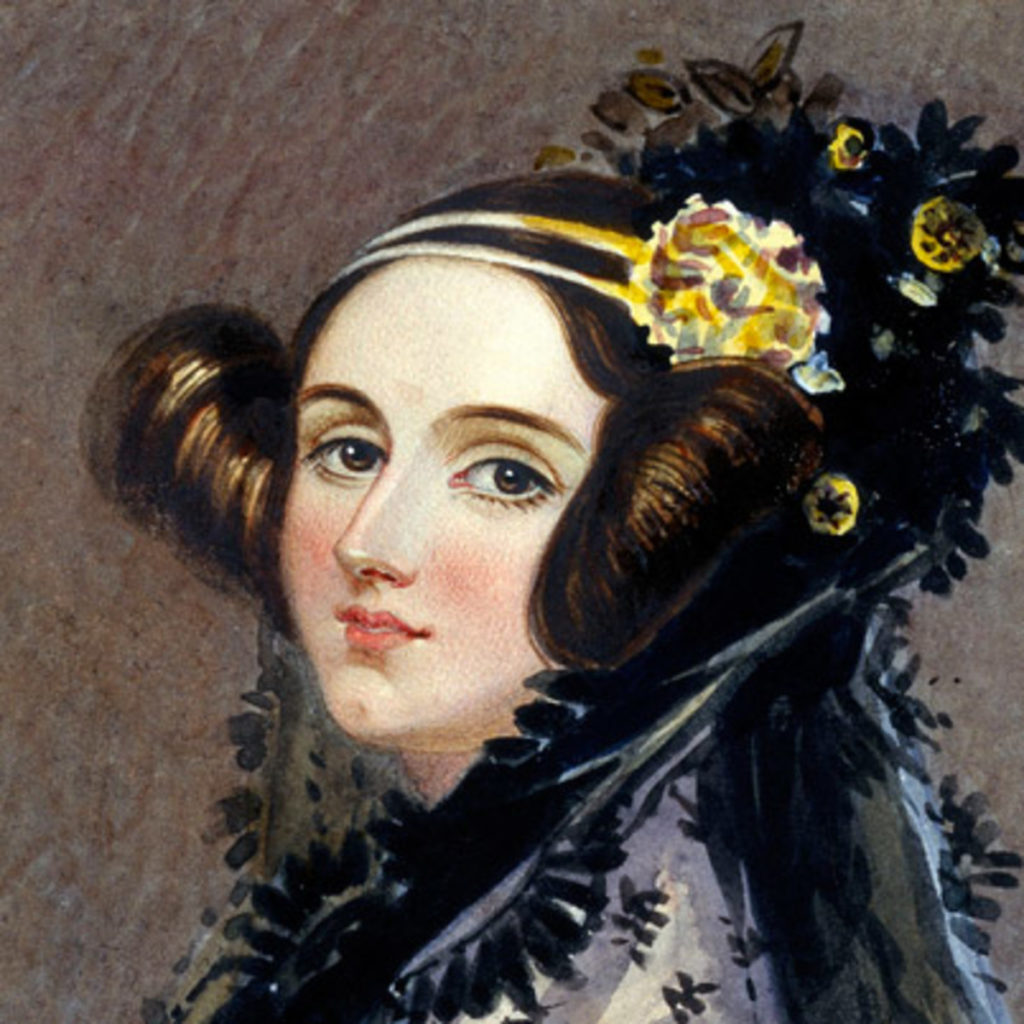
At that time it was not common that women were trained in maths or science as she was. Ada was the daughter of the famous English poet Lord Byron and Annabella Milbanke, Lady Byron who was also trained in mathematics. Her mother made sure that she got a solid science and overall education through private tutors so that Ada would keep away from the insanity she accused Lord Byron of. Thanks to one of her tutors, at a very young age Ada Lovelace met Charles Babbage and despite the age difference, they worked as peers. Babbage recognized Lovelace’s analytic skills and outstanding intellect calling her “The Enchantress of Numbers”.
Ada Lovelace’s contribution was not only the algorithm itself but in the set of notes, she also wrote about her auspicious vision of what the Analytical Engine could achieve.
The operating mechanism can even be thrown into action independently of any object to operate upon (although of course no result could then be developed). Again, it might act upon other things besides number, were objects found whose mutual fundamental relations could be expressed by those of the abstract science of operations, and which should be also susceptible of adaptations to the action of the operating notation and mechanism of the engine. Supposing, for instance, that the fundamental relations of pitched sounds in the science of harmony and of musical composition were susceptible of such expressions and adaptations, the engine might compose elaborate and scientific pieces of music of any degree of complexity or extent. (1)
Ada Lovelace was definitely ahead of her time. The first actual computer came to life around a century later and it, in fact, accomplished what she envisioned.
Place: Brooklyn Public Library
Brooklyn Public Library Central Library is one of the most iconic buildings in Brooklyn. The construction of the building started in 1912 commanded by architect Raymond F. Allmirall but it didn’t open to the public until 1941. The structure is built to resemble an open book, with its spine facing Grand Army Plaza. The great entrance is ornamented with fifteen sculptures of famous characters from American literature like The Raven from the poem by Edgar Allan Poe, Tom Sawyer from the novels of Mark Twain and Moby Dick from the novel by Herman Melville. The entrance also has two massive columns decorated with reliefs representing the evolution of arts and sciences.
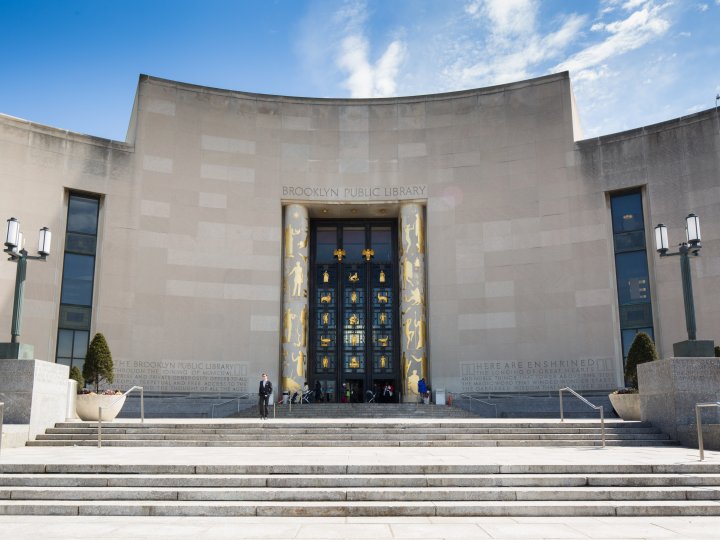
My favorite collection within the library is the Brooklyn Collection, a collection of documents of Brooklyn from pre-colonial times to the present that includes books, photographs, newspapers, maps, atlases, directories, prints, illustrations, and posters among other media. In this collection, I could see the designs and photos of the construction of the subway station I use every day.
The Central Library consists of 352,000 sq feet organized in ten different departments and collections offering numerous programs and services. One of the services that I use the most is the Shelby White and Leon Levy Information Commons that offers a wide range of programming related to digital media and technology. There is an amateur recording studio equipped with and editing workstation that I used for recording an episode of a podcast.
Reflecting about BPL’s services and collections takes me back to the text about Information Ecologies by Nardi and O’Day (1999) where they go beyond considering a library as a place for accessing information, focusing on the relationships within the ecology of the library, including the relationship between people, people, and their environment, and people and technology.
Thing: Personal Computer
The access to information we have today wouldn’t be possible without two things: the internet and personal computers. Before turning into a mass consumer electronic device, computers were used by experts in scientific settings. The earliest example of a personal computer, meaning a computer made for a single user, dates from 1956. The LGP-30 developed by physicist Stan Frankel was meant to be used for science and engineering as well as simple data processing, the price of the LGP-30 was $55,000, a good price for that type of machine at that time.
In 1962 MIT Lincoln Laboratory engineer Wesley Clark designed the LINC, which was meant to function in a laboratory setting. Some end-users from the National Institutes of Health (NIH) participated in a workshop at MIT where they built their own LINCs and brought back to their own institutions.
In 1965’s New York World’s Fair appeared Olivetti Programma 101, which was the first to be described as a desktop computer. 40,000 units were sold including 10 sold to NASA for use on the Apollo space project. The cost of the Olivetti Programma 101 was $3,200. Let’s jump to the year 1971 when the Kenbak-1 was released. This is considered the earliest personal computer by the Computer History Museum. It was designed by John Blankenbaker and the price was $750.
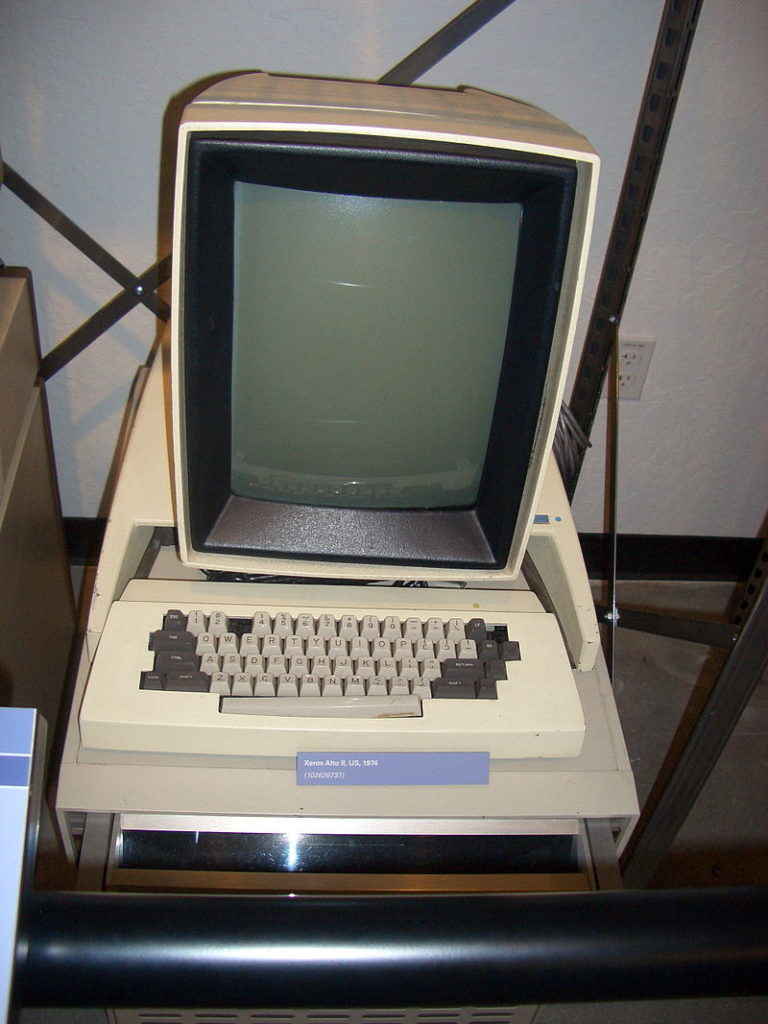
The world would have to wait until 1973 to see a personal computer that looks somewhat like the computers we know today. The Xerox Alto had a graphical user interface (GUI) with windows, icons, and mouse. It also allowed users to print documents and share files. As per the software it had a word processor, a paint program, a graphics editor and email. From that moment fort the development of personal computers occurred rapidly and all the designs that came after the Xerox Alto were in one way or another inspired by it.
End notes
(1) Menabrea, Luigi Federico; Lovelace, Ada (1843). “Sketch of the Analytical Engine invented by Charles Babbage, with notes by the translator. Translated by Ada Lovelace”. http://www.fourmilab.ch/babbage/sketch.html
Resources
Brooklyn Public Library Website www.bklynlibrary.org
Computer History Museum Website https://computerhistory.org
Essinger, J. (2014). Ada’s algorithm : how Lord Byron’s daughter Ada Lovelace launched the digital age. Melville House.
Meriwether, D. H. (2018). Ada Lovelace. Salem Press Biographical Encyclopedia. Retrieved from http://eds.a.ebscohost.com.ezproxy.pratt.edu:2048/eds/detail/detail?vid=3&sid=e89df074-5928-4a07-ac04-f9a65ce05cb7%40sessionmgr4006&bdata=JnNpdGU9ZWRzLWxpdmUmc2NvcGU9c2l0ZQ%3d%3d#AN=88806839&db=ers
Nardi, B. & Day, V. L. (1999). Information Ecologies: Using Technology with Heart.First Monday, 4(5), May 3, 1999. https://firstmonday.org/ojs/index.php/fm/article/view/672/582
Striking out to find my way home: Catholicism and information
This world is filled with persons, places, and things, interrelated with other persons, places, and things and given meaning by the context surrounding them. In thinking through this essay, considering what person, place, and thing are relevant to the themes of this course, to the field of information, and my future career within it, what thoughts and memories kept recurring surprised me. Though memories of library visits, of librarians, of all the things I have accessed because of libraries, I recognize that these all pertain to my experiences as an information seeker and user, less to my future in the information field. In reading pieces like Ravi’s (2019) “Miss Manhattan” and studying the ever-shifting sands of the information field, its constant convolution, I shifted with this these ideas. In pushing beyond where my mind has gone before, I found myself coming right back home – Catholicism.
I am a Catholic. I go to mass. I receive the body of Christ. Person. Place. Thing.
Take away a single part of this and Catholicism falls apart. Ravi’s essay inspired me to critically consider their alternative approach to thinking about the relationship of persons to places to things, its delicate identification of these three concepts as congruently existing in modeled sculptures across New York (2019). If one is able to consider persons, places, and things in a way understanding of layers of interconnection, even congruence, between them, then Catholicism must be relevant here, at least in a personal context. As a religion, it is, in theory, intangible and unembodied, thus ineligible for consideration as a person, place, or thing. But as hours of lecture and class readings have taught me this semester, practice, not theory, defines purpose and nature. As such, Catholicism is practiced and becomes known to us, becomes something we live, touch, and exist in. Because of this, I believe it appropriate for discussion in this post.
As person, Catholicism clearly exemplifies Bates’ (1999) concept of the metafield, as defined in identifying the information field as one that encompasses others in its theory and practice. Catholicism, extant on every continent, represented in some form in every country, is a breathing example of person in that its presence is facilitated by bodies, proxied for by every baptized baby, every confirmed adult. Temporally and geographically, the Catholic Church and her followers epitomize the metafield brought to life, an overarching structure alive with billions of beating hearts. Considering Catholicism as person reminds us that metafield structures are not cold, dead things, and that information absent a human vessel is impossible.
As place, Catholicism complicates, not theoretically but narratively. As a religious practice, Catholicism has entrenched itself in landscapes around the world, from far-flung towns to the largest of urban centers. Close examination of how Catholicism reached so many places quickly reveals its “difficult heritage,” a concept meant to describe the marking of “atrocities perpetrated and abhorred by” the entity that committed them as “significant history” (Macdonald 2016). The complication lies in the idea of the institution of Catholicism “abhorring” its historical policies and actions. Schools, rectories, religious camps, and sacristies where priest abuse occurred for decades still stand, the reality of what happened in these places still largely unacknowledged and unrectified by the Catholic Church. Physical Catholic structures, like churches, monasteries, convents, were used to extend the power of the Church and those that supported her into populations that did not want them, to colonize entire continents. Again, the Catholic Church again relegates the reality of their actions to darkness. As so much historiography and truth-telling has demonstrated, the physical manifestation of Catholicism as geography engenders a difficult heritage almost everywhere it has gone – understanding Catholicism as place opens this heritage up to being worked upon, to being brought into its own salvation through the use of information.
As thing, Catholicism explodes in relevance. At the heart of this faith is the scripture housed in our Bible, which, even if it is literally believed to be authored through the guidance of the Holy Spirit, is a just a book. Bolstering this text are pamphlets laid out in Church vestibules, ready for hungry eyes on Sunday mornings, Catechisms awaiting new students every fall, textbooks on theological morality, apologetics, and other Catholic philosophies. Catholicism’s entire existence is supported by its own production of information, cultivated over thousands of years. To invoke the language of Elfreda Chatman (1999), Catholicism as thing has been used to build a very large round in which every Catholic is expected to live forever. If there is anything to learn from considering Catholicism as thing, it is that the hard to reach and the information impoverished are not always those who are unaware or afraid of how information can be generated, accessed, and used, but also those are adept at these practices within their life in the round. Understanding this means we can address the invisible walls separating things like Catholicism from the rest of the world of information.
As centerpiece or backdrop, the persons, places, and things that make up Catholicism support or exemplify course themes of understanding the breadth of information science as a metafield, of understanding the use, misuse, or disuse of information surrounding history, and reaching information users who are hard to reach. On a personal level, the persons, places, and things that make up Catholicism represent who I am and why I want to work as an information professional.
I am a practicing Catholic, my journey within the Church pocked by the pitfalls that come with the rigors and rigidity of organized religion. Still, I do not walk away because I believe leaning in, listening, and filling gaps is part of my path as a Catholic. As I continue to study information science and understand this field, I have found that this belief in these things lends itself greatly to information work and filling gaps for those in the world we share. Considering Catholicism as person, place, and thing has demonstrated to me that entering the information field as a profession does not feel foreign – in many ways, it feels like coming home.
Bibliography:
Bates, M. J. (1999). The invisible substrate of information science. Journal of the American Society for Information Science, 50(12), 1043-1050.
Chatman, E. A. (1999). A theory of life in the round. Journal of the American Society for Information Science 50(3), 207-217.
Macdonald, Sharon. (2016). “Is ‘difficult heritage’ still difficult?” Museum International 67: 6–22.
Ravi, A. (2019, September 23). Miss Manhattan [blog post]. Retrieved from https://studentwork.prattsi.org/foundations/2019/09/23/miss-manhattan/.
Schwartz, Joan M. & Terry Cook. (2002). “Archives, records, and power: the making of modern memory,” Archival Science 2: 1–19.
Person, Place, Thing: Film, Politics, and Poetry in the Archives
Person: Katherine Groo
I first heard of Groo, who is a professor of film and visual culture at Lafayette College, through her controversial Washington Post piece in December 2018 titled “FilmStruck wasn’t that good for movies. Don’t mourn its demise.” The essay was in response to the then-recent announcement and subsequent outrage that the popular movie streaming service FilmStruck (run by Turner and Warner Bros. and known for its arthouse titles) would be shutting down. In the essay, Groo writes bluntly, “FilmStruck was never a library or a film archive. It was a for-profit streaming platform that provided access to those who could pay for it.” Groo goes on to discuss actual film archives and libraries, including some that also function as (free) streaming services, such as the Internet Archive and Kanopy. She notes that cinema tends to produce many, many artifacts that are not seen as valuable enough for preservation, and suggests that instead of advocating for the for-profit streaming service with its selection of classics, FilmStruck fans advocate for funding for film libraries and archives or other models that will provide open access to a broader collection of movies. The essay helped me to understand what libraries and archives can and should do, by exposing the biases of a streaming service that is at first glance structured much like an archive. More recently, Groo published a book called Bad Film Histories: Ethnography and the Early Archive, in which she discusses her interactions with ethnographic film fragments from the first few decades of cinema. Like her FilmStruck piece, Groo’s book is a fascinating look at archival theories and practices from the academic perspective of a film historian. Despite the fact that she comes from a film background and is not a trained archivist, Groo’s thinking has grounded my understanding of my place as an archivist, working with historians, researchers, and other patrons. She takes the idea of the archive and asks readers to consider alternatives to old models of value-based preservation and profit-based access. Groo discusses how deeply things are shaped by how information professionals organize, name, and share resources. In her FilmStruck essay, Groo writes that history is never a “comprehensive body of works tucked away in an archive,” and that there are always new ways of understanding what we think we know that are not dependent on canonical bodies of work, made canonical by individuals and forces of society not necessarily documented with the works themselves.
Place: Interference Archive
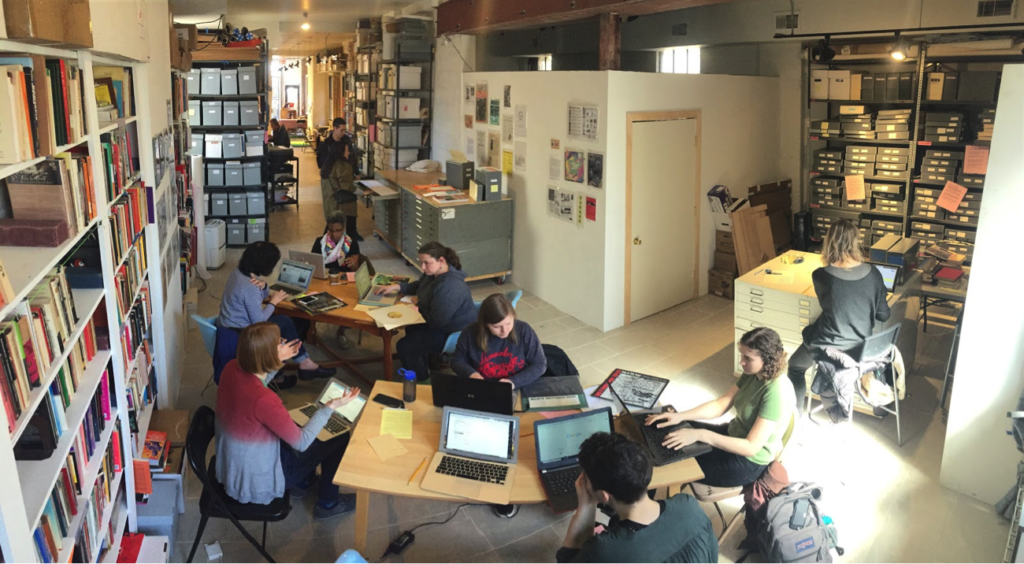
I was first introduced to Interference Archive, which is located in Park Slope, several years ago, and I have been volunteering there since. It’s a place that has shaped my idea of what archives can look like and how archivists can be community members and activists. Interference Archive is an entirely volunteer-run organization that collects archival materials related to social movements and makes those materials available in their open-stacks space. One of the most fascinating things about Interference Archive is their emphasis on accessibility to their materials. All of the collections, including things like posters, zines, buttons, books, and records, are available in their open stacks for any patrons to touch and interact with. For many people who have only interacted with archival collections through the barriers of academic or museum collections with all of their barriers, the openness at Interference is shocking. They also put on exhibitions and programs related to their collections or to relevant work being done by members of the community. The lack of institutional affiliation means that Interference Archive is able to have entirely independent programming. Their programs include workshops, speakers, film screenings, kids events called “radical playdates,” and many more types of events, expanding ideas of what role archives can play in a community. At Interference Archive, the collections are not behind barriers and used only for research; they are the totally integrated into present-day action. As an archivist, I want to think about how the work I am doing is best not just for the materials I work with, but for the people those materials serve. The Archive does not simply house political content and move on; its structure, goals, and events reflect the radical potentials of the materials they collect.
Thing: Lost & Found

Another inspiration to me as an archivist that comes from outside the archives field is Lost & Found: The CUNY Poetics Document Initiative. Lost & Found is a project and publication based at the CUNY Graduate Center, with doctoral students in their Enlish program serving as researchers and editors. Focusing mostly on 20th century American poets, Lost & Found editors use archival materials to research their subjects, and to draw previously unpublished works, correspondence, journals, lectures, and writings in translation into publication for the first time. The series is published annually as a collection of chapbooks—previous issues include works from Audre Lorde, June Jordan, William S. Burroughs, Kathy Acker, Diane di Prima, and more—but research originally done for Lost & Found also frequently turns into book-length publications. The series’ founder, Ammiel Alcalay, says that the principle behind the series is for researchers to “Follow the person.” This is a pretty surprising position for many literary scholars to take—one that at first ignores the canonical context for a writer’s work in the form of literary “schools,” periods, or groups of associates—and instead focuses first on the hard evidence of an individual’s archival output. This series is so exciting to me as an archivist because it integrates scholarly research and archival work. It’s an example of how archivists can help open up new ways of seeing subjects and people.
Resources:
Groo, Katherine. Bad Film Histories: Ethnography and the Early Archive. Minneapolis: University of Minnesota Press, 2019.
Groo, Katherine. “FilmStruck wasn’t that good for movies. Don’t mourn its demise,” The Washington Post, 3 Dec. 2018.
Interference Archive.https://interferencearchive.org/
Lost & Found, The Center for the Humanities. https://www.centerforthehumanities.org/lost-and-found
Bringing a businessman, a library, and a movie into the information world
Imagining new contexts is an excellent way to capture the role of information in topics familiar to me. This article considers start-up founder Adam Neuman, The Beinecke Rare Book & Manuscript Library, and William Burrough’s cut-up film “Towers Open Fire,” a person, place, and thing that pre-date my information science career. Put in the context of information science, all three encounters have taken on new meanings.
By Jack O’Malley
Person: Adam Neumann
Adam Neumann was the CEO of WeWork. “Was,” is the word that hints at a fascinating business case that has recently evolved into a character study. As The New York Times summarizes, WeWork’s fall from a $47 billion private valuation to $7 billion after a botched IPO, which failed partly due to concerning revelations about Nuemann, “came with an even more astonishing exit package for Mr. Neumann: The 40-year-old could receive more than $1 billion after selling his shares to SoftBank and collecting a $185 million consulting fee.”1 A more critical article in The Atlantic paints a more vivid picture, writing that WeWork’s failure “has established Adam Neumann, who escaped from the wreckage a billionaire, as a figure of almost mythical monstrousness—like some capitalist chimera of Midas and Houdini.”2
In a way, observers have invested themselves in classifying Neumann. Everyone wants to answer the question “where does he fit in our understanding of American business?” Yet, stories like these two gloss over the business itself, which employs thousands of employees and serves hundreds of thousands of tenants (or members). The obsession with Nuemann follows a classic error of thinking, which assumes a singular case has more to tell us than the norm. The space Neumann literally takes up in the news crowds out reporting about the fate of those who outnumber Adam Neumann by the hundreds of thousands. Even The Atlantic has trouble imagining creatively who WeWork might be for. “Most modern workers deal with the supply, transport, marketing, sale or investment of stuff,” they write, acknowledging the social force that made WeWork popular.3
Of course, many modern workers don’t sit at a computer. In the eighteen months that I was employed by WeWork, most of the WeWork staff at any given location were people of color making an hourly wage in exchange for manual labor. “Stuff” is often the labor of others. Inventing categories for Adam Neumann seems somehow to have erased many others.
The Beinecke Rare Book & Manuscript Library
The Beinecke at Yale holds some incredible relics: James Baldwin’s papers, over 700 Japanese manuscripts, the Lewis and Clark exhibition maps, and (I once a heard a rumor) William Howard Taft’s trousers. These objects have real power that might convince you that Benjamin’s “aura” really does exist. Incredibly, if you request it, you can touch them. As a student, I thought the chance to be so close to knowledge was simply a privilege; coming to believe it is a right brought me to library science. I highly recommend a trip!
The university keeps this unique space open to the general public and accepts requests from all researches interested in accessing the stacks. In fact, the librarians do almost everything short of handing out flyers on the corner to invite people to see their collection. They admirably emphasize diversity in their holdings, hold readings and award prizes, give tours, and display their most recognizable objects, like the Gutenberg Bible. Still, in the best way, it feels most true to stay that the librarians and curators just want everyone to stand closer to the books.4
“Towers Open Fire”
Best described as “really funky,” this William Burrough’s movie explores the theory of “cut ups” in a series of random images, not all pictorial, and a voiceover. The climactic moment … I won’t spoil! Watch it, show your friends, and see if you all agree on the climax. Burroughs argued that, although the arrangement is random, “in any case you will find that it says something and something quite definite.”5 In its own way, the rapid cutting internalizes user theory. Burroughs was emphatic about the egalitarian nature of the cut ups. I love it because the movie does not do any of the work we expect from a typical movie. In fact, it can feel like watching the movie is the only way to summarize it. Just as it doesn’t do any work, it doesn’t tolerate miscommunication, and the only assumption it makes about a user is that they hit play.
A few years ago, finding “Towers Open Fire” on YouTube made me feel that, yes, information truly is free! That excitement has given way, however, to anxiety about the long term preservation of the film. For instance, an Italian language film clip channel posted the video above, and, while I appreciate that I could find Burroughs work with a simple search, I do not want to trust a semi-anonymous YouTube user. In addition to concern for long-term preservation of what might look like nine minutes of b-roll, I’ve come to recognize another problem too. If there are preserved copies, why aren’t they as accessible as the one on YouTube?
End Notes
1 Amy Chozick, “Adam Neumann and the Art of Failing Up,” The New York Times, November 2, 2019, sec. Business, https://www.nytimes.com/2019/11/02/business/adam-neumann-wework-exit-package.html.
2 Derek Thompson, “WeWork’s Adam Neumann Is the Most Talented Grifter of Our Time,” The Atlantic, October 25, 2019, https://www.theatlantic.com/ideas/archive/2019/10/how-weworks-adam-neumann-became-billionaire/600607/.
3 Thompson, “WeWork’s Adam Neumann Is the Most Talented Grifter of Our Time.”
4 “History and Architecture,” Beinecke Rare Book & Manuscript Library, December 20, 2018, https://beinecke.library.yale.edu/about/history-and-architecture.
5 William Burroughs, “The Cut Up Method,” Accessed November 5, 2019, https://www.writing.upenn.edu/~afilreis/88v/burroughs-cutup.html.
Person, Place, Thing: Ian MacKaye, Grand Central Station, Directories
(Photo: SAUL LOEB/AFP/Getty Images)
Person: Ian MacKaye
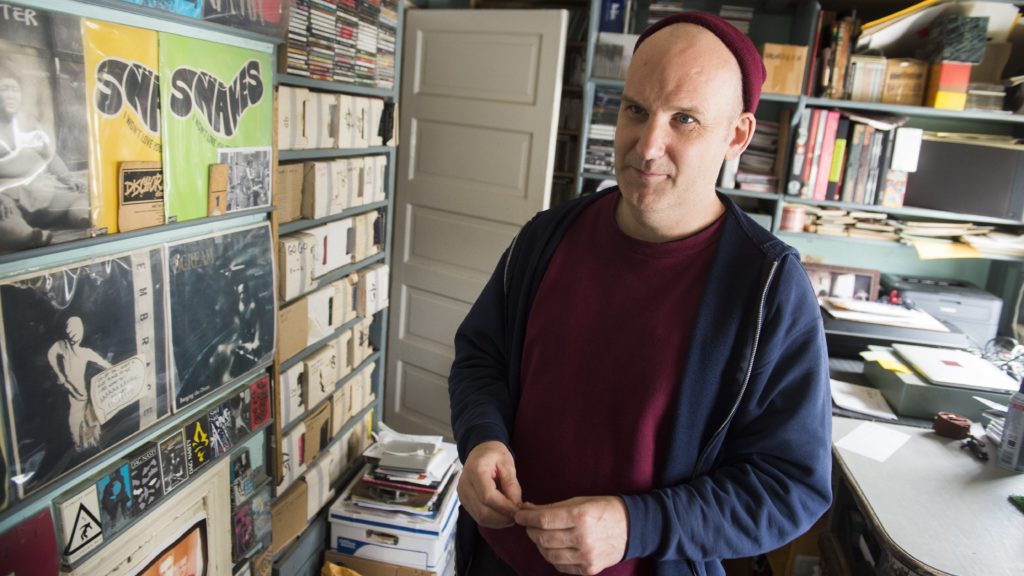
Ian MacKaye is a DC native and founder of the independent punk and hardcore label Dischord Records. Some may call him one of the founding fathers of the DC punk and hardcore scene because of his involvement in seminal bands Minor Threat and Fugazi, and the support he offered other DC musicians through his label. Most notably, Ian MacKaye has archived the DC scene since the late 1970’s. By saving flyers, tapes, records, photographs, zines and other ephemera relating to the music scene, MacKaye took on the role of a community archivist as a teenager. Much of his collection stemmed from saving every little bit that had to do with his own bands and label, and eventually he branched out, saving much of the materials encompassing the entire DC scene.
The act of saving may have started out as a hobby or a simple habit, but as MacKaye’s collection eventually grew it became admired, recognized and most importantly, it was deemed as useful. MacKaye has been the subject of various documentaries and books, and much of his resources have been referred to, not only tell the story of his own projects, but to help shape the voice to the influential, underground, scene he helped found. This is especially important in that he saved materials that many people didn’t think to save, and so without his collection much of the story would have been lost. In 2013, he was invited to speak at the Library of Congress on his role as a citizen archivist, which was impressive considering MacKaye has no formal archival training. He has continued on his mission and has begun to digitize not only the papers from his collection, but the music as well. Much of the formats of the 1980’s are fragile cassettes, which MacKaye has been repairing and restoring to improve their sound upon digitization. Most recently he has had the help of Smithsonian archivist Nichole Procopenko to assist in the organization and proper storage of his collection.
(Photo: Frank English)
Place: Grand Central Station
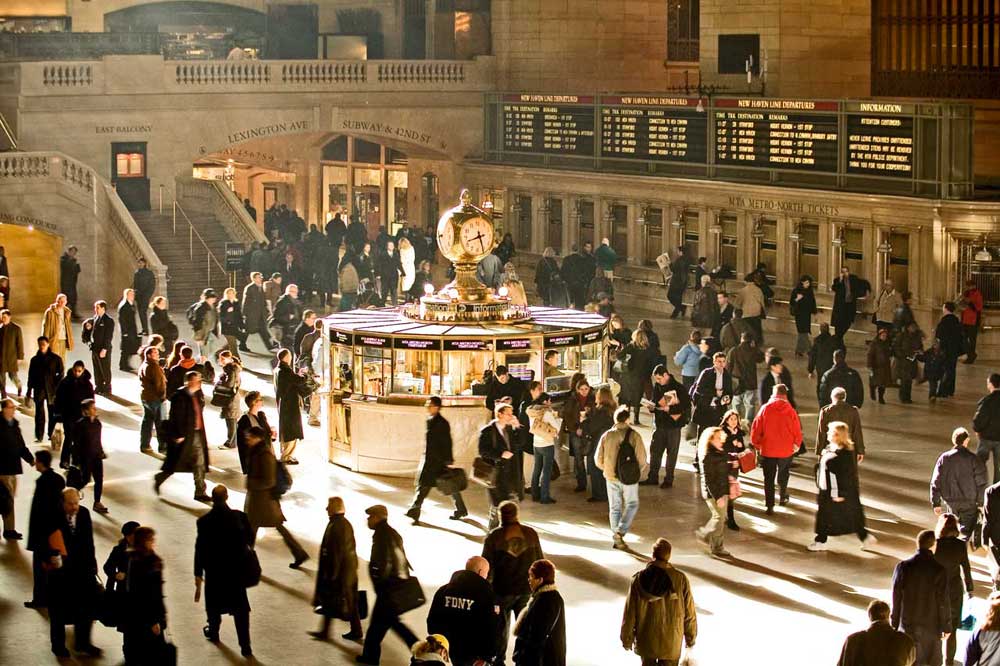
Grand Central Station has a special place in many New Yorker’s hearts. It’s a majestic building full of rich history and sneaky little easter eggs like the whispering gallery. The building is a preserved gem of old New York, unlike its old counterpart on 34th street which saw its demise in 1963. There are many areas in the building worth exploring, if one has the time; I almost always discover something new when I’m passing through, whether it be a new chandelier or a Vanderbilt acorn. One of the most striking things about Grand Central aside from its aesthetics is its impressive flow of information. By observing the main concourse one can see people meeting their loved ones and scurrying toward their destinations. Although the internal systems and infrastructure that run Amtrak, Metro North and the various freight lines are behind the scenes, the central brain of the main concourse is the four faced clock with the information booth inside. Here, information is exchanged quickly and efficiently, almost rendering the large timetables as unnecessary bystanders. Within seconds, the booth’s attendants can easily tell you which of the 124 tracks you need to be on at any given time.
If you decide to skip the information booth the timetables are still reliable and easy to understand. They are organized by the five lines of the Metro North, each with color-coded headers that correspond with the colors of the map. The map design and the corresponding schedules are clean designs without a lot of clutter which makes them easy to read. This design is far less intimidating than the NYC Subway map. This is especially important for travelling visitors that will likely interact with the station during their time in New York. The placement of the central information hub and the timetables along the edges of the concourse provide for an organized system that allows ample room for people to get where they are going. Part of the charm of this station is the hustle and bustle of the people in the main concourse and it wouldn’t be as organized if there were no efficient information system to manage and maintain the crowds.
(Photo: Montclair History Center)
Thing: Directories
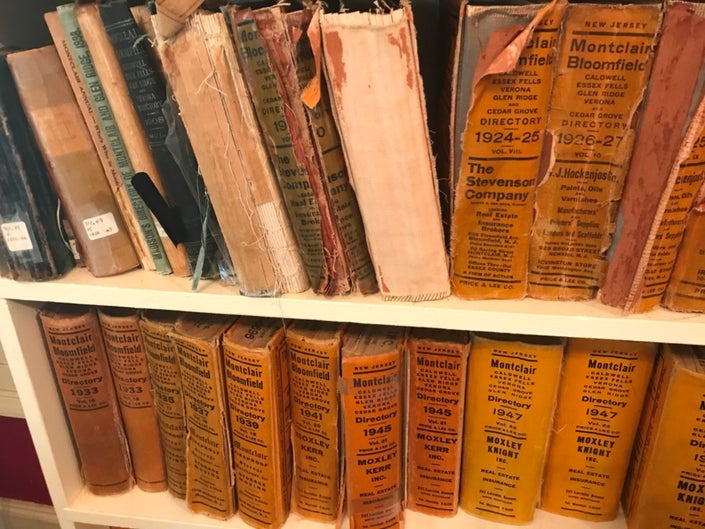
In 2019, directories seem pretty obsolete. Many municipalities stopped printing them altogether since most of what is needed can be found online. However, I have found directories to be quite helpful when handling research requests at the archive. On the most obvious end, a directory is helpful when handling genealogical requests, as the directories can provide proof of residency. Because these physical copies have not been digitized I am often referring back to them, so they are always at arm’s length. I find the directories to be extremely useful not only for genealogical requests but when researchers are looking for information on certain businesses. These tomes provide not only that, but an accurate snapshot of what a region’s commerce may have looked like at a specific time, as well as whether the region was more industrial, rural or urban. They can also provide a timeline of how often the same names and businesses continued to appear. Another wonderful quality of the directory is that it’s easy to use, so you don’t have to spend a ton of time looking through it.
I attended a NJ History Conference this week and directories continued to come up within a fair amount of the research presented. Many of the panelists were looking to old directories to find proof of female-owned businesses in the 19th century and for some, this was the only source where they could verify this information. The directories used by these researchers were also helpful in not only showing proof of a family’s business, but proof that these business owners also owned buildings and had tenants. Some of this is information one could easily verify with Census records, however having it confirmed in another source, one as neat as a printed directory, can be the piece of information a researcher needs. So although these books are sometimes seen as door stoppers, I would say they still have plenty of value in research settings.
Sources:
https://blogs.loc.gov/thesignal/2013/05/ian-mackaye-and-citizen-archiving/
https://sheshredsmag.com/bts-2/
https://brightestyoungthings.com/articles/ian-mackaye-interview
https://www.grandcentralterminal.com/history/
Vanessa Castaldo
Info 601-05
Protected: Toshiyuki Inoko, Disney World, Sawbones
A nanny, in the home, bearing knowledge
I currently work as a nanny on the Upper West Side of Manhattan. My employers are white-collar workers, committed to their careers and to their children. Like many white-collar workers in NYC, they are not from New York, and their parents do not live in the city. In this role, I have participated in a hidden network of labor and information.
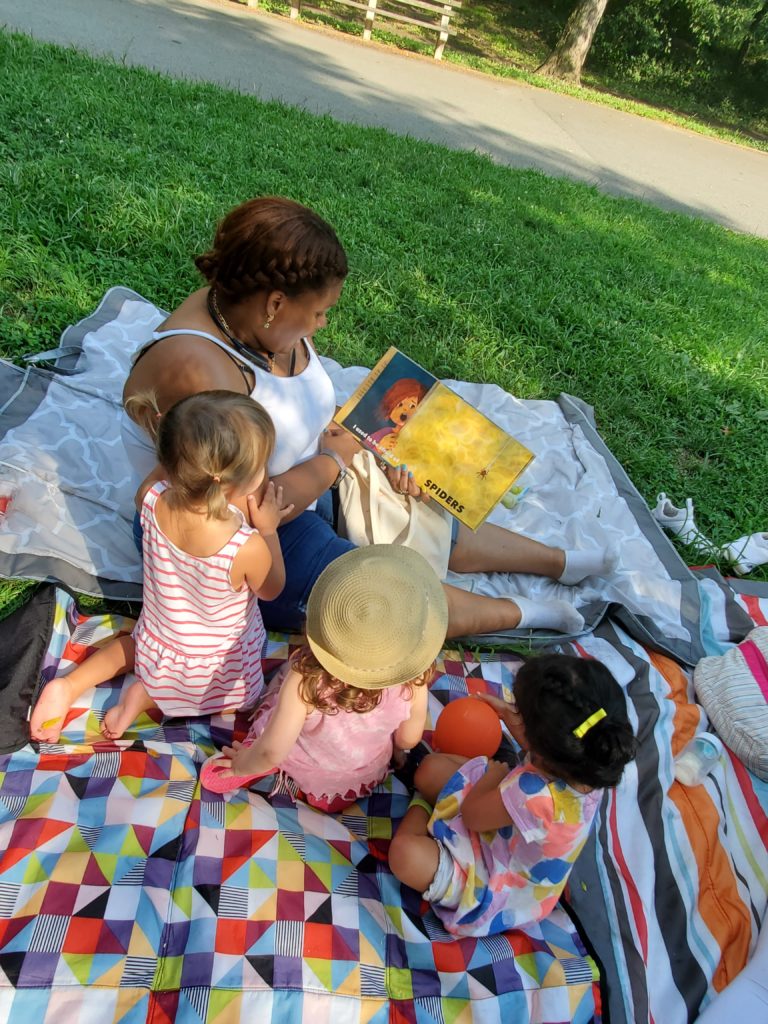
Person: Nanny
This job has revealed to me an entire system of labor that is hidden in many ways. As Downey (2014) discusses in the context of information and technology work, the work that nannies do is underrepresented by employers. It is common for nannies to work “off the books,” meaning that the income is not reported to the IRS and nannies and employers can avoid paying taxes. There are many reasons for nannies to want to remain hidden: immigration status, loss of public benefits, more take-home pay, etc. As a result, many nannies work outside of labor laws like minimum wage, overtime, and sick days.
Because there are few standards, there are a lot of nannies who are working for very little money. A nanny that I know, who is currently looking for work recently said to me, “a nanny’s worst enemy is another nanny,” describing the low salary offers that nannies are given. As Dwoskin, Whalen and Cabato (2019) discuss concerning content moderators in the Philippines, someone who is desperate may take a job with low pay because she needs the job. That makes it hard for other nannies to negotiate a better, commensurate salary. There are domestic workers unions and there is now a Domestic Workers Bill of Rights in NY State that might aid in this problem of labor exploitation. Personally, I do not know any nannies that are members of the unions or who bring up the bill of rights to their employers. In many cases, nannies would be uncomfortable to bring this up for fear of losing their job.
The work of nannies is also hidden because raising children is not typical work. Nannies do social, emotional, logistical, and educational labor in addition to physical labor. This work continues even when we are not physically at work.
Place: Household
The household is the physical workplace of a nanny. Working in the home immediately creates an intimate setting for the employee/employer relationship. I see my employers in their pajamas, I know their good and bad habits, etc. This intimacy brings a nanny into the family, which can be good and sometimes it is messy. A family member is happy to do favors, doesn’t mind when you are running late, and will answer your calls and messages after work hours. An employee, however, should be compensated for all the previously mentioned work, in addition to their salary.
In this dynamic, the white-collar workers are entrenched in their careers and outsource the labor of home and child care to their nannies. While nannies are ostensibly being paid to care for the children, they are also caring for the parents in the chores that they do and the emotional labor of maintaining the home as a familial space. Nannies are often responsible for deciding purchases, cooking meals, supplementing love and support, and constructing family.
Thing: Child-rearing knowledge
In the case of career nannies, as they approach retirement, they will have raised upwards of 20 children in their careers. With this experience, and perhaps the experience of raising their own children, nannies bring a wealth of knowledge to their jobs. For first-time parents, it is often the case that they have no clue where to start to be parents. Parenting is not something that we can study in school, and having children is obviously independent of one’s ability and knowledge of parenting. Sleep training, potty training, learning to read, etc. can be intimidating to parents, but are essential to the growth of the child, and with their experience, nannies often take on these responsibilities. Nannies construct household systems in addition to relaying knowledge and skills to their employers. These household systems include children’s daily routines, nutrition, sleeping schedules, and housekeeping maintenance.
Nannies bring traditional knowledge from their own cultures into the families that they work for. The nannies that work in my building are from all over the world, bringing with them their culture. From home remedies, to old wives’ tales, to cultural values, to folk songs and stories, this cultural knowledge is passed to the children, who then teach it to their parents. For non-native New Yorkers like my employers, they live away from their families and don’t have regular support or cultural knowledge from their parents.
A nanny’s knowledge of raising children is unmistakably valuable. However, this value is not reflected in the status, rights, salaries that nannies receive. This recalls the questions from the beginning of the semester from Bates (2016) and Buckland (1991): “what is information?” and “who gets to decide what information is?” Cultural knowledge and personal experience are not valued as information. Children-rearing is seen in American culture as women’s work, which is still undervalued in society. In addition, the emotional work and knowledge of raising children is difficult to measure, making it less valuable in the eyes of capital.
Resources:
Bates, M. J. (2006). Fundamental forms of information. Journal of the American Society for Information and Technology, 57(8), 1033-1045.
Buckland, M. (1991). Information as Thing. Journal of the American Society for Information Science. Jun1991, 42(5), 351-360.
Downey, G. J. (2014). Making media work: time, space, identity, and labor in the analysis of information and communication infrastructures. Media Technologies: Essays on Communication, Materiality, and Society. Cambridge: MIT Press, 141-165.
Dworskin, E., Whalen, J. & Cabato, R. (2019) Content moderators at YouTube, Facebook and Twitter see the worst of the web – and suffer silently. Washington Post, July 25, 2019.
Domestic Workers United. http://www.domesticworkersunited.org/index.php/en/
Domestic Workers Bill of Rights, New York State Department of Labor. https://labor.ny.gov/legal/domestic-workers-bill-of-rights.shtm
Field Report: MoMA PS1 Printed Matter New York Art Book Fair
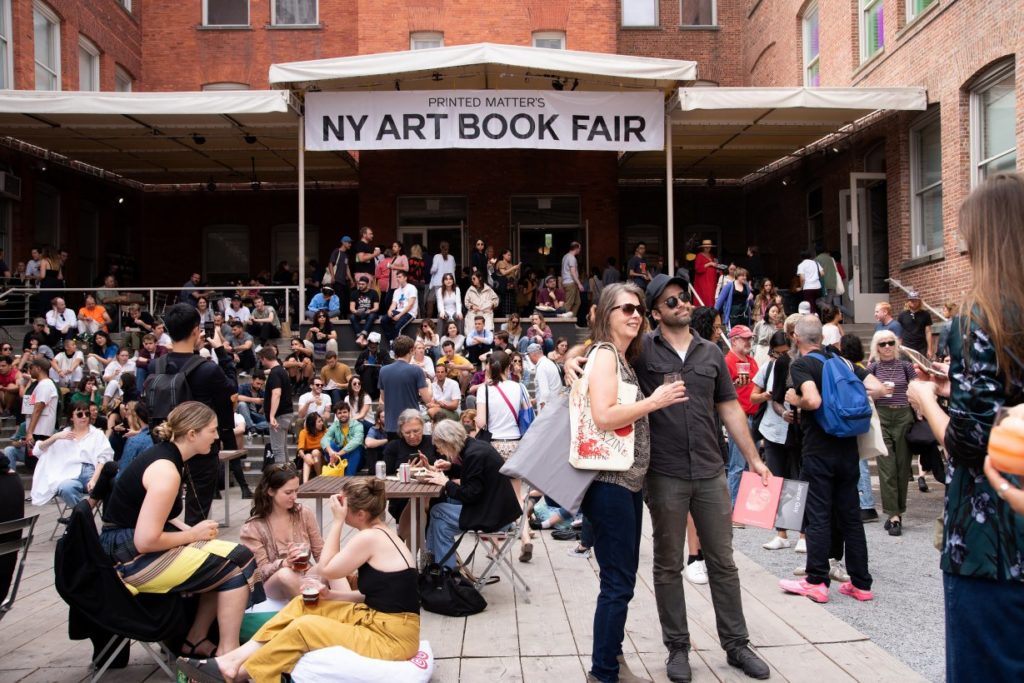
Moma PS1 is one of the oldest and largest nonprofit contemporary institutions in the United States. It regularly organized an event to promote the museum. In this fall, MoMa PS1 hosted the New York annual Book Fair — Printed Matter. The event was held at MoMA PS1 sprawling campus from September 21 to 22. Printed matter’s is one of the biggest book fair of each year, which is a leading international gathering of artists’ books, celebrating the full breadth of the art publishing community. This annual book fair event draws thousands of book lovers, collectors, artists, and art world professionals. This year is the fourteenth year for Printed Matter to present the NYC art book fair.
Before I went to the event, I had several questions in my mind, which requires me to find the answer.
- Why printed matters?
- What is the age range of people who go to the book fair?
- How the exhibitors profit from their issues?
- What is the reason for people choosing to issue printed books over digital books?
- How they define “Archive”?
Regardless of the various digital reading products in the market, such as Amazon Kindle, the population of reading printed books has been descending year by year. Even textbooks are gradually going paperless nowadays. Also, among the teenagers in the 21st century, fewer and fewer teenagers are willing to read printed books. On the one hand, the price of books is always high, which is not friendly to book-lovers. On the other hand, a printed book is harder to carry around than a simple reading tablet.
This year, the Printed Matter event held over 350 booths. It’s a spectacular parade of art, fashion, zines, culture, subculture, color, sound, food, and various performance. At first, this extravaganza made me feel a little overwhelmed because of the dazzling booths. It’s really hard to find the specific exhibitor, ranging from artist collectives to antiquarian booksellers, offering unique publications. In the place of the Fair, there were visitors from different age groups and with different skin colors, but people who purchased the issues, the works, and the books mostly looked older and more knowledgeable. Younger people or teenagers were more thinking of the book fair as a weekend entertained event.

After finishing browsing most of the booths, I entered a booth with name “The Classroom”. The name was attracted me to walk into the space since I wondered what I might learn from this so-called “The Classroom.” This space is presented by a dutch artist, Ruth van Beek. She walked around and elaborated on her thoughts behind her practice in “The Classroom” to the visitors. The exhibit was a dedicated space that provided reading, screening, informal lectures, and other activities by artists, writers and designers. The program highlighted exciting new releases at the Fair and fosters dialogue around important themes for contemporary art publishing and the broader community. ‘That foster dialogue around important themes for contemporary art publishing and the broader community.’ Ruth described bookmaking as an inverse to creating an exhibition. “Making a book is more democratic. They’re for everyone.” After the talk, one of the audience asked a question that I was about to ask, “Will you ever considered making a digital book?”. Then the response from Ruth really touched my heart. “No”, she replied, “It’s the tactility of the book object.”
“Tactile” is a very appropriate word to describe the fair, and visitors were always encouraged to touch, interact and communicate with makers and exhibitors. After I walked out of “The Classroom”, my attention was attracted by a booth, “Queer, Archive, Work”, with slogans on the banner “This publication is a loose assembling of queer methodologies, with a particular view towards network culture, failure, and refutation.” The keywords, Queer and Archive, made me walk towards the booth. I asked the exhibitors Paul Sollellis who is also the co-publisher of this work, about how does he define “Archive” in his publishes from the view as freelance artists. He told me that archive is a process of gathering and collecting memories from different individuals then putting them together. Paul elaborated the issue he was selling on his booth to me that one package contains works from multiple Queer artists. There are journals, photographs, paintings and collages inside. Following his words, I asked him why he chose to do physical copies instead of a digital one. He gave me a short talk on the philosophy level by saying that this is all about the sense of existence and the weight of things. Everything has its own weight, you will know it only when you feel it. I remembered his face looked very serious, not like a seller who was trying to promote his product. I felt that he really believed that the meaning of existence is all about the feeling, or the “tactility”.
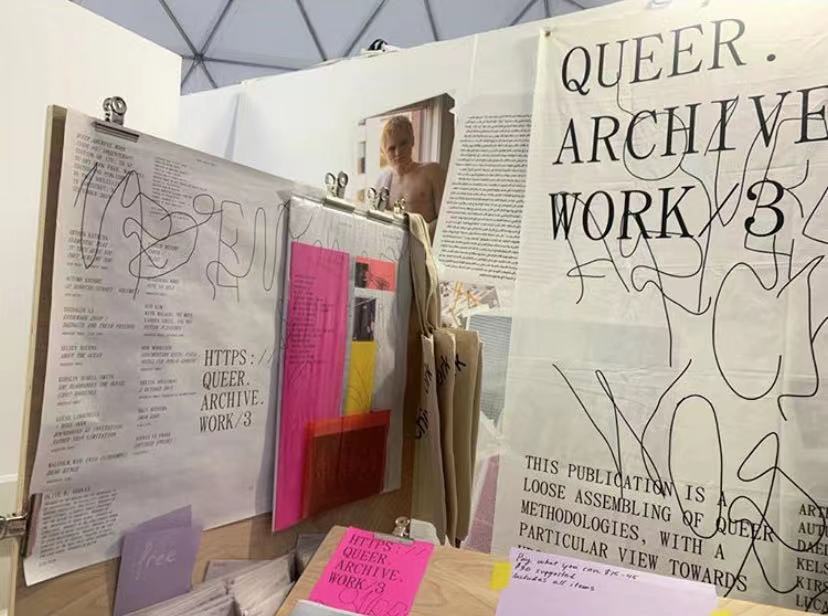
Paul’s definition of “Archive” reminds me that what make archive so significant to our lives is those archives are always meaningful to someone in the world. Like Archill says in his article, “however we define archives, they have no meaning outside the subjective experience of those individuals who, at a given moment, come to use them.” (Mbembe, 2002) Only the things we are doing contains meaning then there is the significance of existence. So is “Archive” and the printed books. Books have different meanings for different individuals. For Ruth, printed matters because of the facility of the book object. And for Paul, printed matters because the weight of the books is the proof of existence. Then I cannot help but think does printed matter to me and why. This is a question that I haven’t found out the answer.References:
References:
“Paul Soulellis, Editor – QUEER.ARCHIVE.WORK.” Printed Matter. Accessed November 3, 2019. https://www.printedmatter.org/catalog/53190/.
Mbembe, Achille. “The Power of the Archive and Its Limits.” Refiguring the Archive, 2002, 19–27. https://doi.org/10.1007/978-94-010-0570-8_2.