Project Description
A sculptural data object that embodies the lived experience of individuals with endometriosis, a condition often marked by severe pain, fatigue, and emotional distress, yet frequently invisible to outsiders.
Data Source: Survey Data: Impact of endometriosis on quality of life
Material: Foam clay
Endometriosis
Endometriosis is a disease in which tissue similar to the lining of the uterus grows outside the uterus. According to the World Health Organization, endometriosis affects roughly 10% (190 million) of reproductive age women and girls globally. Endometriosis can decrease quality of life due to severe pain, fatigue, depression, anxiety and infertility. However, In many countries, the general public and most front-line healthcare providers are not aware that distressing and life-altering pelvic pain is not normal, leading to a normalization and stigmatization of symptoms and significant diagnostic delay. While cisgender women with endometriosis report barriers to accessing care, with lengthy times to diagnosis and limited treatment options available, barriers for trans and gender diverse individuals are even more so enhanced by physician bias and lack of education in gender-affirming care.
The Object
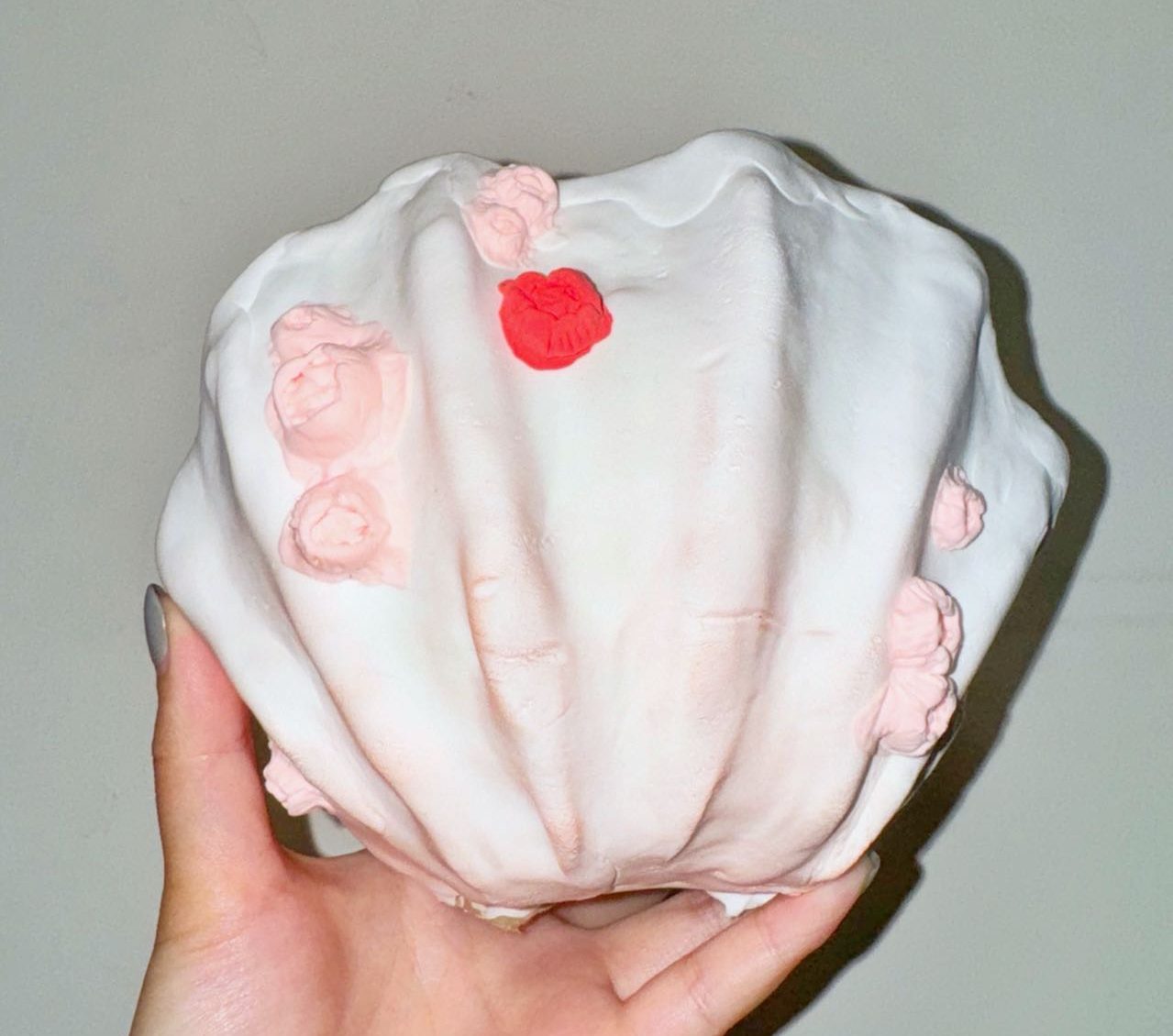
My goal was to craft an object that, on the outside, appears ‘fine’ but reveals a more complex and painful reality on the interior. I hope to create a contrasting visual and tactile experience that mirrors the common experience of endometriosis patients whose severe discomfort is frequently invisible to outsiders and sometimes even medical professionals. I achieved through a scallop shell sculpture made of multi-colored foam clay, which on the outside looks smooth and somewhat unblemished, but once opened, shows layers of textured ‘flesh’ where the various ‘bumps’ correspond with data associated with the endometriosis survey results and act as a metaphor for the scar tissue on internal organs caused by this condition.
The Data
A study conducted by Oehmke et al.(2009) investigated the impact of endometriosis on quality of life among 65 women aged 18–60 years working at a city supermarket in Giessen, Germany. The survey results were developed through in-depth 1-on-1 interviews with these individuals, focusing on their physical and emotional well-being, social function, work-based and/or professional performance, parti-cipation in sexual intercourse and relation with partner. From the results, I selected the data points about the major quality-of-life affecting symptoms exhibited by the participants who have endometriosis, including the number out of 65 participants who reported experience of dysmenorrhoea, dyspareunia, pelvic pain, and infertility.
| Symptoms | Count(out of 65) |
| Dysmenorrhea | 22 |
| Dyspareunia | 24 |
| Pelvic Pain | 16 |
| Infertility | 3 |
Additionally, 10 participants that experienced dysmenorrhoea reported that the pain affected their ability to do gardening, house work, sports and leisure activities; and 24 of the participants who experienced dyspareunia reported different levels of pain. I included those more detailed data as well.
| Impaired Activities | Count |
| gardening | 10 |
| house-work | 10 |
| sports/leisure | 10 |
| work efficiency | 6 |
| professional advancement | 6 |
| social function | 5 |
| Pelvic Pain Level | Count |
| minimal pain | 7 |
| light pain | 12 |
| moderate to strong pain | 5 |
Preparation + Ideation:
- Selecting the data: there weren’t a lot of datasets on endometriosis, and most of the larger scaled data I found focused on investigating the causes and effects of various treatments, while I wanted to find a dataset that focused more on the human experience, impact on quality of life, and individual experience of pain. Eventually, I found the survey data which, though it was conducted on a very small scale, allowed me to use the physical representation to create counts of each individual participant one-by-one instead of reducing their experiences to percentages and ratios.
- The form: the idea of the exterior vs. interior juxtaposition came first, and I searched for different forms that could afford this contrast structurally, isn’t too complex as to take the attention away from the main concept, but also carry an association with femininity. The scallop in Birth of Venus painting came to mind.
- Getting to know the material: The light-weight air-dry foam clay I found was a good fit for rapid experimentation and is easy to mold simple shapes with. I have never used this type of clay before, so I created a number of other objects just to get to know the plasticity of the clay, how it mixes and dries as a preparation. With a sample piece, I experimented with different ways to create texture.


The Process
Creating the scallop shell: I used a cup holder as a skeleton to form the “diptychal” shape and molded it with white clay. On the exterior, I added barnacles—nine in pink and one in red—to visually represent the statistic that “1 in 10” women are affected by endometriosis.


Making the ‘flesh’:

- Layer 1: I crafted layers of clay with bumps in varying shades of pink, each row corresponding to the number of survey participants reporting different symptoms.
- Layer 2: The lower half of the scallop flesh featured more detailed textural representations of the specific impacts on daily activities and levels of pain experienced.


Assembly: I assembled the layers, adding additional folds as padding and 65 decorative pearls to represent each participant in the study.


Reflection:
Trans and gender-diverse individuals not only experience the same difficulties caused by endometriosis but also face significant barriers in receiving diagnosis and gender-affirming care. However, the World Health Organization (WHO) statistics and the Oehmke study, which guided my project, focus on cisgender women and do not take into account the experience of the community. This fact made the project and the subsequent writing-up of this report feel exclusive despite my intentions to highlight and empathize with the unseen pain of the condition.
Additionally, pain is a deeply personal concept and turning deeply personal experiences of pain into numbers and statistics inevitably dilutes the viscerality of it. I appreciated how the structure of the object conveys the metaphor, but taking it further, I’d like to engage with a broader and more inclusive data set, and try to represent individual, qualitative experiences that are rich with personal narratives and emotional depths instead of mere figures.
Leave a Reply